
NASA calculates a 50 percent chance that the Neil Gehrels Swift Observatory will reenter Earth’s atmosphere uncontrollably by June 2026 — a hard deadline set not by bureaucratic schedules but by orbital mechanics — and the agency has contracted an Arizona startup to attempt what it openly admits may be a “far-fetched” rescue before the window closes forever.
A Dying Observatory and a Ticking Clock
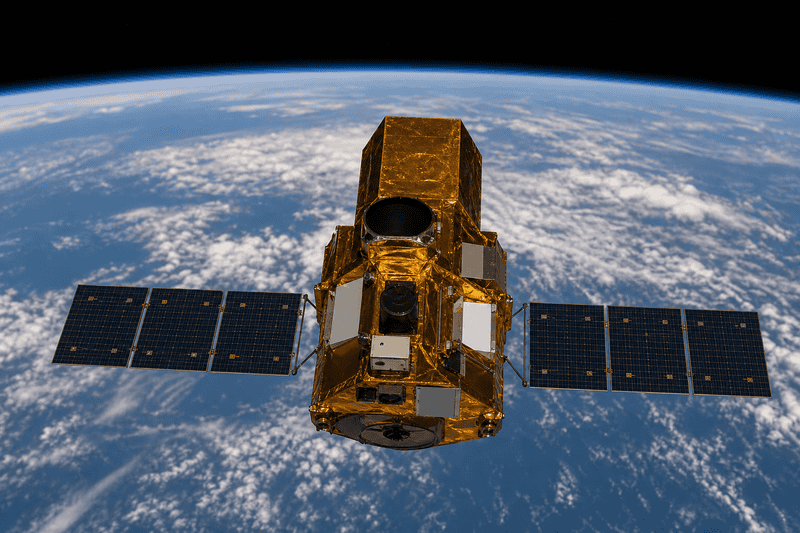
Swift has operated continuously from low-Earth orbit for more than 20 years, logging discoveries that have reshaped high-energy astrophysics since its launch on November 20, 2004. That scientific legacy now faces an abrupt and unglamorous end. According to NASA’s own mission pages, the observatory remains scientifically productive, which makes the prospect of an uncontrolled reentry particularly stark: the telescope would not be retired on NASA’s terms, but on gravity’s.
The probability figures are sobering in their precision. NASA estimates a 50 percent chance Swift falls uncontrollably by June 2026, rising to 90 percent by December 2026. Those numbers are not policy estimates or budget projections — they are the output of orbital decay modeling driven by atmospheric drag and solar activity. No amount of engineering optimism adjusts them downward without a physical intervention.
NASA has confirmed that no replacement mission currently exists for Swift. A chaotic reentry would not merely destroy one spacecraft; it would sever a real-time alert system that the global astronomy community has depended on for two decades to detect and locate gamma-ray bursts — the universe’s most energetic explosions.
What Swift Is — and Why Losing It Would Hurt
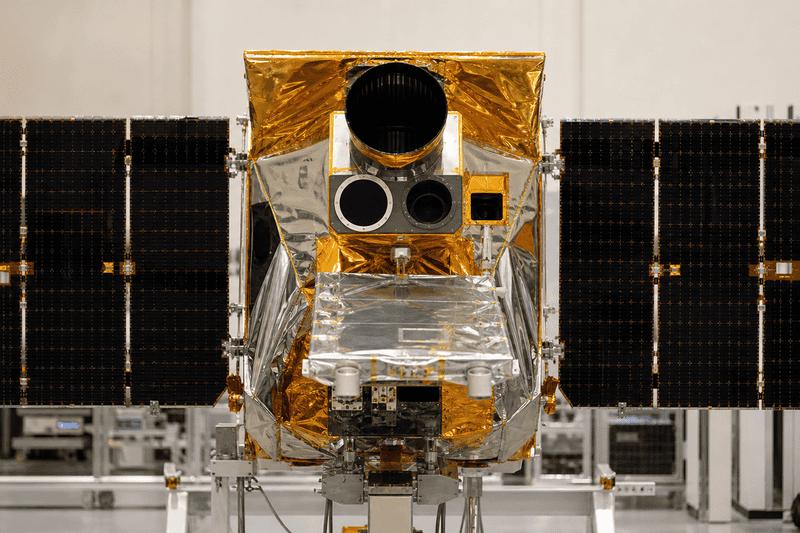
Formally known as the Neil Gehrels Swift Observatory — previously called the Swift Gamma-Ray Burst Explorer — the spacecraft is a three-telescope space observatory built specifically to detect, locate, and study gamma-ray bursts (GRBs): intense, short-lived flashes of high-energy radiation that can briefly outshine entire galaxies. Swift is part of NASA’s Medium Explorer (MIDEX) program, a category of mid-cost science missions designed to deliver high scientific return per dollar. It launched aboard a Delta 7320 rocket into low-Earth orbit on November 20, 2004.
What makes Swift difficult to replace is not any single instrument but the coordinated speed of all three working together. Its Burst Alert Telescope flags a gamma-ray burst within seconds. The spacecraft then autonomously rotates so its X-ray Telescope and UV/Optical Telescope can capture the rapidly fading afterglow — a sequence that happens faster than any human operator could command. No current or planned successor replicates that autonomous rapid-response chain.
Over two decades, Swift expanded well beyond its original brief. The observatory has contributed to studies of supernovae, black hole feeding events, neutron star mergers, and even comets within the solar system. Its alert system feeds a global network of follow-up ground and space telescopes; when Swift detects a burst, observatories around the world pivot toward that patch of sky within minutes. Losing that alert stream would delay or eliminate the multi-wavelength follow-up observations essential for connecting GRBs to their host galaxies and the stellar systems that produce them.
The Physics of an Uncontrolled Reentry
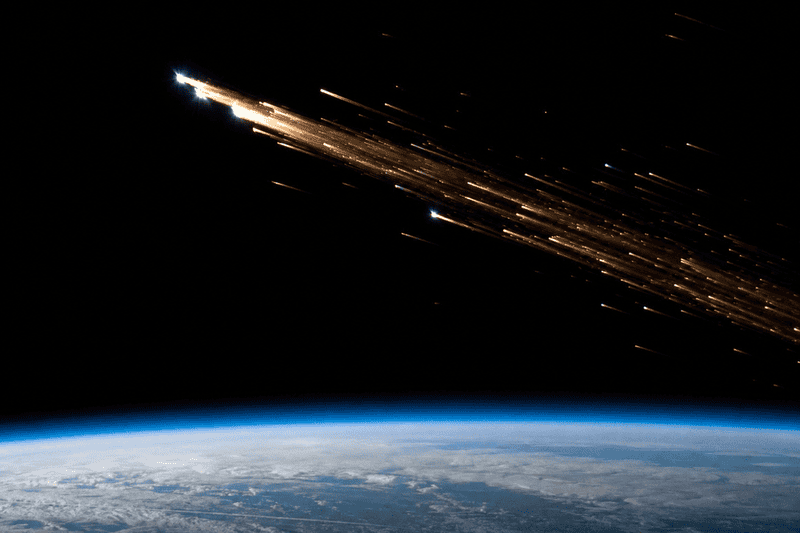
Low-Earth orbit — the band of space roughly 160 to 2,000 kilometers above Earth’s surface — is not a permanent parking spot. Even at approximately 600 kilometers altitude, where Swift operates, a thin but real upper atmosphere exerts aerodynamic drag on every satellite that passes through it. That drag continuously bleeds orbital energy, causing spacecraft to spiral slowly inward over years or decades.
The process accelerates during periods of high solar activity. When the Sun is more active, it heats Earth’s upper atmosphere, causing it to expand outward. A satellite at that altitude suddenly encounters denser air, experiences more drag, and loses altitude faster. The sharp jump in Swift’s reentry probability between mid-2026 and late 2026 reflects this solar-cycle effect compounding a decay process already years in progress.
An uncontrolled reentry is fundamentally different from a managed one. In a controlled deorbit, engineers execute a precisely timed retro-burn — a thruster firing that slows the spacecraft enough to send it along a calculated trajectory, typically aimed at a remote ocean. The spacecraft breaks apart on schedule over uninhabited water. In an uncontrolled reentry, no such targeting is possible. Dense components may survive atmospheric heating and reach the ground at unpredictable locations. The statistical risk to any individual is extremely low, but the uncertainty is real, and the debris contributes to growing concerns about long-term sustainability in low-Earth orbit.
Swift was not designed with end-of-life deorbit capability. That engineering choice, standard practice for 2004-era satellites, is precisely what makes the rescue mission both necessary and technically unprecedented.
The Rescue Plan: Katalyst Space and a First-of-Its-Kind Mission
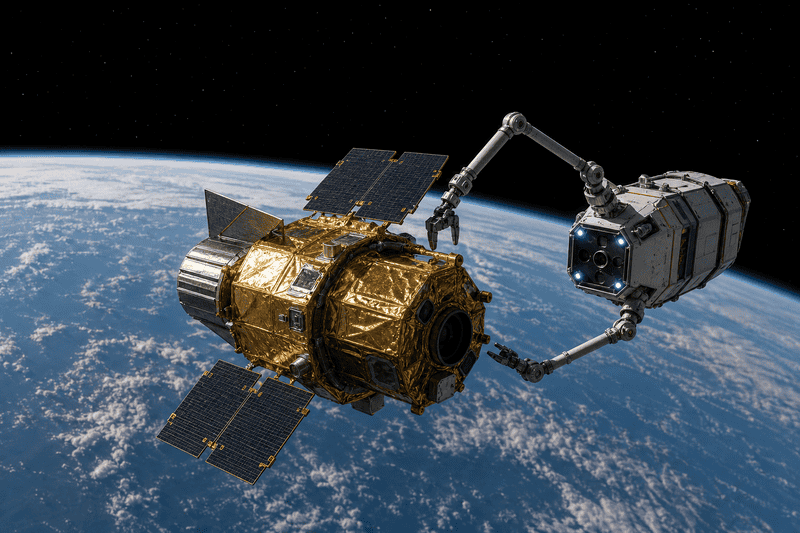
NASA has contracted Arizona-based startup Katalyst Space to attempt the first-ever robotic rescue of an unprepared NASA satellite. “Unprepared” here carries specific technical meaning: Swift was never equipped with standardized docking interfaces, grapple fixtures, or servicing ports of any kind. Katalyst’s own mission description frames the challenge directly — the company must attach to a spacecraft that was never designed to be touched after launch.
Katalyst’s servicing spacecraft is designed to autonomously rendezvous with Swift in orbit, attach to the observatory using its own capture mechanisms, and then use its own propulsion system to alter Swift’s trajectory. The mission presents two possible successful outcomes: boosting Swift to a higher, more stable orbit that buys additional years of scientific operations, or executing a controlled, targeted deorbit that sends debris safely into a remote ocean. Either outcome is vastly preferable to an unguided reentry.
The Katalyst mission is planned to reach orbit via a Pegasus XL rocket — an air-launched vehicle released from a carrier aircraft at altitude before its own motors ignite. This launch method offers scheduling flexibility and the ability to reach specific orbital inclinations without the constraints of a fixed ground-based launch pad, both practical advantages for a mission operating on orbital mechanics’ timetable rather than a traditional launch manifest.
NASA’s stated rationale is explicit: the agency believes the scientific reward of preserving Swift’s operational life outweighs the technical and financial risk of a mission it openly acknowledges may not succeed. That candid admission of uncertainty — calling the rescue attempt potentially “far-fetched” — is itself notable for a space agency more accustomed to projecting confidence.
Why This Mission Is Technically Unprecedented
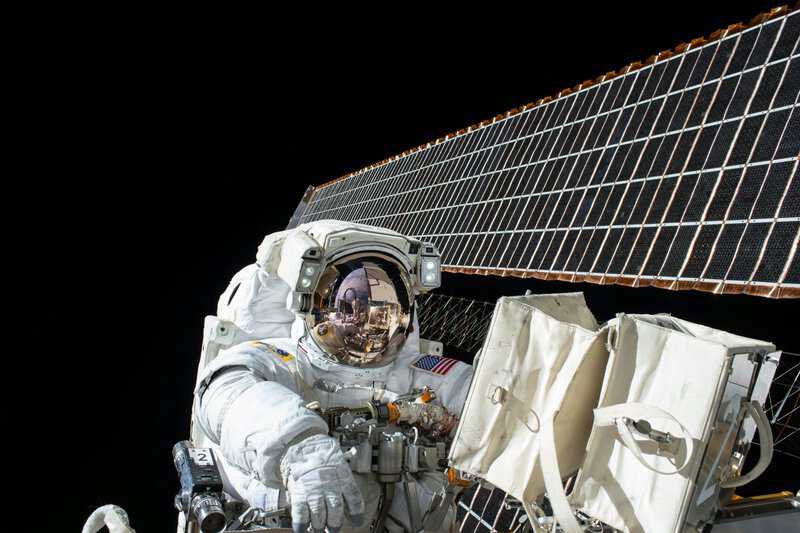
Previous on-orbit servicing missions provide only partial precedent. NASA’s five Space Shuttle servicing missions to the Hubble Space Telescope were conducted by astronauts working on hardware specifically pre-designed with grapple fixtures, modular component bays, and handholds engineered for extravehicular activity. Hubble was built to be serviced. Swift was not.
Autonomous rendezvous and capture with a minimally cooperative satellite at orbital velocities exceeding 27,000 kilometers per hour demands navigation precision measured in centimeters. The Katalyst spacecraft must approach Swift, assess its attitude and rotation state in real time, and execute a capture sequence without continuous human intervention — because the communication round-trip between ground controllers and a spacecraft in low-Earth orbit, while short in absolute terms, is too long for the split-second adjustments that proximity operations require.
The broader implications extend well beyond this single telescope. Scientific American has reported on NASA’s approach to the mission, noting that a successful rescue would establish a commercial template for servicing aging government satellites on an ad hoc basis — reshaping how NASA and other agencies approach end-of-life management for the hundreds of science spacecraft currently in low-Earth orbit. Even a partial failure would generate engineering knowledge about attachment methods, proximity operations, and the behavior of aged satellite surfaces that the industry currently lacks at operational scale.
Broader Stakes: Space Sustainability and What Comes Next
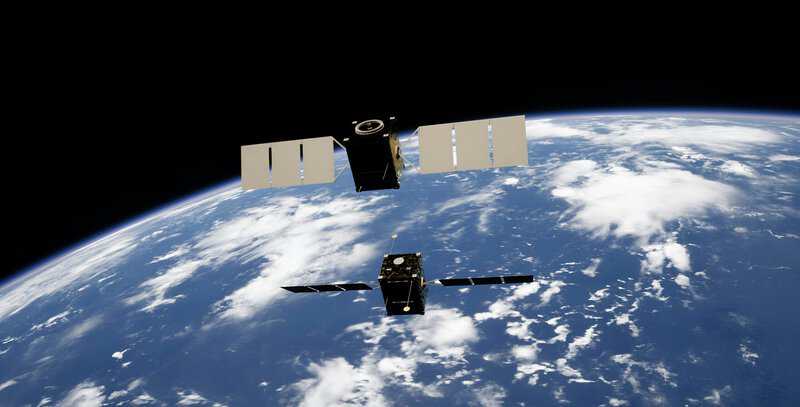
The Katalyst mission functions as an early real-world stress test of whether the commercial satellite servicing sector — supported by NASA’s On-orbit Servicing, Assembly, and Manufacturing (OSAM) initiative — can deliver viable solutions before an asset already in orbital decay is lost. The 50-percent-by-June-2026 probability estimate imposes a hard engineering deadline unusual in the space industry, where schedules routinely slip by months or years. Orbital mechanics, not committee decisions, sets the final date.
If the rescue succeeds, it could influence spacecraft design philosophy for a generation. Future NASA science missions might be built from the outset with standardized docking interfaces — a shift that would enable interoperability across missions and operators, much as common hardware standards have done in other engineering disciplines. Building serviceability into spacecraft from the design phase costs money upfront but could dramatically extend mission lifetimes and reduce the debris burden on an increasingly crowded low-Earth orbit environment.
Gamma-ray bursts remain among the least predictable phenomena in observational astronomy. Their sky positions are random, their durations range from milliseconds to minutes, and no ground-based observatory or narrow-field space telescope can replicate the all-sky monitoring Swift provides. If the rescue fails and Swift reenters uncontrolled, the gap in humanity’s rapid-response GRB detection capability will be of indeterminate length — there is no queued successor, no backup system waiting in the wings.
NASA’s willingness to fund and publicly endorse an effort it calls potentially far-fetched signals a pragmatic shift in agency risk tolerance. Doing nothing, the agency has implicitly acknowledged, is itself a high-risk decision when a 20-year scientific legacy — and the safety calculus of an uncontrolled reentry — hangs in the balance. The attempt, whatever its outcome, reflects a broader recognition that the era of simply launching satellites and walking away is ending, replaced by one in which end-of-life responsibility is treated as an engineering requirement from the moment a mission is designed.