
At the heart of the Milky Way, roughly 26,000 light-years from Earth, an invisible graveyard of stellar corpses radiates some of the most energetic light in the galaxy. NASA’s X-ray observatories have detected a seething glow of high-energy radiation pouring from the galactic core — and much of it traces back not to living stars, but to their collapsed, burned-out remnants. How astronomers identify those remnants, separate their signals from one another, and interpret what they reveal about the galaxy’s history is an active research frontier — and the subject of a public talk by a University of Iowa undergraduate.
Why the Galactic Center Glows in X-rays
No optical telescope can see the galactic center directly. Dense clouds of gas and dust absorb visible light so thoroughly that the core of our own galaxy is hidden from the naked eye and from conventional ground-based astronomy. Switch to X-rays — photons carrying energies thousands of times greater than visible light — and the galactic center erupts into view: crowded with point sources, diffuse hazes of emission, and exotic objects that resist easy classification.
X-rays penetrate much of the obscuring material that blocks optical wavelengths, and space-based detectors positioned above Earth’s atmosphere — which itself blocks X-rays from reaching the ground — can capture that radiation directly. This observational window explains why missions such as NASA’s Chandra X-ray Observatory, NASA’s Nuclear Spectroscopic Telescope Array (NuSTAR), and the European Space Agency’s XMM-Newton have become the dominant tools for galactic center astrophysics.
The galactic center, located in the direction of the constellation Sagittarius, also hosts the highest concentration of stars, stellar remnants, and exotic astrophysical objects in the entire Milky Way. That density makes it an unparalleled natural laboratory for studying compact objects — the collective term for the collapsed stellar remnants left behind when stars die. Nowhere else in the galaxy are so many such objects packed into a comparably small volume of space.
That same crowding creates a serious methodological challenge. Separating the X-ray signal of one stellar corpse from the blended glow of thousands of neighbors requires sophisticated spectral analysis and statistical techniques. Even with Chandra’s sub-arcsecond angular resolution — the sharpest available for X-ray astronomy — much of the galactic center’s emission remains blended into a diffuse background whose precise origins are still actively debated.
Dead Stars That Still Shine: LeFevre’s Public Talk

Making sense of that glow is the subject of a public presentation titled Dead Stars That Still Shine: X-rays from the Galactic Center, delivered by Meredith LeFevre, an undergraduate student in the Department of Physics and Astronomy at the University of Iowa. Part of the Van Allen Observatory’s public observing night series, the talk translates frontier astrophysical research into accessible terms for a general audience.
The central tension driving the research is almost paradoxical: the stars producing the most conspicuous X-ray signatures at the galactic center are, by any conventional definition, dead. They exhausted their nuclear fuel long ago. Yet in their afterlives — powered not by fusion but by gravity — they radiate more energetically than most living stars ever will. Understanding how that happens, and cataloging exactly which dead stars are responsible, is one of the active frontiers of high-energy astrophysics.
What ‘Dead Stars’ Actually Means — and Why They Still Radiate

The term “dead star” covers two distinct categories of object, each with its own X-ray story.
A white dwarf is the dense, Earth-sized remnant left after a Sun-like star — or any star with a mass up to roughly eight times that of the Sun — exhausts its nuclear fuel and sheds its outer layers as a planetary nebula. The remaining core, containing roughly half a solar mass compressed into a volume comparable to Earth, is supported against further gravitational collapse not by fusion but by the quantum mechanical pressure of tightly packed electrons. White dwarfs radiate stored thermal energy into space over billions of years, cooling slowly. In isolation, they produce relatively faint X-ray emission from their hot surfaces. In binary star systems, however, they become something far more dramatic.
A neutron star is an even more extreme product of stellar death, formed when a massive star — typically more than eight times the mass of the Sun — exhausts its fuel and its iron core collapses catastrophically in a supernova explosion. That collapse crushes a mass greater than the Sun into a sphere roughly 20 kilometers across, producing surface gravity approximately 200 billion times that of Earth. Neutron stars are among the densest objects in the observable universe and, like white dwarfs, glow in X-rays — both from residual surface heat and, far more powerfully, from gravitational processes described below.
The existence of white dwarfs and neutron stars as classes of X-ray-emitting compact objects, and the basic physical mechanisms underlying their emission, represent firmly established astrophysical consensus supported by decades of observation and theory. What remains genuinely uncertain — and actively contested — is the precise census of such objects at the galactic center and their collective contribution to the diffuse X-ray emission observed there.
The Mechanism: How Gravity Turns a Dead Star Into an X-Ray Beacon
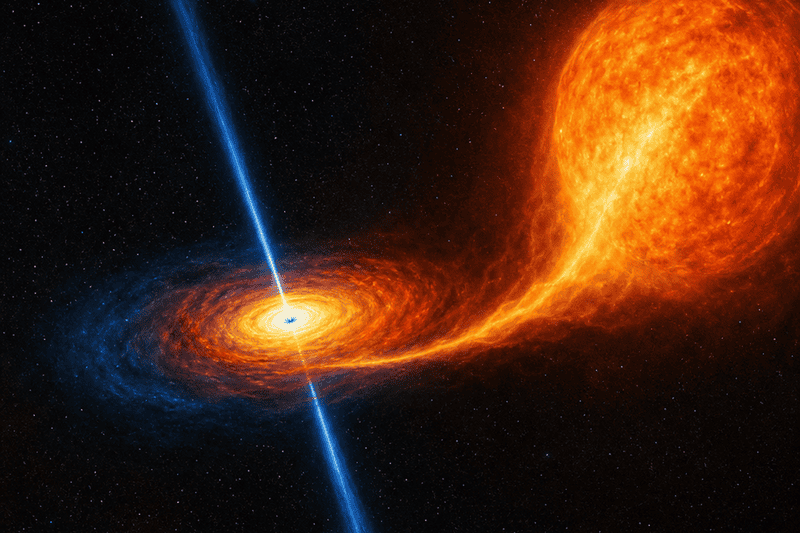
The most powerful X-ray-producing mechanism available to a dead star is accretion — the gravitational capture of matter from a nearby companion star. When a white dwarf or neutron star orbits a normal star in an X-ray binary system, its intense gravitational field can strip hydrogen gas from the companion’s outer layers. That gas does not fall straight down; it spirals inward through a flattened structure called an accretion disk, losing energy to friction and viscosity as it goes. The in-falling material heats to temperatures of tens of millions of degrees Kelvin — far hotter than the surface of any living star — and at those temperatures it radiates primarily in X-rays.
For neutron stars, the process reaches a further extreme. Material from the accretion disk eventually strikes the neutron star’s solid surface, compressed and heated so violently that it can ignite in thermonuclear bursts — brief, brilliant flares of X-ray emission sometimes detectable across tens of thousands of light-years. These Type I X-ray bursts are among the most energetic recurring phenomena in the galaxy and serve as key observational signatures for identifying neutron star X-ray binaries in crowded fields like the galactic center.
White dwarfs in binary systems occupy a related category called cataclysmic variables. In a subset known as novae, hydrogen accreted from the companion accumulates on the white dwarf’s surface until temperature and pressure trigger a runaway thermonuclear explosion, briefly brightening the system by factors of thousands in X-ray and optical luminosity. In the far rarer and more catastrophic case of a Type Ia supernova, enough accumulated mass can destroy the white dwarf entirely.
A secondary, quieter mechanism applies to isolated white dwarfs and neutron stars without binary companions: residual thermal radiation from their still-hot surfaces produces softer X-ray emission. These objects are far less luminous than accretion-powered sources but contribute collectively to the population astronomers attempt to catalog at the galactic center.
What Chandra and NuSTAR Have Revealed
Chandra’s deep surveys of the inner few hundred light-years of the Milky Way have been transformative. What was once interpreted as purely diffuse emission has been partially resolved into thousands of individual point sources, the majority identified as accreting white dwarfs and neutron stars based on their X-ray spectral signatures — the specific distribution of photon energies each source emits, which functions as a fingerprint for the physical conditions in the emitting region.
A landmark interpretation of Chandra data proposed that a large fraction of the galactic center’s apparently diffuse X-ray glow originates from an unresolved population of millions of faint cataclysmic variables and coronally active binary stars — sources individually too faint to detect but collectively bright enough to register as a diffuse haze of emission. This interpretation remains influential, though not universally accepted; alternative models invoking hot diffuse plasma or other source classes continue to be explored.
The region immediately surrounding Sagittarius A* — the Milky Way’s central supermassive black hole, with a mass of roughly four million solar masses — is particularly X-ray bright. Part of that brightness reflects the black hole’s own sporadic flaring activity. Part of it reflects the dense surrounding population of stellar remnants that, over billions of years, likely migrated inward through gravitational interactions with neighboring stars and with the black hole itself.
NuSTAR, which observes higher-energy “hard” X-rays inaccessible to Chandra, has added detail by identifying sources whose harder spectra are more consistent with accreting neutron stars or magnetically active white dwarfs. The combination of Chandra and NuSTAR data continues to refine estimates of the galactic center’s compact-object population — a census that remains incomplete.
Undergraduate Research at the Frontier: Iowa’s Van Allen Observatory
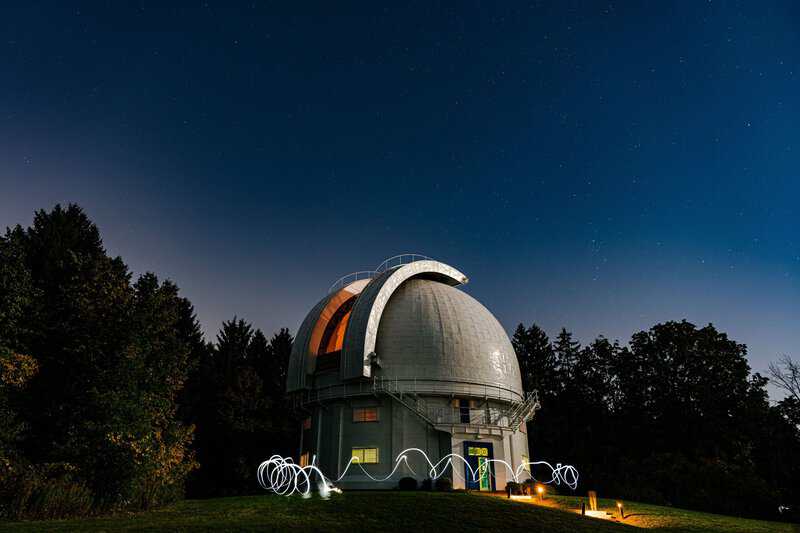
LeFevre’s presentation is part of the public observing night series hosted by the Van Allen Observatory at the University of Iowa. The observatory takes its name from James Van Allen, the University of Iowa physicist who discovered Earth’s radiation belts using instruments aboard Explorer 1 in 1958 — the first successful American satellite. Van Allen’s work established the university as a significant center of space-science research, and that legacy continues in the department’s engagement with topics ranging from planetary physics to high-energy astrophysics.
Presenting on a topic like galactic center X-ray astronomy requires more than surface familiarity with the subject. Translating the technical literature for a general audience demands that a student understand observational methods, physical mechanisms, and the boundary between established consensus and open questions well enough to explain each clearly without distorting any of them. That kind of preparation represents substantive scientific engagement, not merely science communication.
Public observing nights at the Van Allen Observatory serve a dual function: they deepen the presenter’s own command of the material while offering the broader community a credible, accessible entry point into research that would otherwise remain locked in technical journals. Upcoming events in the series are listed on the University of Iowa Department of Physics and Astronomy events page.
Why This Research Matters — and What Remains Unknown
Understanding the X-ray source population at the galactic center carries implications that extend well beyond cataloging stellar corpses. Neutron star binaries are among the strongest candidates for gravitational-wave signals detectable by observatories such as LIGO and, in the future, the space-based LISA mission. Knowing how many such systems exist at the galactic center — and how the region’s extreme environment affects their orbital evolution — directly informs theoretical predictions for gravitational-wave detection rates. Every improvement in the X-ray census of galactic center binaries contributes to gravitational-wave astronomy’s observational road map.
The galactic center also serves as a proxy for understanding other galaxies. Because the Milky Way’s core can be studied in far greater spatial detail than the nucleus of any external galaxy, discoveries made here — about source populations, diffuse emission mechanisms, and the interaction between stellar remnants and a central supermassive black hole — feed directly into models of the X-ray emission observed from the nuclei of billions of other spiral galaxies.
Honest science communication requires naming what is not yet known. The total number of neutron star X-ray binaries at the galactic center is not firmly established. The relative contributions of different source classes — cataclysmic variables, coronally active binaries, hot diffuse plasma, and others — to the observed X-ray background remain debated. The degree to which the galactic center’s extreme stellar density and proximity to a supermassive black hole alter the formation and evolution of X-ray binaries, compared with systems in the galactic disk, is not fully understood. These are open questions, not failures of the science; they define what makes this a productive and ongoing research frontier.
The path from a Chandra photon count to a clearly explained astrophysical mechanism runs, in part, through exactly this kind of work: a student engaging directly with live research, presenting it carefully to a public audience, and modeling the intellectual honesty that good science demands. Presentations like LeFevre’s are how complex findings about dead stars, X-ray binaries, and the Milky Way’s core move from observatory data archives into public understanding.