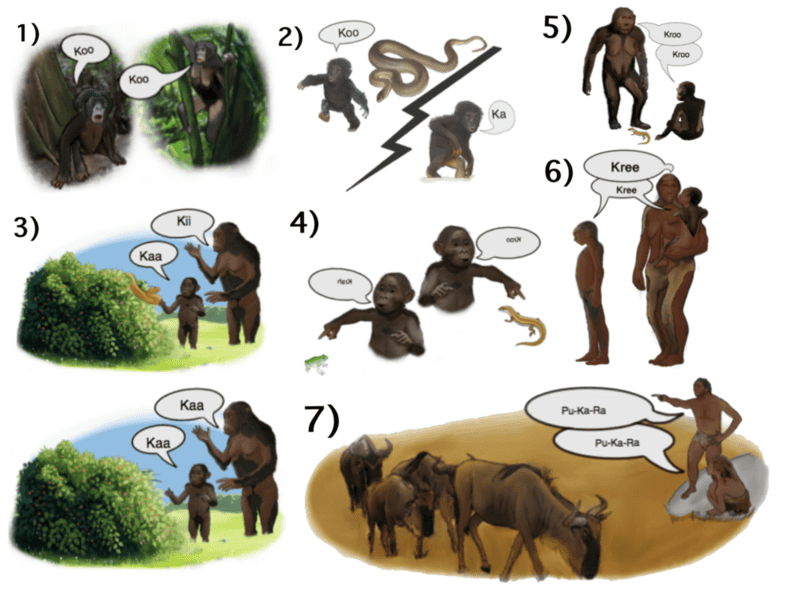
The ‘from where to what’ model of language evolution hypotheses 7 stages of language evolution: 1. The origin of speech is the exchange of contact calls between mothers and offspring used to relocate each other in cases of separation. 2. Offspring of early Homo modified the contact calls with intonations in order to emit two types of contact calls: contact calls that signal low level of distress and contact calls that signal high-level of distress. 3. The use of two types of contact calls enabled the first question-answer conversation. In this scenario, the offspring emits a low-level distress call to express a desire to interact with an object, and the mother responds with a low-level distress call to enable the interaction or high-level distress call to prohibit it. 4. The use of intonations improved over time, and eventually, individuals acquired sufficient vocal control to invent new words to objects. 5. At first, offspring learned the calls from their parents by imitating their lip-movements. 6. As the learning of calls improved, babies learned new calls (i.e., phonemes) through lip imitation only during infancy. After that period, the memory of phonemes lasted for a lifetime, and older children became capable of learning new calls (through mimicry) without observing their parents’ lip-movements. 7. Individuals became capable of rehearsing sequences of calls. This enabled the learning of words with several syllables, which increased vocabulary size. Further developments to the brain circuit responsible for rehearsing poly-syllabic words resulted with individuals capable of rehearsing lists of words (phonological working memory), which served as the platform for communication with sentences. Based on the papers: Poliva, O. (2015). Source: Wikipedia
The evolution of language stands as one of humanity’s most significant milestones, fundamentally shaping society and culture. Emerging around 100,000 years ago, language allowed early humans to communicate complex ideas, share knowledge, and strengthen social bonds. This development facilitated cooperation in hunting, gathering, and resource management, enhancing survival rates. As language evolved, it became more nuanced, enabling the expression of emotions, storytelling, and the transmission of cultural practices across generations. The ability to articulate thoughts and feelings not only fostered community cohesion but also laid the foundation for art, philosophy, and the rich tapestry of human civilization that we see today.