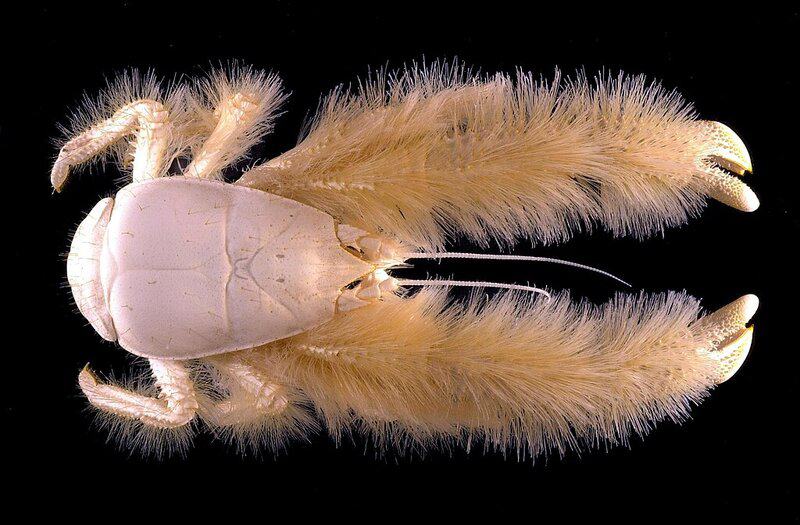
The Yeti crab ( Kiwa hirsuta ), discovered at a depth of 2,300 meters on a hydrothermal vent of the Pacific-Antarctic Ridge during the American par5 campaign. This crustacean has small pincers at the end of long hairy appendages. The whiteness of its body and its bristles quivering in the current make it easy to spot on the black lava surrounding the active chimneys around which it lives. The animal is blind, which does not bother it in these depths where absolute darkness reigns. It is carnivorous, feeding on mussels or detritus. It is thought that it can also feed at least in part on the bacteria that colonize the numerous bristles that it carries on its legs. Source: Wikipedia
Discovered in 2005 near hydrothermal vents in the South Pacific, the Yeti Crab, scientifically known as Kiwa hirsuta, is a remarkable crustacean characterized by its dense, hair-like setae covering its pincers and legs. These bristles host colonies of filamentous bacteria, which the crab may cultivate and consume. This adaptation allows the Yeti Crab to thrive in the extreme conditions of deep-sea hydrothermal vents, where it plays a crucial role in the local ecosystem. (nationalgeographic.com)