
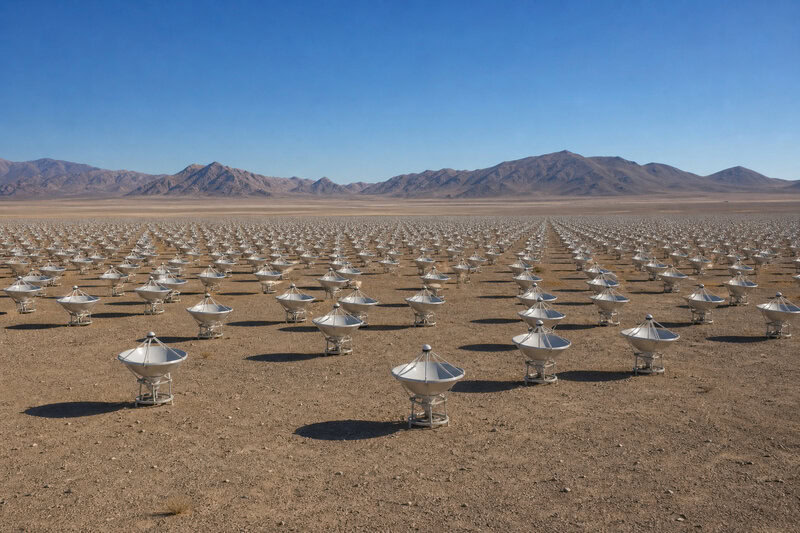
By 2029, a remote Nevada valley will hold 1,650 radio dishes — each slightly more than six meters across — working in coordinated unison as a single, continent-scale instrument tuned to the faintest signals the universe emits. Caltech’s Deep Synoptic Array, known as the DSA, is designed to survey the sky roughly 100 times more effectively than any radio telescope currently in operation. That figure is not an incremental upgrade to existing astronomy — it represents a categorical leap in humanity’s ability to study the radio universe.
What Is a Radio Telescope Array — and Why Do 1,650 Dishes Beat One Giant Dish?
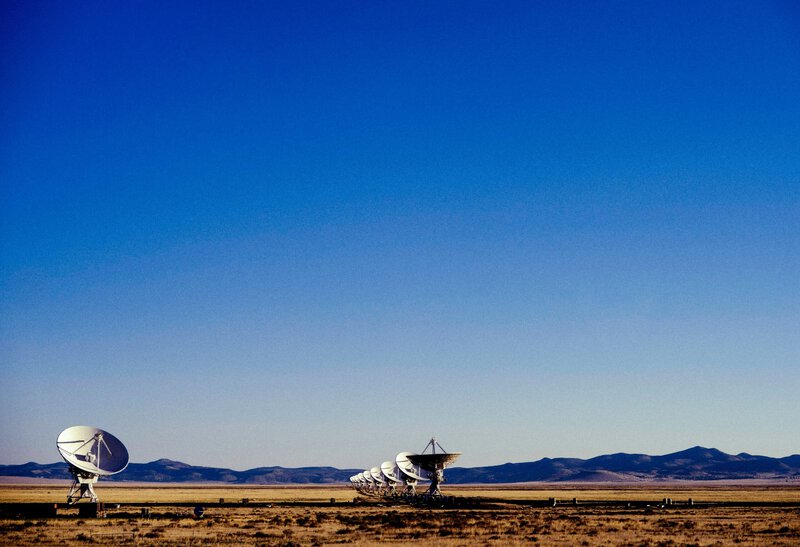
A radio telescope array is a network of individual dish antennas whose signals are combined electronically to behave like a single telescope far larger than any one component — a technique called interferometry. The governing principle is straightforward: the more dishes collecting signal simultaneously, the more electromagnetic energy arrives at the detectors each second, and the fainter the signals that can be distinguished from background noise. Think of it as the difference between a single microphone and 1,650 microphones recording together; the combined signal reaches orders of magnitude deeper into the quiet.
Two properties that readers sometimes conflate are worth separating clearly: sensitivity and angular resolution. Sensitivity describes how faint a signal a telescope can detect. Angular resolution describes how finely it can distinguish two closely spaced sources in the sky. The DSA’s primary engineering achievement is raw sensitivity — the ability to detect extraordinarily weak signals — rather than the razor-sharp angular resolution associated with continent-spanning instruments like the Event Horizon Telescope, which imaged the shadow of a supermassive black hole by linking observatories across multiple continents. The DSA is built to hear the universe’s quietest signals, not necessarily to image their sources with maximum sharpness.
The decision to build 1,650 modest dishes rather than one enormous structure is deliberate and economically rational. Each slightly-more-than-six-meter dish is a mass-producible unit. Individually, none would be remarkable. Collectively, according to Caltech’s project documentation, they form what the institution describes as “by far the most sensitive radio telescope ever constructed.” The engineering logic favors the swarm over the monolith.
Why Nevada? The Science of Electromagnetic Silence
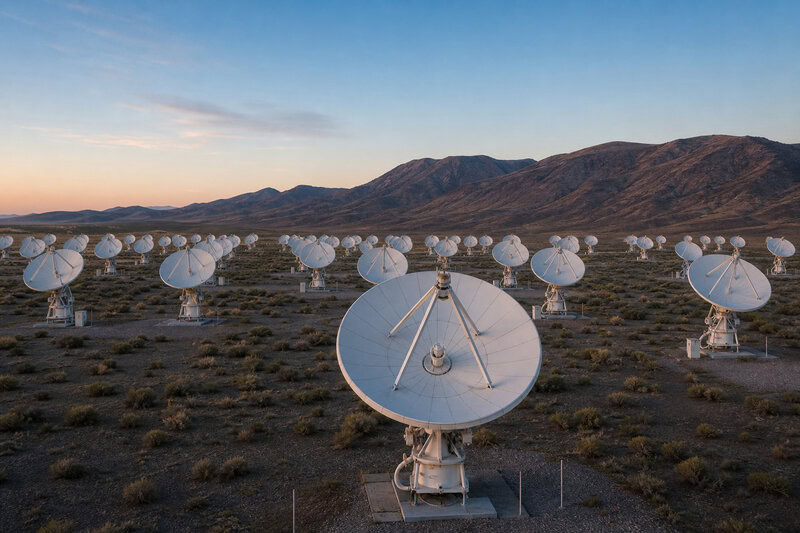
Radio observatories cannot be placed anywhere. Cosmic radio signals arriving at Earth are measured in billionths of a watt — so faint that a single nearby Wi-Fi router, cell tower, or microwave oven can overwhelm them entirely. Radio astronomers therefore seek radio-quiet zones: remote locations where human-generated electromagnetic interference is minimal and where natural landscape features provide additional shielding.
Nevada’s sparse population density and its characteristic basin-and-range topography — where parallel mountain ridges rise sharply from flat valley floors — make certain remote valleys there among the quietest radio environments in the continental United States. The ridgelines act as natural barriers, blocking interference that might otherwise propagate from distant towns or highways across flat terrain.
Caltech has direct institutional experience operating in precisely this kind of environment. The DSA-110, a smaller prototype array of 110 dishes operating in California’s Owens Valley, has already demonstrated the program’s core capabilities — including the localization of dozens of Fast Radio Bursts. The Nevada project scales that proven approach dramatically upward. It should be noted that the specific valley selected for the DSA had not been publicly identified in Caltech materials available at the time of writing; the remote Nevada location is confirmed, but precise coordinates remain unpublished.
What the DSA Will Actually Study
The scientific agenda for the 1,650-dish Nevada radio array spans several of the most compelling open questions in modern astrophysics.
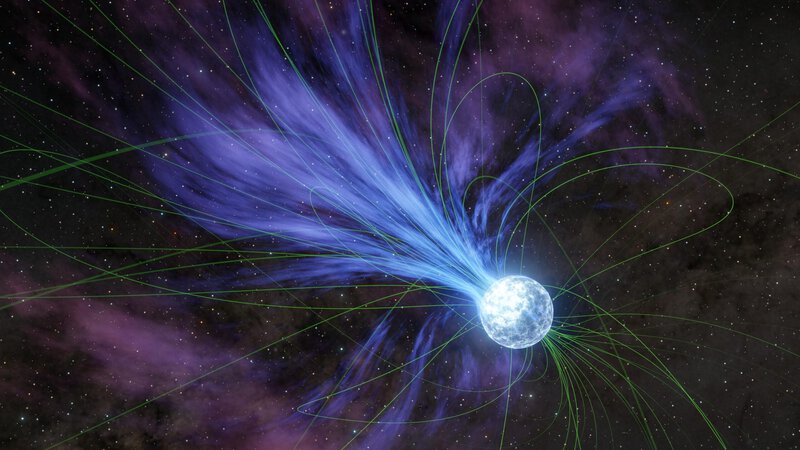
- Fast Radio Bursts (FRBs): These millisecond-duration pulses of intense radio energy originate at cosmological distances — billions of light-years away — and their precise origins remain an active area of scientific investigation. Magnetars, which are highly magnetized neutron stars, are a leading candidate, but the field has not reached full consensus. Caltech’s DSA-110 has already localized dozens of FRBs, establishing the program’s track record. The DSA is expected to detect and localize FRBs at an unprecedented rate, providing the statistical sample needed to narrow the origin question significantly.
- All-sky radio surveys: The array will systematically catalogue radio emissions from stars, map the magnetic fields threading through the Milky Way, and track transient events — short-lived signals — that current instruments lack the sensitivity to detect reliably. The resulting catalogue will serve as a foundational resource for the broader astronomical community.
- Gravitational-wave follow-up: When observatories such as LIGO detect the merger of two neutron stars, the DSA’s combination of wide field of view and sensitivity could rapidly identify the radio counterpart of that event, helping researchers understand the physics of some of the most energetic processes in the universe.
- Unanticipated discoveries: Radio astronomy has a well-documented history of serendipitous discovery — pulsars, the cosmic microwave background, and quasars were all found by instruments scanning the sky without knowing precisely what they would encounter. When any telescope improves observational capability by an order of magnitude, unanticipated findings are not merely possible; they are historically routine.
How “World’s Most Sensitive” Is Measured — and What the Claim Really Means
Sensitivity in radio astronomy is quantified by a metric called System Equivalent Flux Density, or SEFD — essentially a measure of how faint a signal must be before the telescope can no longer distinguish it from its own internal noise. A lower SEFD indicates higher sensitivity. The DSA’s combination of 1,650 dishes and modern low-noise receiver electronics is designed to drive SEFD to historically low levels across a wide swath of sky simultaneously.
Caltech describes the DSA as the most sensitive radio telescope ever built, a characterization that has been reported across multiple outlets covering the announcement. However, independent peer-reviewed benchmarking against other major instruments currently under construction — most notably the Square Kilometre Array, or SKA, being built across South Africa and Australia — has not yet been published. That distinction matters: “world’s most sensitive” is currently a design specification, not a measured operational result. Responsible science reporting requires making that difference explicit.
The SKA and the DSA are better understood as complementary instruments than as competitors. The SKA prioritizes fine angular resolution and operates primarily from Southern Hemisphere sites; the DSA prioritizes wide-field sensitivity surveys of Northern Hemisphere skies. Together, these and other new facilities — including CHIME in Canada and MeerKAT in South Africa — reflect a broad scientific consensus that the radio sky still contains major discoveries waiting to be made.
The Engineering and Logistical Challenge Ahead
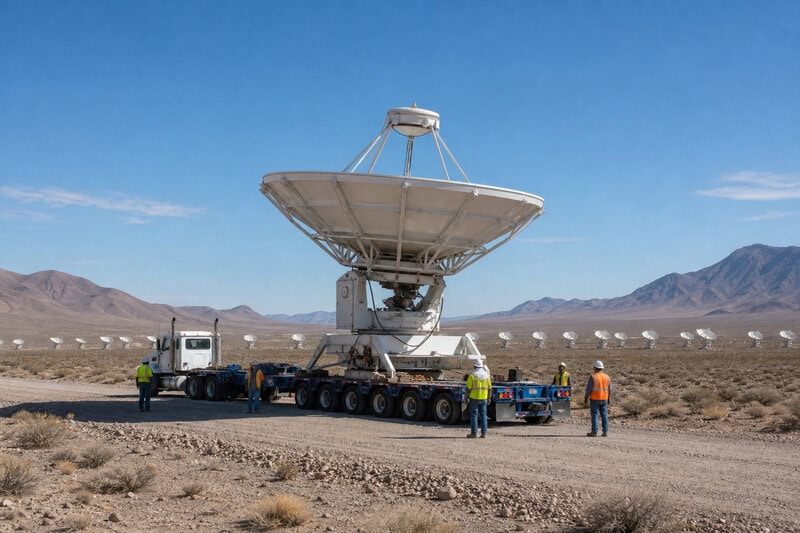
Targeting completion by 2029 gives Caltech roughly five years to design, fabricate, transport, install, align, and commission 1,650 dishes in a remote Nevada valley — an aggressive schedule, though not without precedent for purpose-built radio arrays.
The logistical scope is considerable. Each dish must be manufactured to consistent specifications, transported to a location chosen precisely because it is difficult to reach, individually aligned to tight tolerances, and connected to every other dish via a high-bandwidth data network capable of combining their signals in real time. The physical installation alone is a substantial undertaking.
The data processing challenge may prove equally demanding. The DSA will generate data volumes comparable to those produced by major particle-physics experiments, requiring purpose-built computing infrastructure and sophisticated signal-processing pipelines to convert raw antenna voltages into scientific results. Constructing that computational backbone in parallel with the physical array is itself a major engineering effort.
On the question of cost, Caltech had not published a confirmed total construction budget in publicly available materials reviewed for this article. Figures appearing in early media coverage should be treated as preliminary estimates until officially confirmed by the institution.
Why This Moment in Radio Astronomy Matters
The 2020s represent an unusual convergence of enabling technologies. Low-noise receiver electronics have matured to the point where individual small dishes can achieve sensitivity that once required enormous single structures. Mass-manufacturing techniques make producing 1,650 uniform dishes economically realistic. High-speed computing has reached the point where combining signals from that many antennas in real time is tractable. A decade ago, the DSA would have been prohibitively expensive to build. A decade from now, its discoveries will likely seem obvious in hindsight — as the discoveries of pulsars and quasars do today.
Caltech researchers developing the DSA have designed it with open-ended discovery explicitly in mind — not only to answer today’s pressing questions about Fast Radio Bursts and neutron-star mergers, but to encounter phenomena that current theoretical frameworks have not yet anticipated. That openness to surprise is not vagueness of purpose; it is the defining characteristic of instruments that permanently alter the course of science.
When the DSA turns its 1,650 dishes toward the Nevada sky, it will not simply see more of what astronomers already know. If the history of radio astronomy is any guide, it will almost certainly detect signals we do not yet have names for — and the questions those signals raise will occupy researchers for decades to come.