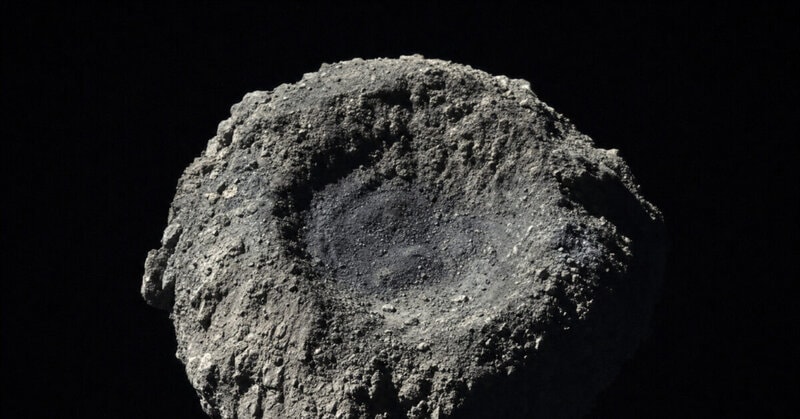
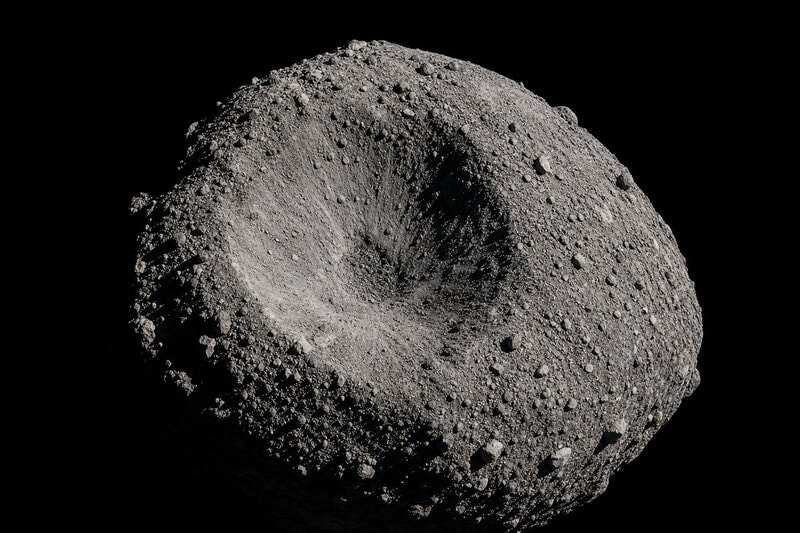
A crater nearly as wide as the asteroid itself — that is what ESA’s Hera spacecraft found when it captured the first close-up images of Dimorphos, the small space rock NASA’s DART mission deliberately struck in 2022. The impact scar is comparable in width to a major sports stadium, a scale so vast it reshaped the entire face of a world that is itself only about 160 metres across.
A Planned Collision and the Question It Left Unanswered
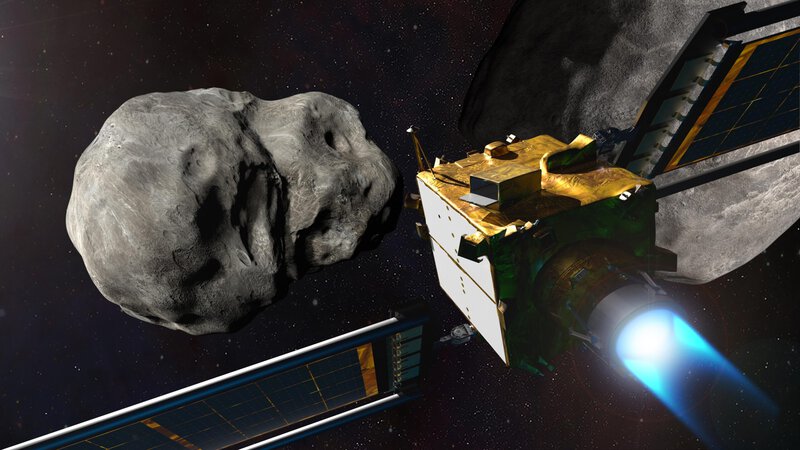
DART — the Double Asteroid Redirection Test — was NASA’s proof-of-concept kinetic impactor mission, designed to demonstrate that a spacecraft could nudge an asteroid off its natural trajectory. The target, Dimorphos, is the smaller moonlet orbiting the larger asteroid Didymos. That orbital relationship was central to the experiment: because Dimorphos circles Didymos, ground-based telescopes could measure any change in its orbital period with high precision, providing a clean before-and-after comparison of the deflection effect.
DART struck Dimorphos in September 2022 at roughly 6 kilometres per second. NASA subsequently confirmed that the collision shortened Dimorphos’s orbital period by approximately 33 minutes — a result that exceeded pre-impact predictions and validated the kinetic impactor concept as a viable planetary-defense tool. What the mission could not deliver, however, was a close-up view of the damage. Ground-based observatories could measure the orbital change but lacked the resolution to image the crater directly. DART itself was destroyed on impact. The true physical extent of what that collision did to Dimorphos remained unknown until a follow-up spacecraft could travel to the asteroid system and look.
Hera’s First Close-Up: The Stadium-Sized Crater on Dimorphos
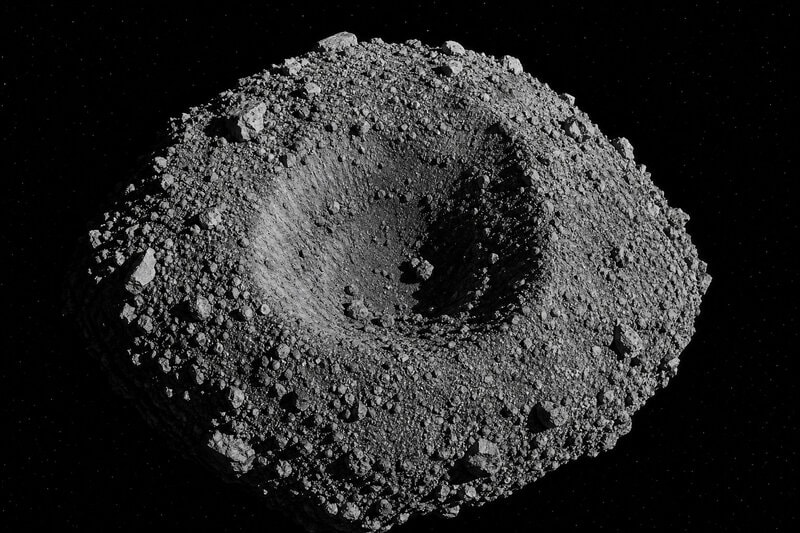
ESA’s Hera spacecraft was designed from the outset as the forensic complement to DART. Its explicit scientific purpose is to characterise the DART impact crater, measure Dimorphos’s mass and internal structure, and transform a one-time proof-of-concept into a repeatable, quantifiable methodology for planetary defense. Hera carries optical cameras capable of high-resolution surface mapping, along with radar instruments intended to probe the asteroid’s subsurface — a toolkit no Earth observatory could replicate at this distance.
When Hera achieved its first close approach to Dimorphos, the images it returned were striking. As ESA’s Hera mission team reported, the face of Dimorphos struck by DART has been flattened into an impact crater the size of a sports stadium — a structure that extends across essentially the asteroid’s entire width. The crater is almost as wide as Dimorphos itself.
That finding, reported by the BBC based on Hera’s initial close-approach data, represents the first close-up, high-resolution ground truth of the world’s first deliberate asteroid deflection. It completes a scientific record that DART opened but could not close on its own.
Why the Crater’s Scale Surprised Scientists

Pre-impact models predicted a crater significantly smaller relative to the total surface area of Dimorphos. A crater that approaches the full width of the asteroid body is not simply a large impact scar — it is evidence that the collision was far more structurally disruptive than a straightforward surface excavation. Understanding why requires looking at how loosely packed asteroids respond to energetic impacts.
When an impactor strikes a body composed of loosely bound rubble rather than solid rock, the debris ejected outward carries substantial additional momentum. This effect — known as ejecta momentum enhancement — means the deflection force delivered to the asteroid is amplified well beyond what the impactor spacecraft’s own mass would produce alone. The larger the crater and the more material ejected, the greater the amplification. Hera’s images are, in physical terms, a visual record of that amplification process: the outsized crater is evidence that ejecta momentum enhancement during the DART impact was substantial, contributing significantly to the 33-minute orbital change NASA measured.
As Astronomy Now noted in its coverage of the Hera findings, the extensive damage to Dimorphos was one of the most immediately striking details in the spacecraft’s first images. The full scientific interpretation of the crater dimensions — and what they reveal about Dimorphos’s interior — is ongoing, with peer-reviewed findings from the Hera mission team expected as the spacecraft continues its survey campaign.
What a Flattened Asteroid Face Reveals About Its Interior
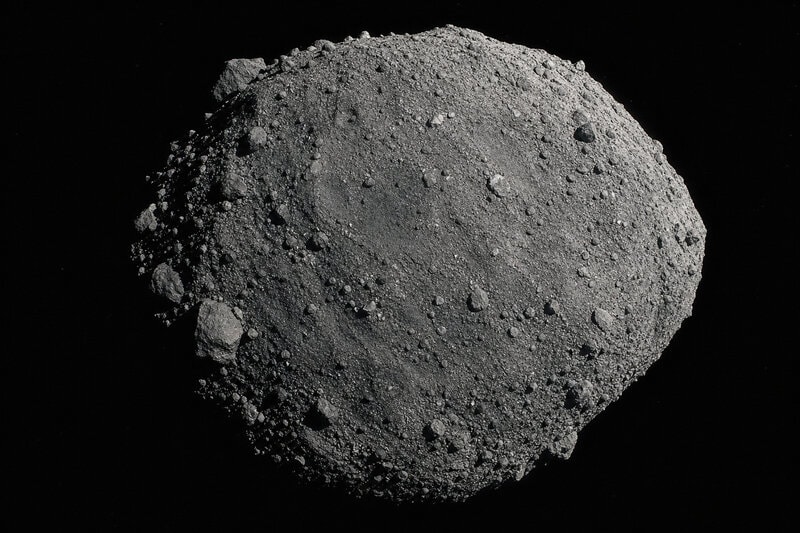
The near-total flattening of the impacted face of Dimorphos is consistent with a body that scientists describe as a rubble pile — an aggregate of loosely bound rocks, dust, and voids held together primarily by weak gravitational attraction rather than structural cohesion. A rubble-pile asteroid does not simply crater at the contact point when struck; instead, the loose interior absorbs and redistributes energy across a larger volume, causing the surface to collapse and reshape on a scale that a solid, monolithic rock body would not.
This distinction matters enormously for planetary defense planning. A solid asteroid and a rubble-pile asteroid of identical size and mass will respond very differently to a kinetic impactor. The rubble-pile structure that Dimorphos’s crater geometry implies is both an explanation for the crater’s unusual scale and a critical data point that modelers will need to incorporate when planning any future real-world deflection attempt against a different target asteroid.
Hera’s onboard radar instruments are designed to probe Dimorphos’s subsurface directly. Data from those instruments — analyzed alongside the visible crater evidence — will help scientists determine whether the asteroid’s interior was significantly restructured by the DART collision, or whether the damage was primarily confined to the surface layers. That question remains open at the time of Hera’s initial close approach. What is established scientific consensus is that DART changed Dimorphos’s orbit; whether the asteroid’s internal architecture was fundamentally altered, and whether it carries any elevated risk of future fragmentation, are active areas of investigation that Hera’s continuing survey is intended to address.
The Missing Variable That Makes Planetary Defense Repeatable
Demonstrating that a kinetic impactor can deflect an asteroid is a necessary first step. Making planetary defense a reliable tool requires something more: a precise understanding of how efficiently each impact works — specifically, the ratio of orbital change achieved to the energy and mass of the impactor used. That efficiency figure depends critically on crater geometry and ejecta behavior, which is exactly what Hera’s images now provide for the first time.
A larger-than-expected crater, implying higher-than-modeled ejecta momentum enhancement, carries an encouraging implication: future mission planners may be able to use smaller or fewer spacecraft to deflect a threatening asteroid than worst-case planning scenarios assumed. That is a potentially significant finding for cost and logistics, particularly given the compressed timelines that a real planetary-defense emergency might impose.
At the same time, the extensive structural damage Hera’s images document raises a question the planetary-defense community is actively debating: could a sufficiently energetic impact on a rubble-pile asteroid cause it to fragment rather than deflect cleanly, potentially converting a single threatening body into multiple smaller but still dangerous fragments? As Gizmodo reported, that possibility is among the open scientific questions Hera’s data is expected to help constrain. It is not a conclusion current evidence supports, but it is a scenario that responsible planetary-defense modeling must account for.
ESA and NASA have both described the DART-Hera pairing as the foundation of an international planetary-defense methodology. The crater dimensions Hera has now documented will feed directly into the physics models used to plan any future response to an asteroid identified as genuinely threatening.
What Comes Next in Hera’s Science Campaign
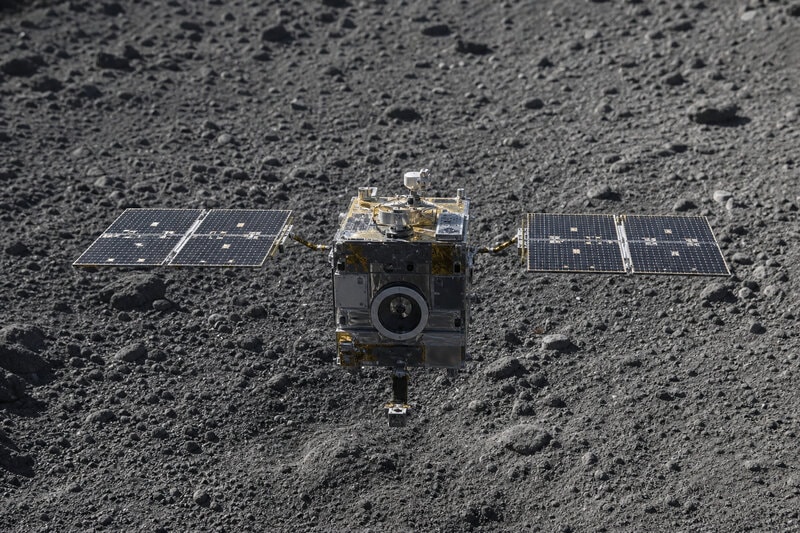
The close-approach imagery that revealed the stadium-sized crater represents the opening chapter of Hera’s science campaign rather than its conclusion. The spacecraft is designed to spend months characterising both Dimorphos and its parent body Didymos in sustained detail. CubeSat deployments are planned to gather surface and subsurface data at ranges even closer than the main spacecraft can safely achieve, adding further resolution to the picture of what DART’s impact actually did to the asteroid.
The full scientific return — including precise mass measurements of Dimorphos, interior density maps derived from radar data, and a complete morphological survey of the crater’s shape and depth — will be published through ESA’s Hera mission science program and peer-reviewed literature. That body of data will constitute the empirical foundation that planetary-defense researchers worldwide will rely on when designing and justifying future missions.
Space.com’s coverage of Hera’s first close look captures the broader significance of the moment: humanity now has the first confirmed, high-resolution evidence of what a deliberate kinetic impact does to an asteroid at operational scale. The answer — a stadium-sized crater that reshaped an entire asteroid’s face — is both more dramatic and more instructive than pre-mission models anticipated. By documenting cause, effect, and structural consequence at the scale that actually matters for protecting Earth, Hera has transformed DART from a successful experiment into a documented case study that the planetary-defense community can build on.