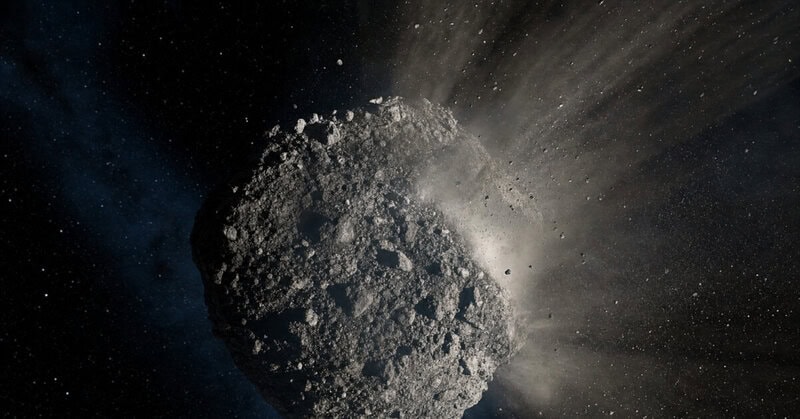
When NASA’s DART spacecraft slammed into the asteroid Dimorphos on September 26, 2022, mission scientists expected to shorten the space rock’s orbit by roughly 10 minutes. The actual result was a 32-minute reduction — more than three times the minimum threshold for success — and that unexpected number has fundamentally reshaped how planetary scientists think about deflecting asteroids.
A Controlled Experiment 7 Million Miles From Earth
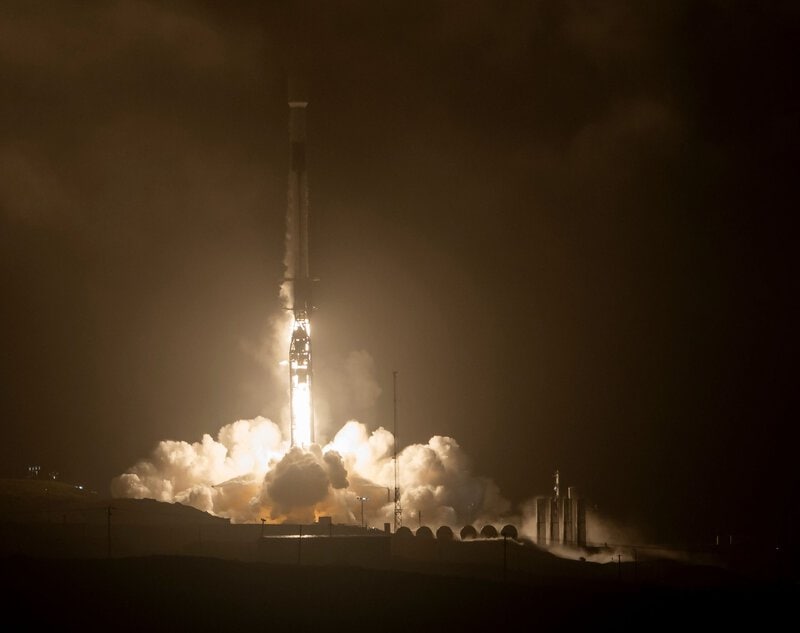
DART (Double Asteroid Redirection Test) was a 1,260-pound spacecraft built and operated by NASA’s Johns Hopkins Applied Physics Laboratory. Its sole purpose was to test whether a kinetic impactor — essentially a guided, high-speed projectile carrying no explosive payload — could measurably alter an asteroid’s trajectory. The mission targeted Dimorphos, a roughly 580-foot-wide moonlet orbiting the larger, 2,560-foot-wide asteroid Didymos. Neither body posed any threat to Earth; NASA selected the binary system precisely because measuring changes in a moonlet’s orbital period around its parent is far more precise than tracking a solo asteroid drifting through deep space.
The underlying concept behind the planetary defense test is straightforward: strike an asteroid years or decades before a predicted Earth impact, and even a tiny velocity change accumulates over time and distance into a trajectory miss. But no one had ever tested this approach in practice before DART. The mission was an investment in capability — not a response to an emergency, as NASA’s Center for Near Earth Object Studies (CNEOS) has consistently emphasized.
The Impact: What Happened in the Seconds That Counted
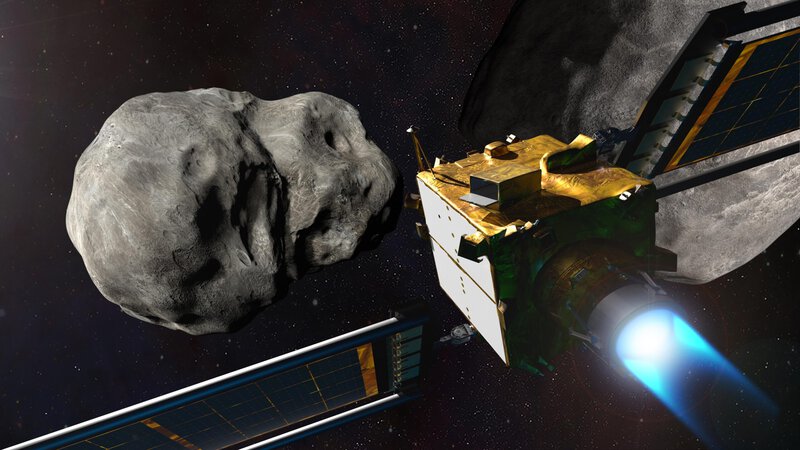
DART’s onboard DRACO camera transmitted images until the final moment, capturing Dimorphos’s boulder-strewn surface in unprecedented detail as the spacecraft closed in at roughly 14,000 miles per hour. Contact was confirmed at 7:14 p.m. EDT on September 26, 2022, when the signal from DART simply ceased. ESA’s LICIACube cubesat, deployed 15 days before impact, captured close-up imagery of the collision and documented a massive plume of pulverized rock and dust blasting outward from the impact site.
Post-impact observations by both the Hubble and James Webb space telescopes tracked that ejecta plume for weeks, revealing it stretched thousands of miles into space. Those measurements gave scientists the data they needed to calculate exactly how much momentum had been transferred to Dimorphos — and the answer was larger than anyone had predicted. New images processed after the mission confirmed a stadium-sized crater on Dimorphos’s surface — physical evidence that the impact was far more energetic than the spacecraft’s own kinetic energy alone could explain.
The Unexpected Physics: Why the Numbers Came Out So Large
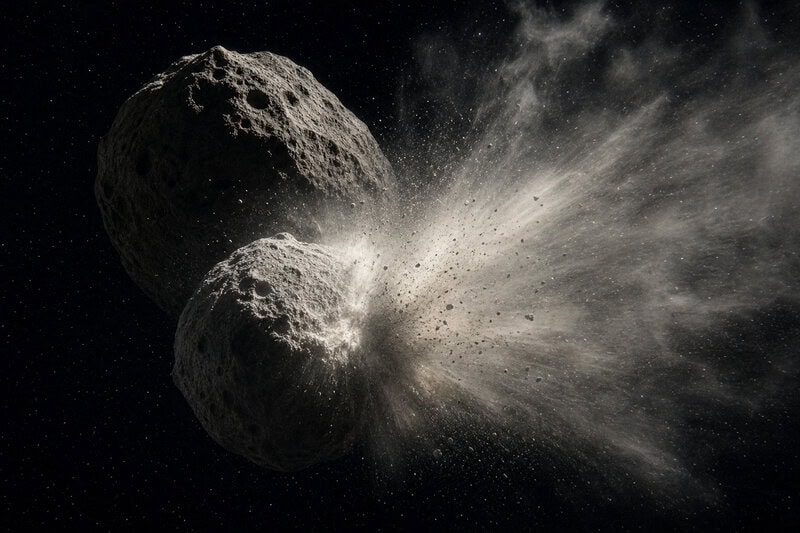
The 32-minute orbital period change — confirmed by NASA and an international network of ground-based observatories measuring the dimming pattern of Dimorphos as it passed in front of Didymos — far exceeded predictions because of a phenomenon called momentum enhancement, driven by the ejecta plume. In plain terms: DART didn’t just push Dimorphos forward; it also blasted tons of rock and debris off the surface in the opposite direction. That escaping material acted like rocket exhaust, giving Dimorphos an additional kick that amplified the deflection well beyond what the spacecraft’s mass and velocity would have produced on their own.
Scientists quantify this amplification using a parameter called beta (β). A beta of 1.0 would mean only the spacecraft’s kinetic energy mattered — no amplification from ejecta at all. Researchers publishing in the journal Nature in 2023 estimated DART’s beta at somewhere between 2.2 and 4.9, meaning the ejecta recoil multiplied the deflection effect by up to nearly five times. That range matters: the precise value depends heavily on the asteroid’s composition, internal structure, and surface properties — factors that vary considerably from asteroid to asteroid. NASA scientists have been explicit that this result, while encouraging for the overall planetary defense record, cannot be assumed to apply universally to every potential threat scenario.
What the Crater Reveals — and What It Leaves Open
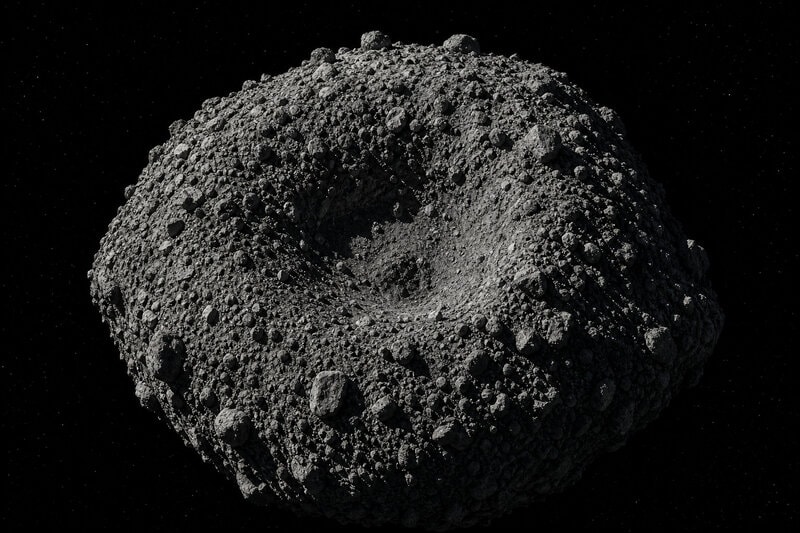
The stadium-sized crater confirmed that Dimorphos has a loosely consolidated rubble-pile structure — held together primarily by weak gravity rather than solid rock — which is consistent with many small near-Earth asteroids. That structure carries both good news and bad news for planetary defense planners. On one hand, rubble piles amplify ejecta production, boosting beta and making deflection more efficient than it would be against solid rock. On the other hand, a sufficiently powerful impact could potentially break a rubble-pile asteroid apart rather than redirect it, scattering fragments rather than eliminating a threat. The crater’s size and morphology, analyzed using Hubble imagery and LICIACube data, helped scientists constrain estimates of Dimorphos’s surface strength and feed those parameters into computer models for future mission planning.
ESA’s Hera mission has since returned close-range images of the crater, confirming the scale of the collision’s surface effects. Hera, which arrived at the Didymos system in 2026, is conducting a detailed survey of the impact site and Dimorphos’s altered orbit — providing ground-truth measurements that DART’s before-and-after comparison alone could not deliver. Among the key questions Hera is working to resolve:
- Exactly how much mass was ejected during the impact, and in what directions
- How the collision changed Dimorphos’s spin state (early data suggested it rotates differently post-impact)
- Whether the impact altered the rubble pile’s structural integrity or overall shape
- How precisely the new orbital period can be measured to sharpen the beta estimate
Preliminary analyses have also suggested subtle morphological changes to Dimorphos itself — possible shifts in its shape or orientation relative to Didymos — which could have broader implications for understanding how binary asteroid systems respond to external perturbations. These findings are described as emerging and contested in the scientific literature, and Hera’s close-range data are expected to either confirm or rule them out in the coming years.
What DART Actually Proved — and What It Didn’t

DART’s success is legitimately historic. It is the first time humanity has measurably and intentionally changed the motion of a celestial body — a conclusion that is not contested, appearing across multiple peer-reviewed studies and formally stated by NASA. The Dimorphos orbit change results demonstrated that kinetic impactors are a viable planetary defense tool under the right conditions.
However, scientists and NASA officials have been careful to define precisely what DART tested: one specific scenario involving a relatively small moonlet with a rubble-pile structure, struck with ample warning time and well-characterized orbital parameters. A real-world threat might involve an asteroid of unknown composition, with little warning, and no convenient binary companion to use as a measurement baseline. The mission validates one approach under one set of conditions — it does not resolve every conceivable threat scenario.
That caveat leads directly to the irreplaceable role of early detection. A kinetic impactor — the most practical near-term asteroid deflection tool currently available — only works if a threatening asteroid is identified years or decades in advance. This is why NASA’s NEO Surveyor space telescope, currently in development, is considered a critical complement to what the DART demonstration established: finding threats early enough to act on them is a prerequisite for any deflection strategy to succeed.
The Broader Legacy: From Test to Evidence-Based Engineering

What DART ultimately delivered is a validated, physics-based framework for calculating asteroid deflection outcomes. Before September 2022, planetary defense was largely theoretical — scientists could model kinetic impacts in computer simulations, but those simulations had never been tested against reality at scale. Now they have been, and the data revealed that reality is more complex, and in some ways more capable, than the models assumed.
The beta parameter — that amplification factor driven by ejecta momentum — is now an empirically grounded concept rather than a theoretical estimate. Hera’s ongoing survey will refine it further, and future missions will extend the dataset to other asteroid types and structures. The goal, as NASA scientists have framed it, is to move planetary defense from contingency planning into evidence-based engineering: a discipline with real-world validation, known variables, and quantified uncertainties.
No known asteroid currently poses a credible near-term threat to Earth, according to CNEOS. DART was not a response to danger — it was preparation for a future that humanity now has better tools to manage. A 32-minute number, produced by the collision of a half-ton spacecraft with a space rock 7 million miles away, turned out to carry more information about the physics of planetary defense than a decade of simulations had provided.