
Every astronaut aboard China’s Tiangong space station consumes roughly two kilograms of supplies per day — food, water, oxygen, and spare parts — meaning a three-person crew burns through more than two metric tons of cargo every year without a single resupply mission. China’s answer to that unforgiving arithmetic is the Qingzhou, a next-generation cargo spacecraft whose test flight earlier in 2025 verified core docking, propulsion, and pressurization capabilities, and which is tentatively scheduled for its operational debut in January 2027.
Why Cargo Spacecraft Are Harder to Build Than They Look
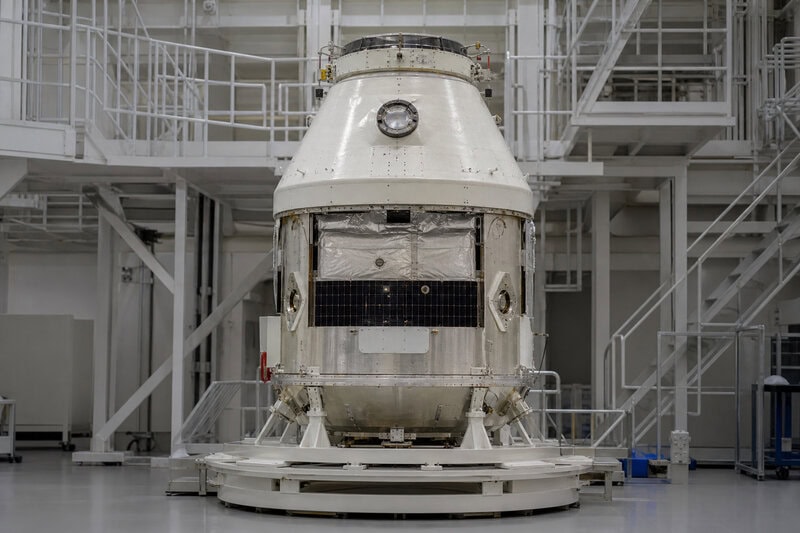
The phrase “cargo spacecraft” undersells the engineering challenge. A vehicle in this role must perform three distinct jobs in sequence: survive launch aboard a rocket while absorbing intense vibration and acceleration forces; autonomously rendezvous and dock with a station traveling at roughly 7.7 kilometers per second; and then deliver both pressurized goods that crew members can safely handle and unpressurized hardware exposed to the vacuum of space. Fail at any step and the mission — and potentially the crew’s survival margin — is compromised.
Autonomous rendezvous is perhaps the most technically demanding phase. The spacecraft must find, approach, and physically lock onto a docking port without human pilots at the controls, relying on layered GPS, radar, and optical sensors that continuously cross-check one another as the vehicle closes the final few hundred meters. No single sensor is trusted alone; the redundancy is intentional, because a navigation error at closing speed could destroy both vehicles.
Once docked, the station’s atmosphere must remain sealed. Standard docking ports use metal-on-metal seals and a pressure-equalization valve that allows crew to confirm no leak exists before opening the hatch. That procedural step — wait, verify, then open — is not optional caution; it is an institutionalized lesson drawn from historical spacecraft anomalies documented in post-flight engineering reviews by agencies including NASA and ESA.
On departure, the cargo spacecraft serves one final unglamorous function: it doubles as a trash compactor. After the crew unloads supplies, they pack the vehicle with waste material, and the spacecraft performs a de-orbit burn that sends it into the atmosphere, where it burns up. Disposal is an engineered feature of the mission architecture, not an afterthought.
Meet Qingzhou: China’s Smaller, Cheaper Space Truck
China’s existing cargo workhorse is the Tianzhou spacecraft — Tianzhou meaning “heavenly vessel” — which has reliably supplied Tiangong since 2017. It is a capable vehicle, but its relatively large size and dependence on dedicated Long March rocket launches carry a per-mission cost that Chinese planners want to reduce as station operations extend into the 2030s.
Qingzhou, whose name translates roughly as “light vessel,” is explicitly designed to be smaller and cheaper. The naming choice is deliberate: where Tianzhou implies grandeur, Qingzhou signals efficiency. The 2025 test flight validated Qingzhou’s core systems in orbit — a standard qualification step that space agencies worldwide require before trusting any new vehicle with life-critical cargo. No cargo spacecraft enters operational service without first demonstrating in orbit that its docking hardware seals correctly, its propulsion system performs as modeled, and its pressurized volume holds atmosphere through the extreme thermal cycling of low Earth orbit.
China is simultaneously developing the Mengzhou, a next-generation crewed spacecraft whose debut is tentatively expected later in 2025 or 2026, capable of carrying astronauts and eventually supporting missions beyond low Earth orbit. Qingzhou and Mengzhou together represent a generational refresh of China’s entire human spaceflight transportation architecture — one vehicle handles people, the other handles supplies, and each is optimized for its specific role.
The Engineering Inside: Propulsion, Power, and Pressurization
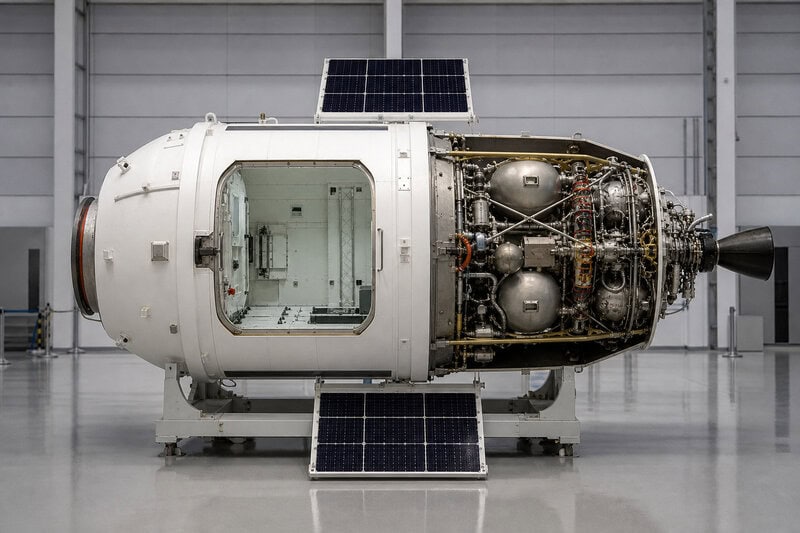
Cargo spacecraft are typically divided into two sections. The pressurized cargo module is essentially a sealed cylinder that crew members can enter in a shirt-sleeve environment to unload supplies. The service module houses propellant tanks, engines, solar panels, and avionics. Qingzhou follows this two-section architecture, as do the Tianzhou and Russia’s long-serving Progress vehicles — a design logic validated across decades of space station operations.
Orbital maneuvering relies on hypergolic propellants, meaning fuels that ignite spontaneously on contact with an oxidizer and require no separate ignition system. This characteristic makes them highly reliable in the vacuum of space, where a failed ignition could doom the mission. The trade-off is toxicity: hypergolic propellants are hazardous to handle on the ground. The global cargo spacecraft industry — from Progress to Cygnus to Tianzhou — has accepted this trade-off for decades because reliability in orbit outweighs handling complexity on the launch pad.
Solar arrays convert sunlight into electricity to power the computers, heaters, sensors, and communications systems that keep the spacecraft functional during a mission that may last months docked at the station. Active thermal control systems — fluid loops and radiators — then dump waste heat into space. In vacuum there is no surrounding air to carry heat away, so without active thermal management, electronics would overheat and fail. This is one of the less-discussed but genuinely critical engineering challenges of operating any spacecraft for extended periods.
Pressurization integrity is monitored continuously by onboard sensors. Even a slow leak — one that might take hours to become dangerous — would be flagged well before a crew member opens the hatch. This is not over-engineering; it reflects lessons institutionalized after real anomalies throughout the history of human spaceflight.
The Commercial Launch Strategy: Why Economics Matter for Station Survival
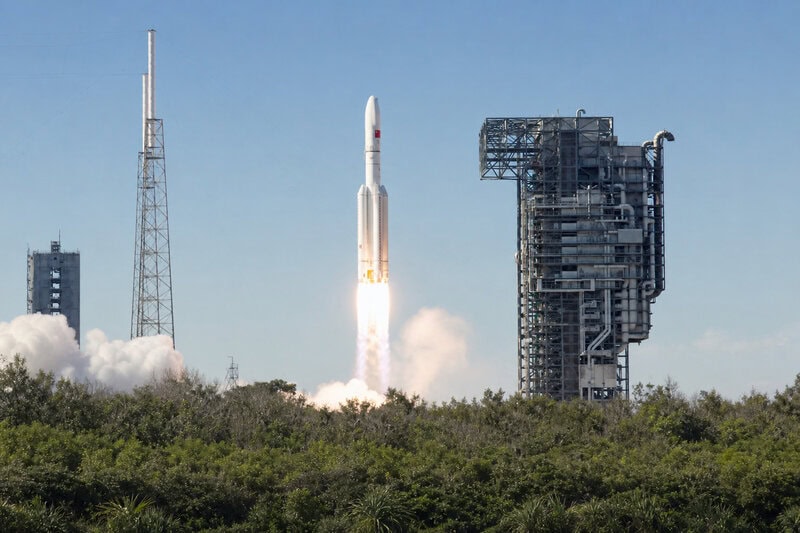
One of the more consequential decisions embedded in the Qingzhou program is China’s exploration of commercial launch providers to reduce per-mission costs. Commercial launch providers have been shortlisted for China’s low-cost cargo spacecraft program, though no specific provider or contract had been publicly confirmed as of mid-2025.
The logic mirrors what NASA demonstrated with its Commercial Resupply Services program, which brought SpaceX’s Dragon and Northrop Grumman’s Cygnus into service and measurably lowered the agency’s per-kilogram delivery costs to the International Space Station. When launch becomes cheaper, operators can afford more frequent resupply missions, reducing the risk of critical shortages and creating room in the manifest for more ambitious scientific payloads.
Lower per-kilogram costs also change what is economically rational to send to the station. At high cost, every kilogram must be justified against strict priority criteria. At lower cost, margins widen — crews can receive more experimental equipment, replacement hardware can be stocked in advance rather than ordered in emergencies, and the station as a research platform becomes more productive. That is not a secondary benefit; it is a structural change in how the station operates day to day.
It is worth distinguishing what is established from what is still emerging. Autonomous cargo resupply is mature, proven technology. China’s Tianzhou series has demonstrated that Chinese engineers can build reliable cargo spacecraft capable of performing all required mission phases. The commercial launch integration for Qingzhou, however, remains an emerging element — one with clear strategic rationale but details that have not yet been publicly confirmed.
How Qingzhou Fits China’s Larger Tiangong Strategy
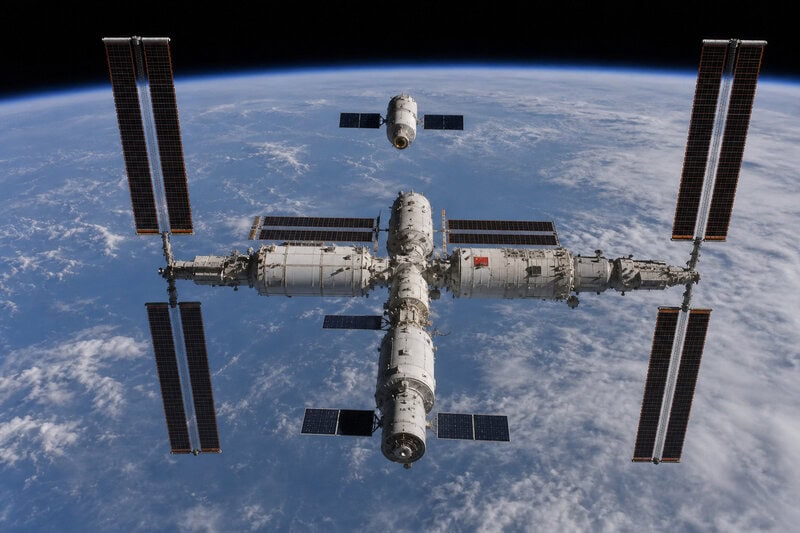
Tiangong — “heavenly palace” — is China’s modular space station in low Earth orbit, comprising a core module and two laboratory modules. China has planned for Tiangong to operate through at least the 2030s, with ambitions to expand the station’s scale as the International Space Station approaches the end of its operational life. Sustained occupation over that timeline requires a logistics chain that is both reliable and affordable — reliability to prevent life-threatening shortages, affordability to prevent the program from becoming economically unsustainable.
Crews currently rotate every six months via the Shenzhou crewed spacecraft. Consumables and equipment must arrive more frequently than crew rotations alone allow, which is the operational gap that Tianzhou currently fills and Qingzhou is designed to fill at lower cost. Mengzhou, once operational, will take over crew transport and eventually enable longer-duration or deeper-space missions, freeing China’s crewed vehicle fleet from the constraints of current hardware.
The division of labor — Mengzhou for crew, Qingzhou for cargo — mirrors the architecture NASA adopted when it separated crew and cargo transportation programs under Commercial Crew and Commercial Resupply Services. That separation is not merely organizational; it provides operational resilience. If one vehicle type is grounded for technical review, the other can sustain partial operations. A station program dependent on a single vehicle for both crew and cargo has no such buffer. China’s emerging dual-vehicle architecture builds that buffer directly into the system design.
What Comes Next — and What Remains Uncertain
The January 2027 target for Qingzhou’s operational launch is a planning milestone, not a firm date. Final launch windows depend on Tiangong’s orbital position and phasing, rocket readiness, and the outcome of any additional qualification testing following the 2025 test flight. Spaceflight schedules at this level of complexity carry genuine uncertainty, and describing the date as tentative — as Chinese space program statements have done — is accurate, not evasive.
Several key details about Qingzhou remain officially undisclosed as of this writing: its confirmed cargo capacity, the exact specifications of its docking system, and which commercial launch vehicle — if any — will be selected for early operational missions. The Mengzhou crewed spacecraft’s debut timeline is itself described as tentative, meaning China’s human spaceflight schedule carries multiple interdependent variables that could cascade if any single element encounters delays.
What can be stated with confidence is this: autonomous cargo resupply is a proven technology with a multi-decade track record across multiple national programs; economic pressure to reduce per-kilogram delivery costs is universal among space station operators; and China’s Tianzhou program has already demonstrated the baseline engineering competence that Qingzhou builds upon. The Qingzhou program represents an incremental but strategically significant step — not a leap into the unknown, but a deliberate effort to make the known more affordable, and in doing so, to make continuous human presence in low Earth orbit more sustainable for the decades ahead.