
A single gram of genuine saffron demands the hand-harvested stigmas of roughly 150 Crocus sativus flowers — and experienced Valencian cooks insist they can taste the difference between that and a cheap substitute in the first forkful of paella. Food chemists have now begun to explain exactly why that instinct is correct, tracing the failure back through three interlocking reaction pathways that govern everything a properly made paella can be.
Origins and Cultural Weight
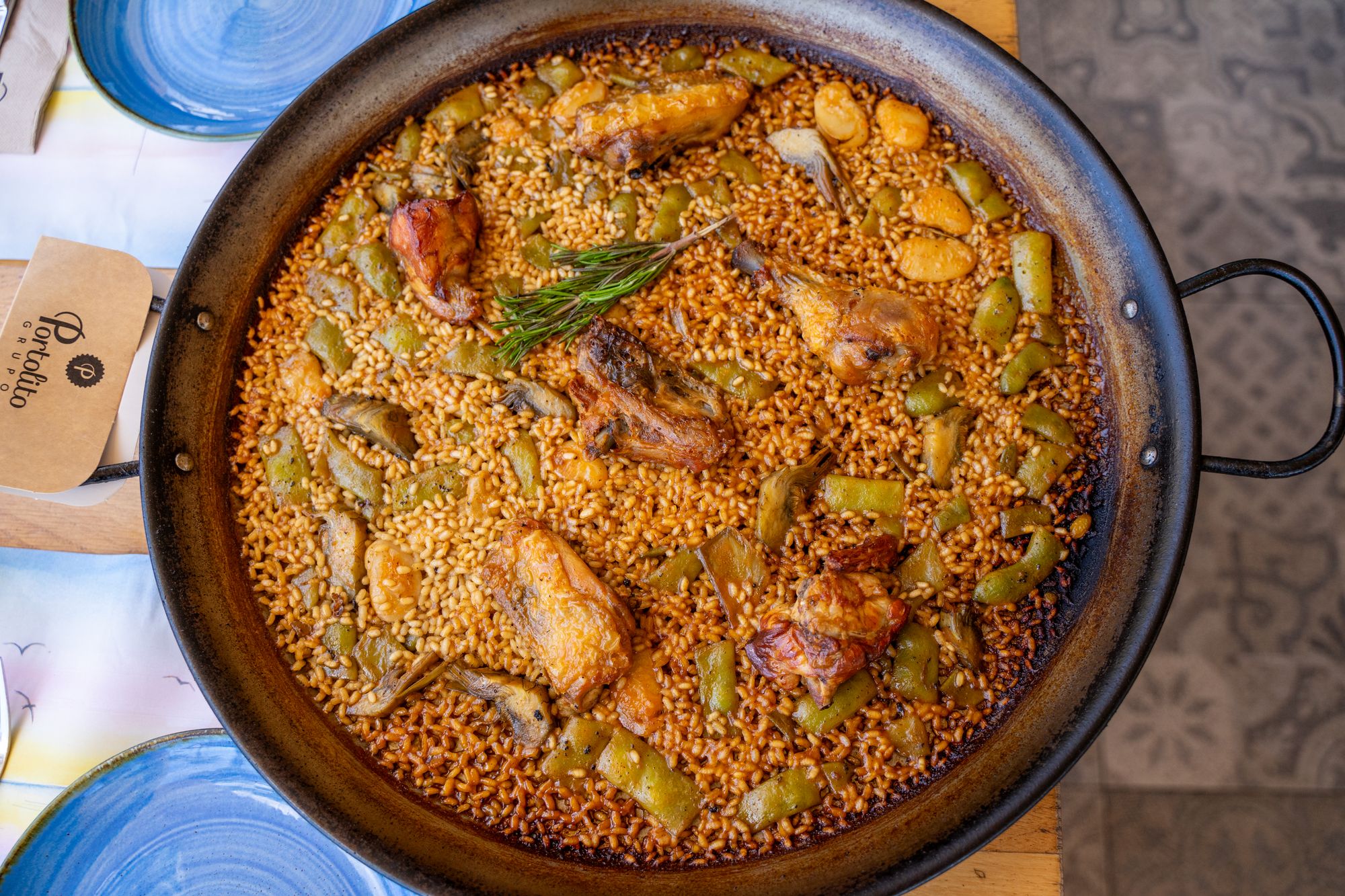
Paella was born in the rice-farming wetlands surrounding Valencia on Spain’s eastern coast, most likely in the mid-nineteenth century, when field workers cooked rice over open fires with whatever proteins were at hand — rabbit, chicken, and the flat green beans and butter beans native to the Valencian huerta. The dish’s name derives from the Latin patella, meaning pan, a reminder that the vessel preceded the recipe. Valencians are protective of that lineage: the regional government formally defines paella valenciana by a specific ingredient list, and the debate over what does and does not constitute authentic paella remains genuinely contentious in Spain today.
Seafood variants and mixed paellas — combining chicken, seafood, or pork — emerged later as the dish spread outward from Valencia. Each regional interpretation adjusts the protein and vegetable base while preserving the same underlying cooking logic: saffron-infused broth absorbed by short-grain rice in a wide, shallow pan over high heat. Understanding why that logic exists requires following the chemistry.
One Spice, Three Molecules, and an Entire Flavor Architecture
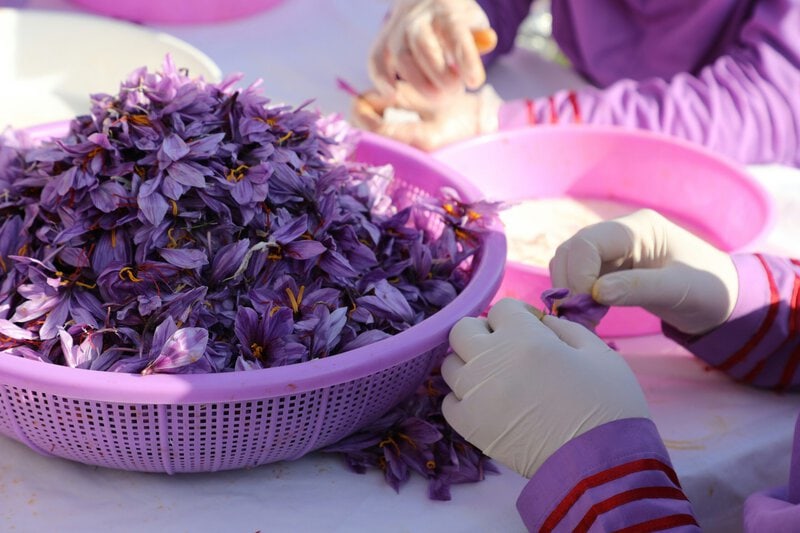
Saffron’s extraordinary cost is driven almost entirely by harvest logistics. Each Crocus sativus flower produces only three stigmas, which must be picked by hand within hours of blooming in autumn. The International Organization for Standardization grades saffron globally under ISO 3632, and authentic product retails between roughly five and ten dollars per gram — a price that reflects not scarcity of the plant but the irreducible human labor required to collect it at scale.
That price is chemically justified by a triad of compounds that no cheap substitute replicates in full. Crocin is the red-orange carotenoid pigment responsible for saffron’s vivid color. Picrocrocin is a bitter glycoside that provides the spice’s characteristic savory depth. Safranal is the volatile aldehyde — released when picrocrocin breaks down under heat — that produces the floral, hay-like aroma. Researchers including Assimopoulou and colleagues, writing in the Journal of Chromatography A in 2005, identified and characterized this compound triad in detail, establishing it as the chemical fingerprint of authentic saffron quality.
Cheap saffron is frequently adulterated with safflower petals, turmeric, or dried corn stigmas — materials that can approximate the orange color but contain none of picrocrocin or safranal. The dish gains stain but loses taste, a substitution that ISO spectrophotometric testing can detect. ISO 3632 defines Grade 1 saffron by a coloring strength above 250 on its absorbance scale; below that threshold, and certainly with adulterants, the chemistry of the dish is compromised before the cook has added a single other ingredient.
Compounding the problem, crocin concentration degrades rapidly with light and heat exposure. Improperly stored or old saffron loses its potency before it ever reaches the pan, meaning even nominally authentic saffron can fail if it has been sitting in a clear jar on a sunlit shelf. Proper storage — in an airtight container, away from light, at room temperature or cooler — is not optional fussiness; it is a prerequisite for the chemistry to work.
How Saffron Carotenoids Actually Flavor — Not Just Color — the Rice
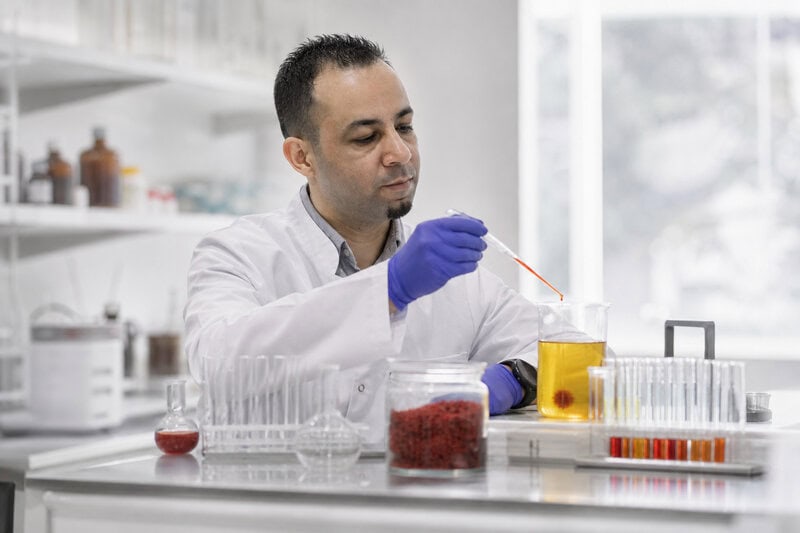
Crocin belongs to the carotenoid family, the same class of pigments found in carrots and tomatoes. What makes it unusual — and uniquely suited to paella — is that sugar chains attached to its ends render it water-soluble, allowing it to dissolve readily into the aqueous broth that saturates the rice. This property was documented by Escribano and colleagues in the Journal of Agricultural and Food Chemistry in 1996 and explains why saffron distributes evenly through a pot of cooking liquid in a way that turmeric, with its fat-soluble curcumin, cannot.
When saffron threads are steeped in warm water or broth before being added to the pan — a technique that traditional Valencian recipes specify — heat gently accelerates the hydrolysis of picrocrocin into glucose and safranal. This releases the spice’s characteristic aroma at precisely the moment the liquid meets the rice. The warm-water steep, rather than a boiling-water steep, matters: safranal is volatile enough to evaporate quickly at high temperatures, meaning saffron added too early during a high-heat cook loses its aromatic compounds to the air before they can bind to the grain.
Research by Carmona and colleagues, published in Critical Reviews in Food Science and Nutrition in 2007, confirmed that flavor-active compounds in saffron are highly concentration-dependent. Below a sensory threshold, a dish registers as bland or one-dimensional regardless of how vivid its color appears. This is precisely why adulterated product with high dye content but low picrocrocin fails organoleptically: the eye is deceived; the palate is not.
Starch Gelatinization and the Maillard Reaction: Building the Rice’s Architecture
At least three distinct reaction pathways shape paella’s final taste, color, and texture, and they must occur in the right sequence.
The first is starch gelatinization. Paella rice — typically a short-grain variety such as Bomba or Senia, capable of absorbing two to three times its volume in liquid — takes up the saffron-infused broth as amylose and amylopectin chains hydrate and swell. The goal is distinct, tender grains, not the deliberately broken starch of a risotto. This requires the broth to be absorbed steadily rather than stirred, which is why paella is left largely undisturbed once the liquid is added. Stirring ruptures the swollen starch granules and releases surface starch into the liquid, producing the creamy, starchy texture that defines risotto but ruins paella.
The second pathway, and the one that marks the boundary between competent and exceptional paella, is the Maillard reaction. As the broth reduces in the final minutes of cooking, the bottom layer of rice loses moisture and contacts the hot pan surface directly, reaching temperatures above 140°C (284°F). At that point, the Maillard reaction — a non-enzymatic browning between amino acids and reducing sugars, first described by French chemist Louis-Camille Maillard in 1912 and extensively characterized by food scientist John Hodge at the USDA in 1953 — generates hundreds of aromatic compounds simultaneously. The result is the socarrat: the crispy, deeply browned crust that Valencian cooks consider the dish’s highest achievement, producing pyrazines and furans responsible for its roasted, coffee-like undertones.
Socarrat formation requires narrow thermal precision. Too low a temperature and the crust never develops; too high and the rice burns past the Maillard window into acrid pyrolysis. Experienced cooks rely on two cross-sensory signals: a transition from bubbling, steamy sound to dry crackling within one to two minutes of the broth fully absorbing, and a shift in aroma from savory-steamy to toasted-nutty. Both signals align with the chemistry of the browning window and serve as real-time process indicators more reliable than any timer. Recipes that honor this technique — such as grilled paella mixta as developed by Serious Eats — emphasize listening and smelling as core skills, not afterthoughts.
The third pathway is caramelization of sugars contributed by the tomato, onion, and wine that typically form the sofrito base. Caramelization begins above 160°C (320°F) and produces furanones and diacetyl, adding buttery and fruity top notes that sit beneath the more dominant Maillard products. The three pathways — gelatinization, Maillard browning, and caramelization — are not sequential but overlapping, and managing their overlap is what separates an excellent paella from a merely acceptable one.
The Pan as Chemical Reactor
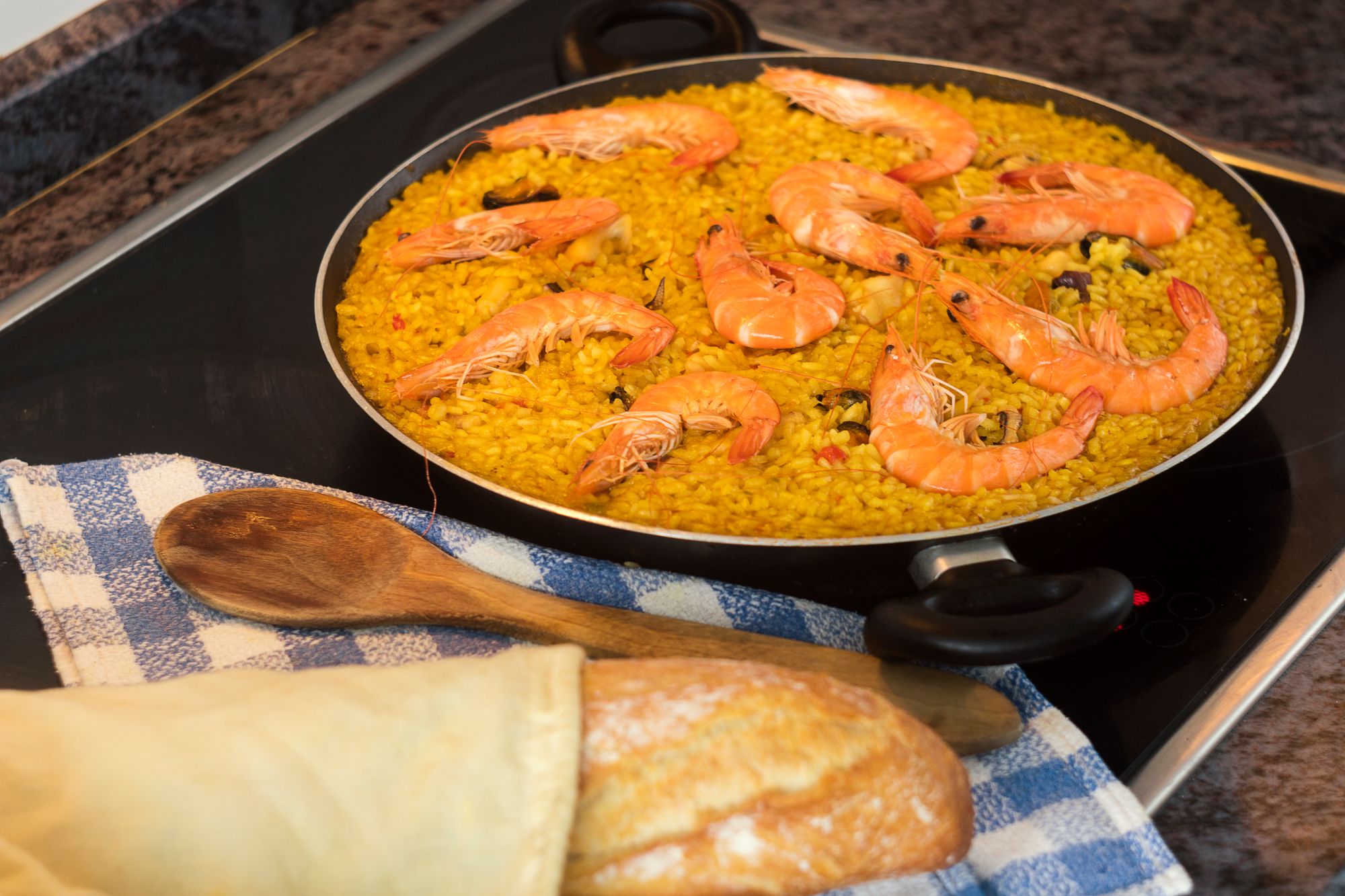
The traditional paella pan — a wide, shallow carbon-steel vessel with sloped sides — is not merely a cultural artifact. Its geometry is engineered to maximize the ratio of surface area to volume, ensuring that broth evaporates evenly across a large footprint and that the maximum proportion of rice can reach the pan floor and develop socarrat. A deep pot produces the opposite conditions: trapped steam, uneven absorption, and little to no crust. This is why improvising paella in a tall-sided saucepan produces a dish that may taste reasonably correct but will never achieve the texture that defines the original.
Carbon steel conducts heat rapidly but unevenly compared to cast iron, creating a temperature gradient from pan center to rim. Skilled cooks compensate by rotating the pan over the heat source — a technique that also prevents localized burning of the saffron-stained broth before starch gelatinization is complete. The two processes must proceed in parallel: the broth must feed the rice while the bottom layer simultaneously reaches browning temperature, a coordination that the pan’s shallow depth makes physically possible.
The slightly acidic environment introduced by white wine or tomatoes early in the cook slows the Maillard reaction’s rate. At lower pH, browning is chemically inhibited, which extends the window for broth reduction without over-caramelization — a balance that traditional recipes achieve empirically without ever naming the underlying mechanism. Fat rendered from chicken or chorizo adds a further chemical dimension: because crocin is water-soluble while many other flavor compounds are lipid-soluble, the fat phase carries a different subset of aroma molecules than the aqueous phase, meaning the fat content of the protein directly influences which aromatic compounds the rice ultimately absorbs.
What Cheap Saffron Actually Does to the Chemistry — and Why It Cannot Be Fixed
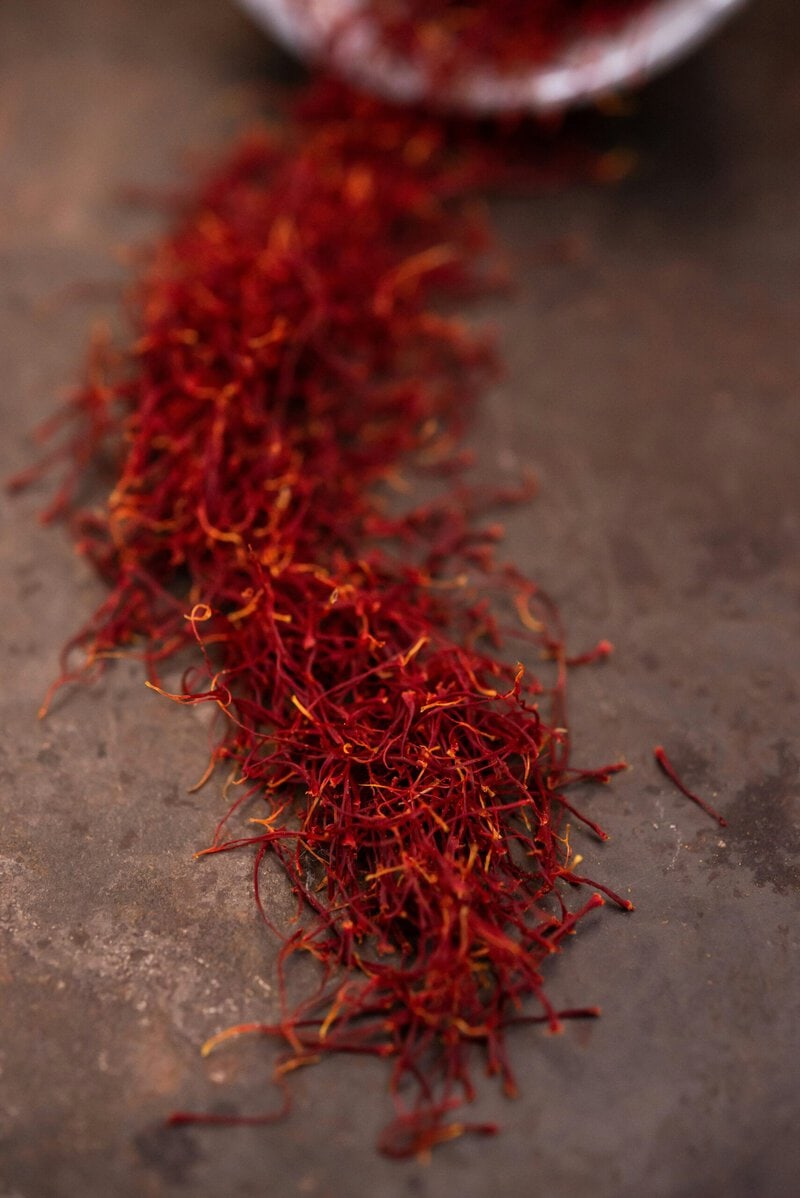
Substituting low-grade or adulterated saffron removes the picrocrocin-to-safranal conversion pathway entirely. The cook is left with a dish that may approach authentic color but is missing the bitter-sweet contrast that safranal and picrocrocin provide against the Maillard-generated roasted notes of the socarrat. The two flavor layers — spice-derived and crust-derived — are meant to resolve against each other; without the saffron side of that equation, the socarrat reads as merely burnt rather than complex.
Turmeric-based adulterants introduce curcumin, which is fat-soluble rather than water-soluble. In an aqueous cooking medium it distributes unevenly, producing blotchy rather than uniform color — a visual tell consistent with ISO 3632 quality assessments. The problem is not simply aesthetic: uneven distribution means uneven flavor, compounding the absence of picrocrocin with the presence of curcumin’s sharper, more medicinal bitterness in concentrated pockets.
Because saffron’s volatile compounds are released during a brief, temperature-sensitive window, there is no compensatory technique once authentic saffron is absent. Adding more of a low-potency product saturates the dish with bitter off-notes from extraneous plant material without delivering the target flavor compounds. Food scientist Harold McGee observed in On Food and Cooking (2004) that spice quality functions as a ceiling: a dish can reach no higher aromatic complexity than the least volatile-rich ingredient it contains. That principle applies with particular force to paella, where saffron is the sole aromatic spice in the traditional Valencian formulation.
Choosing Rice, Broth, and Protein — and Why Each Decision Is Chemical
Rice variety is not a matter of preference but of starch architecture. Bomba, the variety most prized for paella, contains a higher ratio of amylose to amylopectin than ordinary long-grain rice. Amylose absorbs liquid more slowly and holds its structure more firmly under heat, which is why Bomba can absorb two to three times its volume in broth without turning mushy. Senia and Bahía are acceptable alternatives; long-grain varieties such as basmati or jasmine absorb liquid too quickly and produce a drier, less cohesive result. Arborio, the risotto standard, contains too much amylopectin and releases surface starch the moment it is agitated, which is why it would produce a creamy, porridge-like texture even if the cook avoided stirring.
Broth quality is the second major variable. Homemade seafood or chicken stock carries dissolved gelatin from collagen, glutamates from meat, and a range of volatile flavor compounds that commercial stock either lacks or delivers in weaker concentration. Gelatin increases the broth’s viscosity slightly, which slows absorption into the rice grain and allows gelatinization to proceed more evenly. The practical consequence is that a paella made with good homemade stock has more evenly cooked grains than the same recipe made with water and a bouillon cube.
Protein selection shapes the fat phase and therefore the lipid-soluble aromatic profile of the finished dish. Chicken thighs, which contain more intramuscular fat than breasts, render more fat into the pan during the initial searing step, enriching the lipid phase available to carry fat-soluble flavor compounds. Shellfish contribute little fat but release inosine monophosphate — a nucleotide that amplifies umami perception — into the broth as they cook, raising the overall savory intensity of the liquid that the rice subsequently absorbs. These are not incidental effects; they are the mechanisms by which protein choice changes the flavor of the rice itself, not merely the toppings on it.
The Science of Getting It Right
The chemistry of paella resolves into a small number of practical principles, each grounded in a specific reaction pathway.
- Source ISO Grade 1 saffron and store it correctly. Keep threads in an airtight, opaque container away from heat. Crocin degrades rapidly under light and warmth; even authentic saffron stored carelessly will underperform.
- Steep saffron threads in warm — not boiling — water or broth for 20 to 30 minutes before adding to the pan. This temperature range maximizes picrocrocin hydrolysis into safranal while limiting evaporative loss of the resulting volatile, producing the highest possible aromatic yield from a given quantity of spice.
- Add the saffron infusion mid-cook, not at the start. Once the pan has dropped from its initial high-heat protein-searing phase, the lower temperature preserves safranal’s volatiles long enough to penetrate the rice as it absorbs the broth. Recipes that build paella in stages — such as this structured approach to Spanish paella — reflect this sequencing intuitively.
- Use the correct rice and do not stir. Bomba or Senia varieties absorb broth without rupturing. Stirring at any point after the broth is added releases surface starch and eliminates the possibility of distinct, separate grains.
- Trust acoustic and olfactory cues for socarrat. The Maillard reaction produces a transition from bubbling to dry crackling within one to two minutes of full broth absorption; the aroma shifts from savory-steamy to toasted-nutty. Both cues signal the correct browning window. A timer set without those cues is unreliable because heat sources and pan sizes vary too widely.
- Verify saffron authenticity before purchase. Place a few threads in cold water: genuine high-crocin saffron releases a golden-yellow color slowly over 10 to 15 minutes, consistent with crocin’s solubility kinetics described under ISO 3632. Dyed adulterants bleed color almost instantly. This simple field test costs nothing and takes less time than a pot of water takes to boil.
Paella is among the most recognized dishes in Spanish cuisine, and its reputation rests on a convergence of chemistry that took centuries of empirical refinement to stabilize and only recent decades of food science to explain. The lesson from the molecular level is the same one Valencian cooks learned by taste: every shortcut in the ingredient list is a shortcut in the reaction cascade, and the dish has no mechanism for hiding it.