
Imagine a robotic arm aboard a deep-space vehicle freezing mid-task — not because of a hardware fault, but because engineers never had a realistic, affordable way to train and test it before launch. That scenario, long a quiet anxiety in aerospace engineering, now has a direct countermeasure: Rice University and NASA have jointly released the iMETRO Dynamic Simulation, described by its developers as the world’s first open-source remote space robotics simulator. By making the platform freely available, the two institutions have lowered the entry cost for serious space robotics research from millions of dollars in physical infrastructure to an internet connection.
What iMETRO Dynamic Simulation Actually Is

At its core, iMETRO Dynamic Simulation is a digital twin — a high-fidelity virtual replica of a real physical system whose behavior mirrors its real-world counterpart closely enough that experiments run in software produce results valid for actual hardware. That counterpart is NASA’s physical iMETRO test facility, a specialized environment built to develop and evaluate robotic systems intended for use in space. The simulator is calibrated to mirror that facility’s geometry, sensor behavior, and robot dynamics, so results are transferable rather than purely theoretical.
The platform was developed specifically to create and test robots designed for use aboard space vehicles and in structured indoor environments. That scope is an important distinction: iMETRO Dynamic Simulation does not attempt to replicate open lunar or Martian terrain, which constitute a separate class of simulation problem requiring different physical models. Instead, it focuses on the confined interiors of spacecraft habitats and vehicles, where robotic assistants will need to operate alongside or in place of crew members during long-duration missions.
For readers unfamiliar with software licensing, open-source means the underlying code is publicly available, modifiable, and redistributable without licensing fees or proprietary restrictions. Universities, startups, and independent researchers worldwide can build on it immediately. The platform’s stated goal, as described by its developers, is to accelerate research and development in space robotics — positioning it as shared infrastructure for a global scientific community rather than a finished commercial product. Coverage of the release and its ambitions is available in Scienmag’s report on the Rice and NASA open-source space robot simulator release.
The Problem It Solves: A Critical Bottleneck in Deep-Space Ambitions
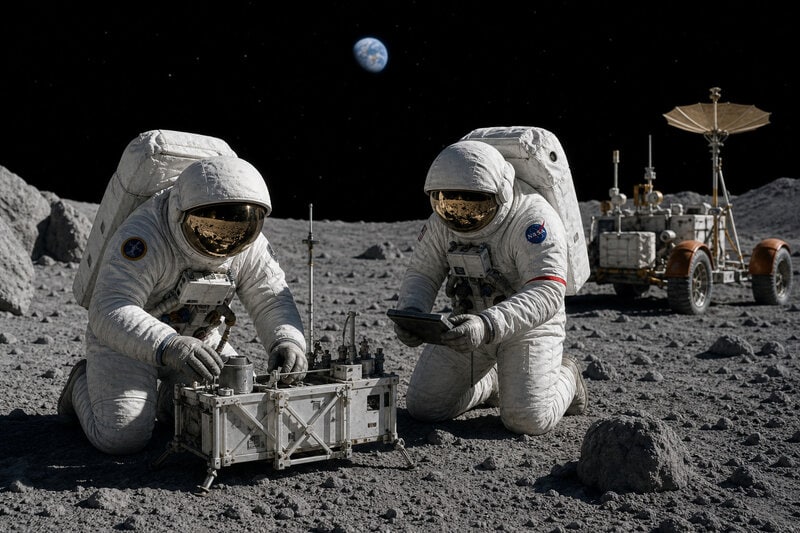
NASA and its partners have identified maximizing human efficiency during long-duration spaceflight as one of the central unsolved challenges of missions to the Moon, Mars, and beyond. Astronauts on multi-year missions cannot spend the majority of their time on manual, routine, or hazardous tasks — robotic assistants are a core part of the solution. But those robots must be extensively trained and validated before they can be trusted in environments where failure has no easy fix and no rapid resupply.
Physical test facilities like NASA’s iMETRO are rare, expensive to operate, and impossible to replicate at scale. That scarcity creates a chokepoint: promising robotic designs stall between theory and deployable hardware with no affordable path to close the gap. For most research institutions, the cost of physical testing infrastructure places serious space robotics work permanently out of reach.
The remote dimension of the platform compounds the challenge further. Remote space robotics — systems where operators control robots across meaningful distances, whether from another module within a spacecraft or from a ground station on Earth — must contend with communication delay and limited sensory feedback. Those constraints cannot be tested casually; they require a simulation environment sophisticated enough to model them as realistic operating conditions rather than edge cases.
It is broadly accepted in aerospace engineering that simulation reduces development cost and risk — established consensus, not a claim unique to iMETRO. Whether this specific platform will achieve the pace of acceleration its developers project remains to be validated by the independent research community as it begins working with the tool.
How the Simulator Works: Inside the Digital Twin
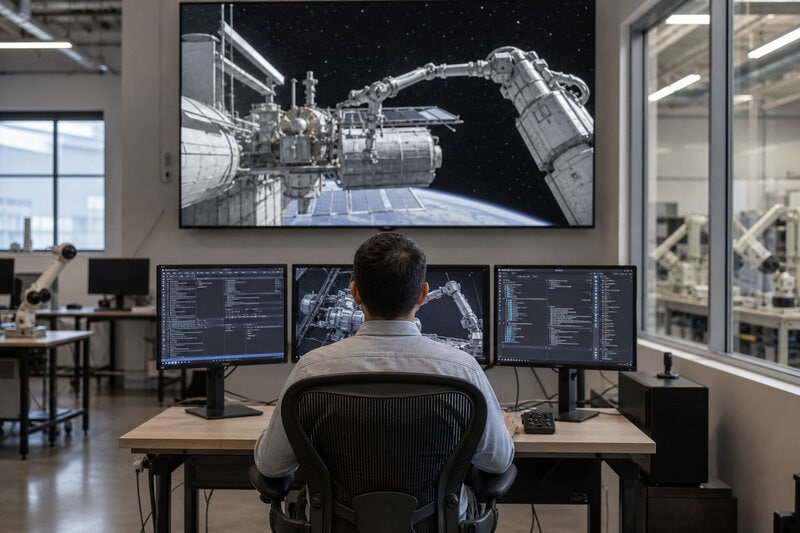
The term high-fidelity carries specific meaning here and should not be confused with the physics engines found in consumer robotics kits or video games. A high-fidelity space robotics simulator must accurately model microgravity effects, constrained-space maneuvering, robotic arm torque and range of motion, and sensor latency — conditions that interact in complex ways and cannot be approximated loosely without introducing errors that would invalidate real-world predictions.
Because iMETRO Dynamic Simulation is built as a digital twin of an existing NASA facility rather than a generalized physics sandbox, its models are grounded in measured real-world data from that facility. When a research team runs an experiment in the simulator, they are running it against parameters drawn from an actual NASA test environment. That calibration is what makes results potentially transferable to physical hardware rather than remaining confined to the virtual world.
The simulator is also designed to incorporate the realistic constraints of remote operation. Operators controlling robots at a distance face delays between commands and responses, reduced tactile feedback, and incomplete situational awareness. Modeling these constraints authentically within the simulation means that robotic systems developed here are being prepared for actual spacecraft operating conditions, not idealized ones.
One firm scope boundary bears repeating: iMETRO Dynamic Simulation targets space vehicles and structured indoor environments — spacecraft habitat and vehicle interiors. Simulation of open planetary surfaces, lunar regolith, Martian dust, or variable terrain represents a distinct class of problem that this platform does not claim to address.
Why Open-Source Changes the Equation for Space Robotics
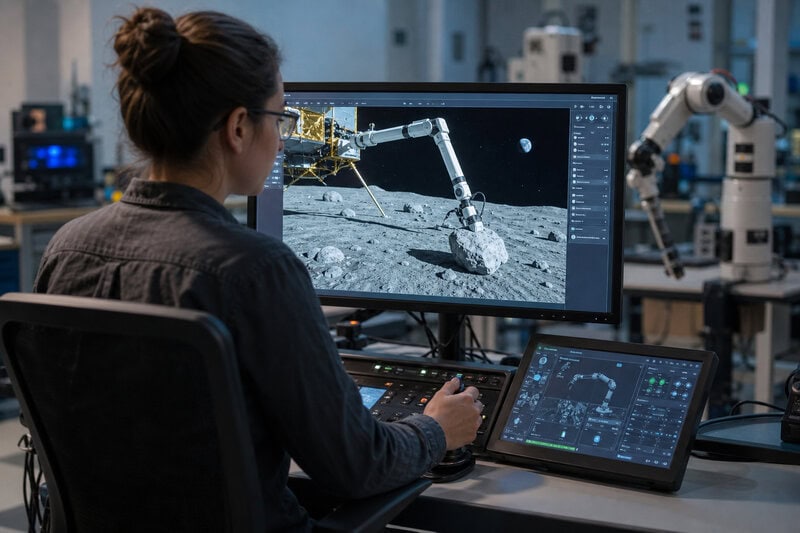
Historically, high-fidelity space robotics simulators have been internal government or contractor tools, unavailable to the broader research community. Every laboratory that wanted to work seriously on space robotics had to rebuild foundational simulation infrastructure from scratch, duplicating effort, cost, and, inevitably, error. The result was a fragmented landscape in which results from different institutions were difficult to compare and hard to build upon.
Open-source software changes that dynamic in compounding ways. When researchers worldwide can modify, improve, and publish results using the same platform, the simulator itself improves faster than any single institution could manage alone. Bugs are caught by more eyes. New capabilities are contributed by teams with different specializations. Results become directly comparable across studies, enabling the cumulative scientific progress that isolated proprietary tools cannot support.
The beneficiaries extend well beyond NASA and Rice University. Graduate researchers at institutions without large aerospace budgets gain access to a credible simulation environment they could not previously afford. International space agencies working on long-duration mission programs gain a shared starting point. Commercial space startups developing robotic systems for in-space servicing or habitat maintenance gain a testing ground that requires no government partnership to access. Robotics engineering programs gain a tool that connects coursework directly to real NASA standards.
Open-source status alone, however, does not guarantee adoption or continuous improvement. The platform’s long-term value will depend substantially on documentation quality, community support structures, and ongoing institutional commitment from both Rice and NASA. The launch is the beginning of that commitment, not its fulfillment.
Rice Engineering has shared additional context about the collaboration’s goals and historic nature in Rice Engineering’s announcement of the Rice University and NASA robotics acceleration mission.
The Rice-NASA Partnership: Why This Collaboration Matters
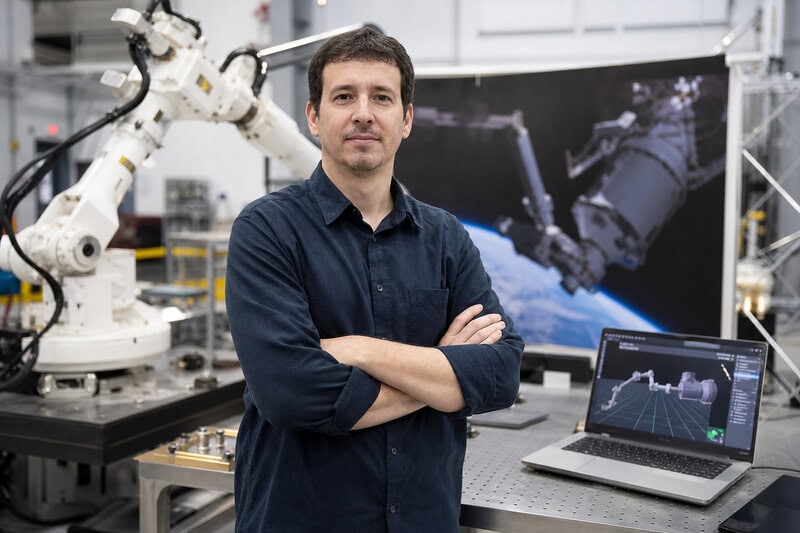
The collaboration between Rice University and NASA reflects the model of academic-government partnership that has historically produced foundational aerospace tools. Research universities bring iterative scientific inquiry, peer-review culture, and a pipeline of graduate researchers; NASA contributes physical facilities, operational expertise, and the institutional credibility that turns a promising tool into an adopted standard. Together, they give iMETRO Dynamic Simulation both scientific rigor and the legitimacy needed for other institutions to invest in using it.
The “world’s first” designation, attributed by the project’s own developers, carries real weight if it holds under scrutiny. It would mean that, until now, no equivalent open-source remote space robotics simulator existed at this level of fidelity — a gap that is notable given how central simulation has become to every other area of modern engineering. That claim warrants independent verification as the broader community engages with the platform, but the developers’ public confidence in making it reflects their assessment of the existing landscape.
NASA’s involvement also carries a concrete practical implication. A simulator built as a digital twin of an actual NASA facility means robotic systems trained within it are being tested against real physical standards, not arbitrary benchmarks invented for the platform. That connection to physical ground truth is what separates a genuinely useful simulator from a compelling demonstration.
Readers interested in the broader research infrastructure supporting this work can explore Rice University’s Ken Kennedy Institute, which supports advanced computing and data science research at Rice — relevant context for understanding the computational scale behind projects of this kind. Industry commentary on the launch’s significance is available in professional discussion of the Rice and NASA open-source simulator announcement on LinkedIn.
What is confirmed: the platform has launched, it is open-source, and it is built against a real NASA facility. What remains to be measured — by independent researchers, over time — is actual impact on mission readiness timelines, commercial space robotics development cycles, and the volume and quality of academic output the field produces as a result.
What Comes Next: Training Tomorrow’s Space Robots
The near-term research pathway the platform opens is meaningful. Teams can now design, iterate, and stress-test robotic systems in simulated spacecraft interiors before committing to physical prototypes — potentially compressing development timelines that previously spanned years of waiting for facility access or hardware funding. That compression matters most for smaller institutions that previously could not participate in space robotics research at a competitive level.
The broader human spaceflight context makes the timing consequential. As NASA’s Artemis program targets sustained lunar presence and eventual crewed Mars missions, the operational demands on robots inside spacecraft will only grow. Crew members on long-duration missions will depend on robots to handle routine maintenance, hazardous material management, and tasks that would otherwise consume hours of irreplaceable crew time. A shared simulation standard against which those robots can be designed and validated is not a minor convenience — it is a prerequisite for fielding systems that can be trusted in that environment.
The remaining gap between simulation and spaceflight should be stated plainly. Even the most accurate digital twin cannot replicate every variable of actual flight. Hardware failures follow their own logic. Material behavior in true microgravity and radiation environments introduces factors no current simulator captures completely. Unforeseen interactions between robotic systems and human crew in confined quarters will require real-world learning that no software can fully anticipate. iMETRO Dynamic Simulation is a complement to physical testing and eventual flight experience — not a replacement for either.
With that caveat acknowledged, the platform represents the shared infrastructure layer that space robotics research has been missing: an open foundation on which the next generation of space robots can be designed, tested, and — with the full validation process that follows — eventually trusted with human lives. Its significance lies not in what it accomplishes at launch, but in what it makes possible for every researcher, institution, and mission that builds on it from here.