
For twenty years, NASA’s Neil Gehrels Swift Observatory has functioned as the cosmos’s fastest 911 dispatcher — detecting the universe’s most violent explosions and alerting telescopes worldwide within seconds. In 2025, the telescope that spent two decades racing to catch dying stars found itself in its own race against gravity, its orbit silently shrinking toward the point of no return. On 3 July 2026, a robotic spacecraft called LINK, built by Katalyst Space, lifted off on a mission to intercept Swift and push it back to safety — the first commercial orbital rescue of a NASA science observatory ever attempted.
What Swift Was Built to Do — and Why It Still Matters

Swift launched in 2004 with a singular scientific purpose: to catch gamma-ray bursts, or GRBs, within seconds of their occurrence and relay precise coordinates to ground telescopes around the world. Gamma-ray bursts are intense flashes of high-energy radiation released when massive stars collapse into black holes or when neutron stars — the dense, city-sized remnants of stellar explosions — spiral together and merge. They are the most energetic transient events known to science, briefly outshining entire galaxies before fading over hours or days.
What made Swift uniquely powerful was its architecture. NASA designed Swift with three co-aligned telescopes covering gamma-ray, X-ray, and ultraviolet/optical wavelengths simultaneously. That combination allowed scientists to study a burst’s evolution from its violent birth through its fading afterglow in a single, continuous observation — something no other operational spacecraft can replicate today. The observatory has detected more than 1,400 GRBs over its lifetime, more than any other instrument in history.
The scientific returns have been profound. Swift played a direct role in the landmark 2017 multimessenger observation of GW170817, the collision of two neutron stars that simultaneously generated gravitational waves and light. Swift’s ultraviolet telescope captured the kilonova afterglow of that event — the glowing cloud of freshly forged heavy elements — helping confirm that cosmic collisions of this kind are responsible for producing gold, platinum, and other heavy metals found throughout the universe.
Beyond GRBs, Swift monitors X-ray binaries, tidal disruption events — instances where a black hole shreds a passing star — and active galactic nuclei, building a long-baseline archive that researchers use to track how some of the universe’s most extreme objects change over time. No currently operational successor carries Swift’s specific combination of rapid-response triggering and multi-wavelength follow-up, meaning its loss would leave a genuine and difficult-to-fill gap in humanity’s ability to characterize the universe’s most energetic events as they happen.
The Problem: Orbital Decay and the Threat of Uncontrolled Reentry
Swift orbits Earth at roughly 600 kilometers altitude, a region where trace amounts of atmosphere — too thin to breathe, but not too thin to matter — exert a continuous drag on any spacecraft passing through them. This process, called orbital decay, slowly lowers a satellite’s orbit over months and years until it enters the denser layers of the atmosphere and burns up. For most satellites, this is planned and manageable. For Swift, it became a crisis.
Unlike the International Space Station, which uses periodic engine firings called reboosts to maintain its altitude, Swift carries no onboard propulsion capable of counteracting atmospheric drag. Its orbit has been shrinking steadily since 2004. Without intervention, that decay would eventually lead to an uncontrolled reentry — an outcome that poses two distinct problems. First, it would end the mission abruptly, destroying two decades of irreplaceable calibrated scientific infrastructure. Second, depending on the trajectory of reentry, fragments of the spacecraft could survive atmospheric heating and reach the ground, scattering debris over areas that cannot be predicted far in advance.
NASA’s decision to pursue an external commercial rescue rather than simply allowing a controlled deorbit reflects a clear-eyed assessment of Swift’s continued value. Replacing Swift’s unique rapid-response capability would require years of development and hundreds of millions of dollars — a cost-benefit calculation that makes a commercial servicing mission look relatively attractive by comparison.
Enter LINK: How Katalyst Space Plans to Pull Off the Rescue
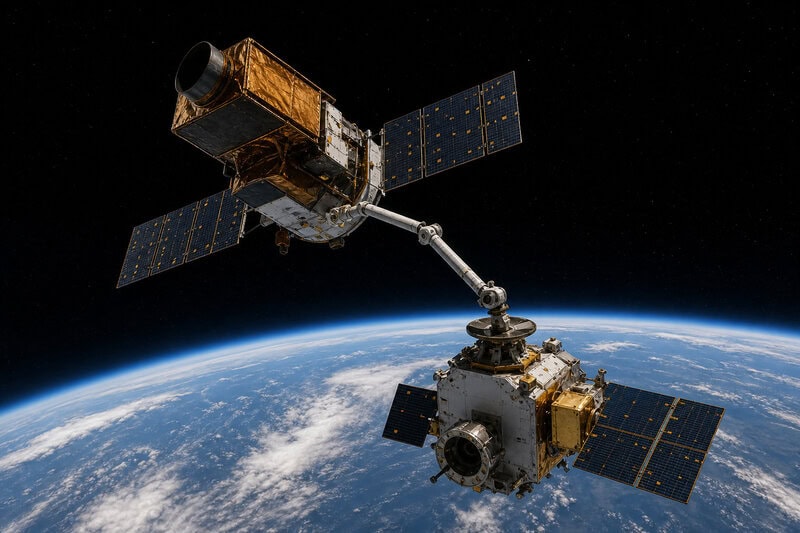
NASA awarded Katalyst Space a contract under its on-orbit servicing initiative to develop LINK, a robotic servicer spacecraft designed to rendezvous with Swift, capture it, and reboost it to a higher, stable orbit. The mission is entirely robotic — no astronauts are involved, and no human hands will touch Swift during the operation. Katalyst’s goal is to meet up with the falling observatory and raise it to a higher orbit using LINK’s robotic capture capabilities — a technique sometimes described informally as an orbital tow.
The central engineering challenge is that Swift was never designed with servicing in mind. It carries no standardized docking ports, no grapple fixtures, and no interfaces built to accommodate an external spacecraft latching on. LINK must therefore use robotic capture mechanisms to grapple with an object whose geometry was designed for science, not servicing — a task that demands extraordinary precision at orbital velocities where errors cannot be corrected manually and milliseconds matter.
Once attached, LINK would fire its own propulsion system to raise Swift’s orbit, effectively converting the servicer’s fuel reserves into new altitude for the observatory. If the capture and reboost succeed, the mission would not merely prevent reentry — it could meaningfully extend Swift’s operational life, giving the science community additional years of observations from a platform whose calibration history and performance characteristics are already thoroughly understood after two decades of operation.
Why This Engineering Problem Is Harder Than It Looks
On-orbit servicing is not new. Northrop Grumman’s Mission Extension Vehicle program has successfully docked with and extended the lives of commercial communications satellites, establishing that robotic servicing is technically feasible. But those missions targeted satellites specifically designed with docking interfaces, whose operators were expecting a servicing visit. Swift represents a meaningfully harder problem: a science spacecraft with complex, fragile instruments, irregular geometry, and no pre-installed hardware for receiving a visiting vehicle.
LINK must execute a precise orbital rendezvous — matching Swift’s speed, altitude, and attitude autonomously — before any capture attempt can begin. At roughly 600 kilometers altitude, both spacecraft are moving at approximately 7.5 kilometers per second. Ground controllers cannot intervene in real time; communication delays and the tight geometry of proximity operations mean that LINK’s onboard systems must make critical decisions faster than any human operator could. A collision during the approach would not merely fail the rescue — it could shatter Swift and create a debris field at an altitude used by hundreds of other spacecraft.
The capture itself requires LINK to physically grasp a spacecraft that was designed to point telescopes at the sky, not to be grabbed. Engineers have had to identify structural elements on Swift robust enough to bear the loads of a docking and reboost without damaging the observatory’s instruments or its solar arrays. That analysis, conducted remotely using decades-old design documents and models, illustrates how much engineering judgment the mission demands before a single thruster fires.
The Science at Stake: Why Losing Swift Would Hurt
Swift’s rapid-alert system has become a cornerstone of time-domain astronomy — the study of cosmic events that change on timescales of seconds to years. Within roughly a minute of detecting a gamma-ray burst, Swift transmits precise coordinates to an international network of ground-based and space-based telescopes, allowing those instruments to begin observations while the burst is still evolving. That speed is not a luxury; GRB afterglows fade quickly, and the first minutes of observation frequently contain information unavailable at any later time.
The observatory’s contributions extend well beyond any single discovery. Its long-baseline archive of X-ray observations spans two decades of cosmic variability, giving researchers the ability to compare how objects like active galactic nuclei — the intensely bright cores of galaxies powered by supermassive black holes — have changed over time. Archives of this kind, built over years of consistent observation with a single well-characterized instrument, cannot be replicated quickly or cheaply. A new observatory launched tomorrow would need years of operation before its dataset approached Swift’s depth and continuity.
The loss of Swift would represent a genuine gap in humanity’s ability to monitor and respond to the universe’s most energetic transient events — not just a gap in data collection, but a gap in the real-time alert infrastructure that an entire generation of astronomers has built their observing strategies around.
Broader Context: Commercial Servicing as NASA’s New Strategy
The LINK mission fits within NASA’s broader philosophical shift toward treating low-Earth orbit infrastructure as maintainable rather than disposable — an approach that mirrors how the aviation and maritime industries manage long-lived, high-value assets. Rather than building spacecraft to be used once and discarded, the agency is exploring whether commercial partners can extend the operational lives of government science assets at a fraction of the cost of building replacements.
If LINK succeeds, the implications extend well beyond Swift itself. NASA operates a fleet of aging observatories whose orbits are decaying or whose propellant reserves are nearly exhausted. A proven template for commercial orbital rescue could reshape how the agency plans mission lifetimes from the outset — encouraging engineers to design future spacecraft with servicing interfaces as a standard feature rather than an afterthought, and prompting program managers to budget for servicing missions the way an airline budgets for maintenance rather than replacement. The economics, if LINK’s approach proves repeatable, could be compelling: a servicing mission that costs tens of millions of dollars is a very different proposition from a replacement observatory that costs hundreds of millions and requires a decade to build and launch.
What Success Looks Like — and What Remains Uncertain
A successful LINK mission would be defined by four sequential achievements: a controlled rendezvous with Swift, a stable robotic capture of the observatory, a confirmed reboost to a higher and sustainable orbit, and a safe separation leaving Swift to continue operating independently. Each step carries its own engineering risk, and each must be executed with precision by systems operating autonomously in an environment where communication delays and orbital mechanics leave no margin for improvisation.
It is important to be clear about what the mission can and cannot accomplish. LINK can counteract orbital decay by raising Swift’s altitude and buying additional years before drag becomes critical again. It cannot repair aging instruments, replace consumables inside the observatory, or reverse the effects of two decades of radiation exposure on Swift’s detectors. The observatory’s scientific productivity after a successful rescue will depend heavily on the health of its hardware — factors that lie entirely beyond the reach of any orbital tow.
The precise duration of the life extension a successful reboost would deliver has not been publicly quantified; it depends on the new orbital altitude achieved, the rate of atmospheric drag at that altitude, and the ongoing health of Swift’s systems. What is not in doubt is the ambition of what is being attempted. LINK lifted off on 3 July 2026, and its outcome will be watched closely by the astronomy community and the space industry alike — a test not only of one company’s technology, but of whether humanity has learned to treat the tools it builds to understand the cosmos as worth fighting to preserve.