
More than 500,000 stars blaze in a single frame — a number that rivals the population of a major metropolitan area — and every one of them belongs to a structure older than Earth itself. NASA’s Hubble Space Telescope has photographed Messier 3, a globular cluster so extraordinarily dense it resembles a cosmic snow globe suspended in deep space. Its stars radiate genuine red, white, and blue hues, making it an uncommonly fitting subject for a landmark national celebration.
Half a Million Stars, One Extraordinary Image
NASA released a new Hubble Space Telescope image of Messier 3 to mark the United States’ 250th anniversary. The timing was deliberate, but the science behind the photograph stands entirely on its own — independent of any calendar date and remarkable by any astronomical standard. The resulting image captures more than 500,000 individual stars in extraordinary resolution, placing it among the most detailed globular cluster photographs in Hubble’s three-decade archive.
The visual effect is immediate and striking. Stars crowd the frame so densely toward the cluster’s core that they appear to merge into a single luminous mass, then gradually thin toward the edges in a pattern that mirrors a shaken snow globe settling back to stillness. What makes the scene even more arresting is its color palette: the stars genuinely blaze in red, white, and blue. NASA applied no patriotic filter — those colors reflect real differences in stellar temperature, age, and composition. The coincidence of authentic astrophysics and national symbolism is, by any measure, unusually precise.
What Is Messier 3?
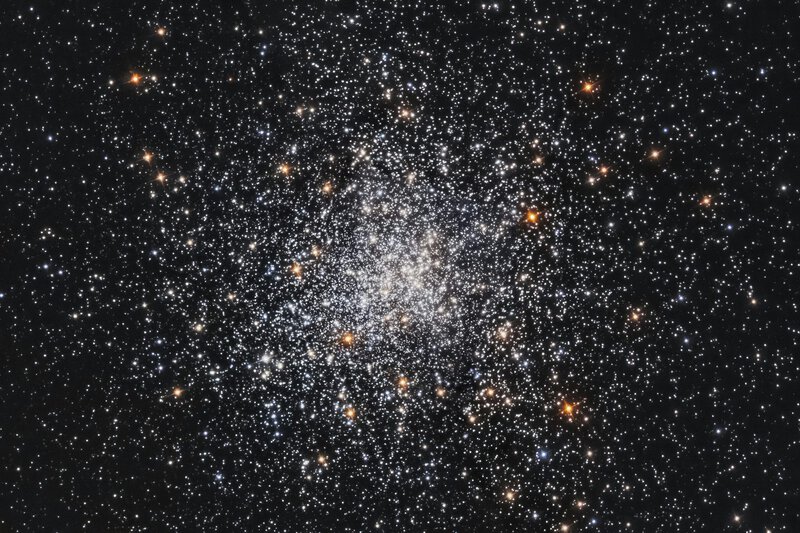
A globular cluster is a tightly bound, roughly spherical collection of hundreds of thousands of ancient stars held together by mutual gravity, typically orbiting in the outer halo of a galaxy rather than within its flat disk. These are not random, loose groupings. They are coherent, long-lived communities — gravitationally locked together for billions of years — and they rank among the oldest structures astronomers have identified anywhere in the observable universe.
Messier 3 is one of the largest and brightest globular clusters associated with the Milky Way. French astronomer Charles Messier catalogued it in 1764, and it has been studied continuously ever since, accumulating a scientific record spanning centuries of observation. The cluster sits approximately 34,000 light-years from Earth, meaning the light captured in Hubble’s photograph left those stars tens of thousands of years before humans built the first cities — long before any written language existed to describe the night sky ancient peoples looked up at.
That distance places M3 well beyond the Milky Way’s disk, in the diffuse halo surrounding the galaxy. Its membership in the Milky Way’s family of globular clusters makes it scientifically valuable not only as an object of study in its own right, but as a data point in the broader map of how the galaxy assembled over cosmic time.
Breaking Down What Hubble Actually Captured
The scientific content of this new Hubble image of Messier 3 goes well beyond its visual appeal. More than 500,000 individually resolved stars give astronomers a dataset rich enough to study stellar populations, variable stars, and cluster dynamics at a level of detail unavailable to earlier generations of researchers.
The color science deserves particular attention, because it is frequently misunderstood. When a Hubble image shows red, white, and blue stars, those colors are not chosen for aesthetic or editorial reasons — they are grounded in physics. Cooler, older stars emit light weighted toward the red end of the visible spectrum; hotter, more massive stars burn white or blue. In an image of M3, those color differences tell a story about which stars formed early in the cluster’s history and which represent different populations within it. The red giants scattered through the frame are among the most evolved stars in the cluster; the bluer stars are comparatively hotter or more massive. Together, they create a natural color mosaic that happens, in this case, to align closely with the colors of the American flag.
The sheer resolution of Hubble’s image is what makes it scientifically useful rather than merely decorative. Ground-based telescopes struggle to separate individual stars within the densely packed core of a globular cluster because Earth’s atmosphere blurs starlight into overlapping smears. Hubble, operating above the atmosphere since 1990, eliminates that blurring entirely, allowing researchers to identify, measure, and catalogue stars that would otherwise be indistinguishable from their neighbors.
The Merger Hypothesis: Did M3 Form From a Collision?
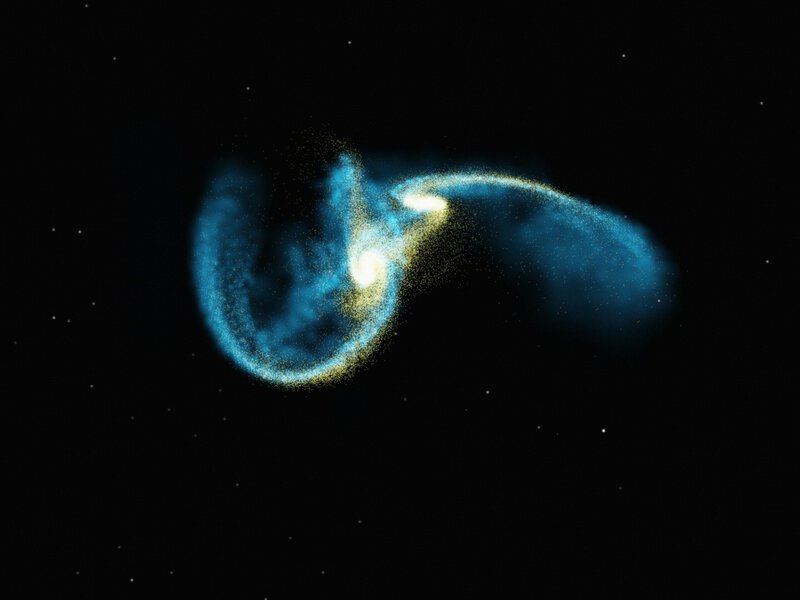
One of the more compelling — and not yet settled — questions in M3 research concerns the cluster’s origins. Researchers have proposed that Messier 3 may have formed from a merger between globular clusters, a hypothesis that could help explain certain anomalies in its stellar population that a single-origin model struggles to account for fully. This is an active area of scientific investigation, not an established consensus. It represents a compelling interpretation of available evidence, but it has not been confirmed.
The underlying mechanism, if the hypothesis holds, would work roughly as follows. When two globular clusters pass close enough to one another, their mutual gravity can draw them into a slow collision unfolding over millions of years. Stars from both clusters intermingle, and the surviving merged object inherits a mixed stellar population — stars of different ages, different chemical compositions, and different orbital histories, all bound together within a single gravitational system. Astronomers search for forensic signatures of such a merger by examining the spread of stellar properties within a cluster, looking for subpopulations that do not fit a single-generation formation story.
The rich diversity of star colors visible in Hubble’s photograph of M3 — from evolved red giants to hotter blue stars — is precisely the kind of evidence researchers examine when evaluating whether a cluster has a complex, multi-generation formation history. The image does not resolve the merger debate on its own, but its resolution and star count make it a valuable tool for the scientists pursuing that question.
Why Hubble Remains Irreplaceable for This Kind of Science
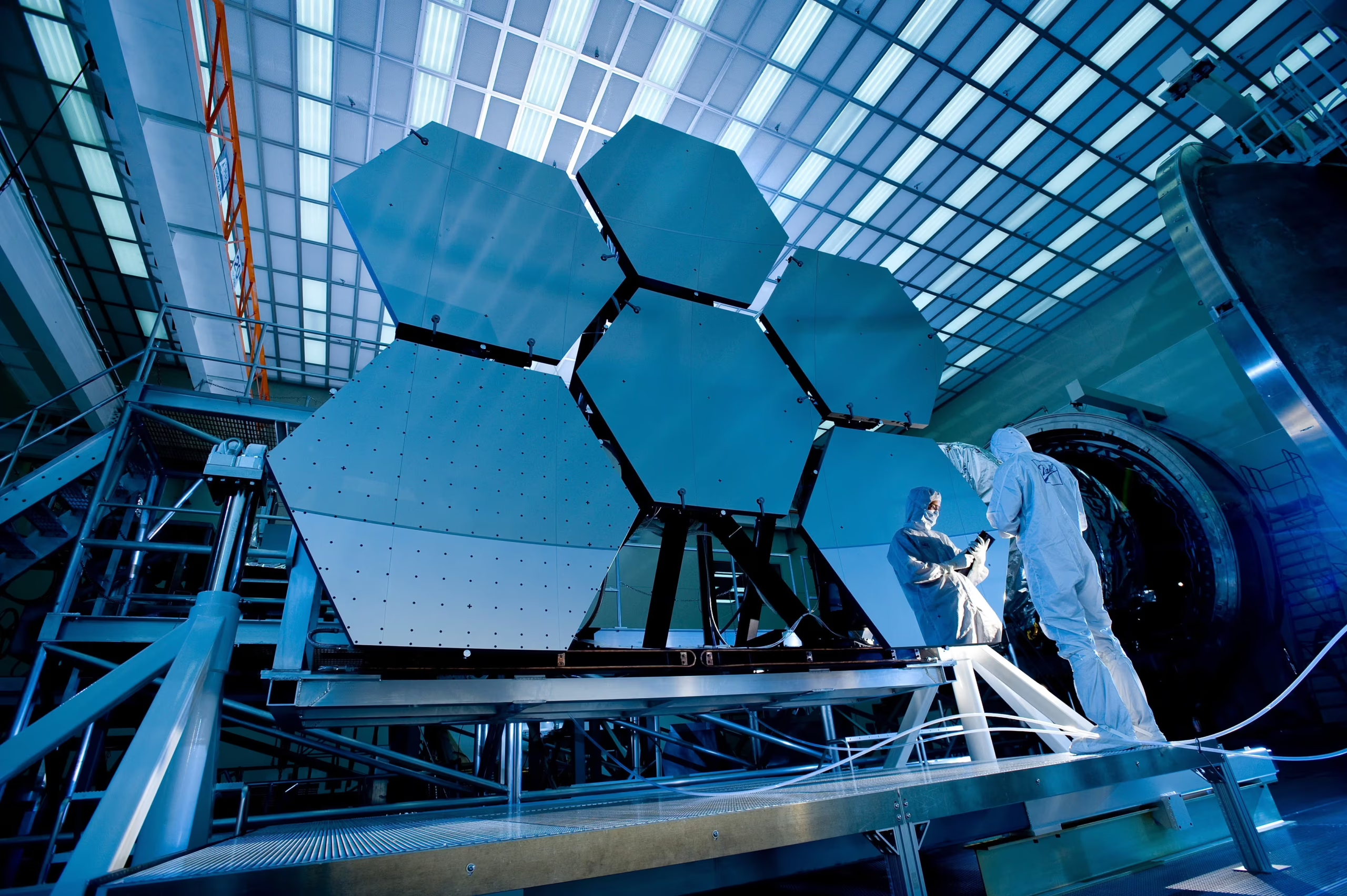
The James Webb Space Telescope, launched in late 2021, has rightly captured public attention with its extraordinary infrared views of the deep universe. But Webb and Hubble are complementary instruments, not competitors. For the specific science of characterizing stellar populations within globular clusters, Hubble retains a distinct advantage. Its sensitivity to ultraviolet and visible light — the wavelengths at which stars like those in M3 emit most of their energy — makes it particularly well suited to this work, and its archive of globular cluster observations now spans more than three decades of continuous operation.
That archive matters more than any single image. Scientists continue to extract new findings from older Hubble data precisely because the telescope captures so many stars at such high resolution that follow-up analyses — using improved computational methods, updated stellar models, or new theoretical frameworks — regularly yield results years after an image was first released. The Goddard Space Flight Center’s record of Hubble’s globular cluster work reflects an accumulation of science that no single observation, however striking, can fully represent on its own.
The Patriotic Framing: Where Science Meets National Milestone
NASA’s decision to release the M3 image in conjunction with the United States’ 250th anniversary is a curatorial choice, not a scientific one — and that distinction is worth stating clearly. The image’s value to researchers studying stellar populations, cluster dynamics, and galactic archaeology is entirely independent of its release date. Globular clusters do not care about anniversaries.
What makes the patriotic framing unusually credible rather than forced is the natural color coincidence. NASA did not adjust or manipulate the data to produce a red, white, and blue image — the physics of stellar temperature did that work without any editorial assistance. Agencies like NASA regularly time image releases to anniversaries, holidays, and cultural events as a transparent strategy for connecting broad audiences to ongoing scientific work. In this particular case, the alignment between the authentic science and the cultural moment is closer than usual, lending the release a coherence that similar efforts do not always achieve.
The image has circulated widely since its release, drawing attention from audiences who might not otherwise encounter the science of globular clusters — which, from a public engagement perspective, is precisely the outcome NASA’s communications strategy is designed to achieve.
What This Image Means for Our Understanding of the Universe
Globular clusters like M3 are among the oldest structures in the Milky Way. Studying them gives astronomers access to a fossil record of conditions in the early universe — including how stars formed when the cosmos was young, when the chemical elements available for star formation differed substantially from those abundant today, and when the galaxy itself was still assembling from smaller components. Every observation of M3 is, in a real sense, an observation of deep cosmic history.
The debate over M3’s possible merger origin connects to broader questions about how galaxies and their satellite clusters assemble over cosmic time — questions that span observational astronomy, computer simulation, and theoretical astrophysics. Whether M3 formed from a single collapsing cloud of ancient gas or from the slow collision and merger of earlier clusters matters not just for understanding M3, but for understanding the general processes by which structures like it come to exist throughout the universe.
As Hubble continues to operate and future observatories contribute complementary data at wavelengths Hubble cannot access, images like this one will remain scientific reference points — anchoring decades of comparative study. In a single photograph of Messier 3, NASA’s Hubble Space Telescope has delivered both a celebration of human history and a reminder that the universe’s own history, written in the light of half a million ancient stars, extends incomparably further back than any human milestone.