
In the days after an imaginary global switch-off of every coal plant, oil refinery, and gas burner, the atmosphere would not begin to heal — it would, paradoxically, get briefly warmer. A 2021 study published in Nature Climate Change modeled exactly that scenario and found that an abrupt, overnight halt to all fossil fuel combustion would trigger a short-term warming spike of roughly 0.5-1 °C above the then-current level before any cooling began, because the reflective haze of industrial pollution would vanish from the sky within weeks while the carbon dioxide driving long-term warming would linger for centuries. That single finding reframes the entire debate over how — not just whether — humanity needs to exit the fossil fuel era.
The Atmosphere’s Two Clocks: Fast Aerosols, Slow Carbon
To understand why an overnight shutdown produces a heat surge, it helps to think of the atmosphere as running on two radically different timescales simultaneously. Sulfate aerosols — the tiny reflective particles released when coal and oil combust — wash out of the lower atmosphere in a matter of days to weeks, much like dust settling after a storm. Carbon dioxide molecules, by contrast, persist in the atmosphere for hundreds to thousands of years, absorbed only gradually by forests, soils, and oceans. This divergence between the fast clock of aerosols and the slow clock of carbon drives almost every result in fossil fuel phase-out science.
The Intergovernmental Panel on Climate Change (IPCC) Sixth Assessment Report (AR6, 2021) documents the current state of that slow clock in stark terms: atmospheric CO₂ concentration now exceeds 420 parts per million (ppm), the highest level in at least 800,000 years of ice-core records. Roughly half of all CO₂ emitted by human activity is absorbed by land and ocean carbon sinks; the other half remains in the air, accumulating year after year.
Even if every emission ceased today, the IPCC AR6 projects an additional 0.3-0.5 °C of warming over the next two to three decades — a phenomenon scientists call committed warming, or “warming in the pipeline.” This extra heat is not from new emissions; it is stored energy that the oceans have absorbed from decades of elevated greenhouse gas concentrations and will slowly release into the atmosphere over coming decades. This two-clock problem is settled science, not a fringe hypothesis: it appears consistently across the CMIP6 ensemble, the world’s leading coordinated climate modelling project, coordinated by the World Climate Research Programme.
Scenario 1 — The Overnight Halt: A Paradox of Sudden Heat and Slow Recovery
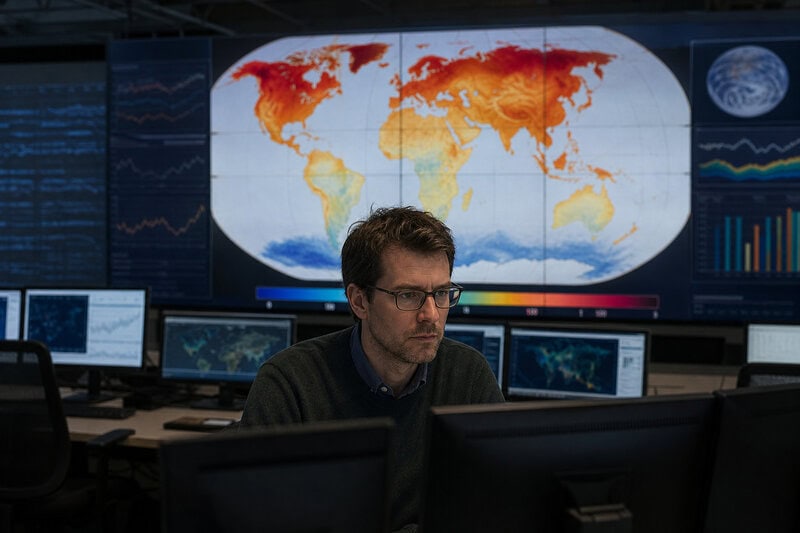
Climate modellers have run the thought experiment of an abrupt global shutdown, and the results are counterintuitive. Research by Joeri Rogelj and colleagues, published in Nature Climate Change in 2021, found that in the first decade after such a halt, global mean temperature would rise by an additional roughly 0.5 °C above the level at the moment of cessation. The mechanism is straightforward once the two-clock framework is understood: industrial aerosols, which currently act as a partial sunshade masking some of the warming from CO₂, disappear almost immediately once combustion stops. CO₂ forcing, however, declines only on a geological timescale. The result is a period scientists call the termination shock of aerosol loss — a temporary but significant unmasking of heat that was always there, hidden beneath the pollution.
After that initial spike, temperatures would plateau and begin an extremely slow descent over centuries as natural carbon sinks gradually draw down atmospheric CO₂. The IPCC cautions that this passive drawdown is far too slow to prevent severe near-term impacts — sea-level rise, intensified extreme weather, and ecosystem disruption already locked in by current concentrations — without deliberate carbon dioxide removal (CDR), meaning engineered or land-based processes designed to actively pull CO₂ out of the air.
Not everything would stall, though. Methane — a potent greenhouse gas with a roughly 12-year atmospheric lifetime, per IPCC AR6 — would decline noticeably within two decades of a halt, offering some climate relief relatively quickly. Nitrous oxide from industrial and agricultural sources tied to fossil fuel supply chains would also begin to fall. But the CO₂ signal, dominant and enduring, would define the atmospheric story for generations.
The societal dimension must be stated honestly: an overnight halt is physically conceivable inside a climate model but is functionally impossible in the real world. The International Energy Agency’s World Energy Outlook 2023 notes that fossil fuels still supply roughly 80% of global primary energy. An abrupt stop would trigger cascading infrastructure failures — in electricity grids, food supply chains, and heating systems — before any atmospheric benefit could be realized. The overnight scenario is scientifically instructive, not a policy option.
Scenario 2 — A Phased Transition Over Decades: Managed Decline, Minimised Shock
The IPCC’s pathway aligned with the Paris Agreement’s 1.5 °C limit describes a very different trajectory: emissions decline steeply through the 2030s, reach net zero around mid-century, and are supplemented by carbon dioxide removal to draw down residual atmospheric CO₂. In this scenario, climate models project peak warming of approximately 1.5 °C followed by gradual stabilisation — a much more manageable outcome than the spike-and-slow-descent of an abrupt halt.
The aerosol dynamic explains why gradualism helps. In a phased transition, aerosol pollution decreases alongside fuel use, so the masking effect fades slowly rather than vanishing in a single shock. Analysis drawing on the CMIP6 ensemble suggests this approach reduces the transient warming overshoot compared with an abrupt halt — a meaningful difference when the agreed global target is 1.5 °C and every tenth of a degree translates into measurable impacts on coral reefs, ice sheets, and human health.
Regional weather patterns also respond differently to the pace of change. Studies published in Nature Geoscience project that a managed transition preserves more stability in monsoon systems across South Asia and sub-Saharan Africa than an abrupt halt would, because gradual aerosol reduction gives large-scale atmospheric circulation patterns time to re-equilibrate rather than being jolted into rapid reorganisation that could displace billions of people dependent on seasonal rainfall for agriculture.
One element remains genuinely contested among scientists: how much residual fossil fuel use in so-called “hard-to-abate” sectors — aviation, cement production, high-temperature industrial processes — is compatible with a 1.5 °C outcome. This is an active area of climate model research, not settled consensus, and the answer has significant implications for the design of any real-world phase-out strategy.
What the Models Agree On — and Where They Diverge

Despite their differences, the models in the CMIP6 ensemble share several robust conclusions. First, the sooner and more steeply emissions fall, the lower the eventual peak warming: every decade of delay in beginning a steep decline commits roughly 0.1-0.2 °C of additional long-term warming, per IPCC AR6 Working Group I. Second, ocean heat uptake means surface temperature responses always lag behind emissions reductions by one to three decades, so the atmospheric improvements from any phase-out pathway will not feel dramatic within a single human lifetime. These two points together explain why urgency in the early years of a phase-out matters so much even though the rewards arrive slowly.
Where the models diverge is instructive. A 2023 study in Science by James Hansen and colleagues argued that industrial aerosol masking may be larger than IPCC central estimates, implying that an abrupt halt could cause a warming spike closer to 1 °C — a figure that remains actively debated by mainstream climate scientists, who question some of the study’s assumptions about aerosol forcing. The disagreement is not about whether the spike would occur, but about its magnitude.
The deepest uncertainty in post-fossil-fuel atmospheric projections lies in cloud feedbacks: how changing aerosol loads alter cloud cover, and thus how much sunlight Earth reflects back into space. The IPCC AR6 Chapter 7 explicitly acknowledges that cloud feedbacks carry the largest uncertainty in projecting climate sensitivity, and that uncertainty compounds in scenarios involving large, rapid changes in aerosol concentrations.
The Carbon Budget: How Much Room Is Left?
Central to both scenarios is the concept of the carbon budget — the total cumulative amount of CO₂ that can still be emitted while keeping global warming below a given threshold. The IPCC AR6 estimates roughly 500 gigatonnes of CO₂ remaining for a 50% chance of staying below 1.5 °C. At current global emission rates of approximately 37-40 gigatonnes per year, that budget is equivalent to only about 12-13 years of business-as-usual combustion.
This is where the political and scientific dimensions converge most sharply. The High Ambition Coalition’s open letter on fossil fuel transition states that greenhouse gas emissions must peak by 2025 at the latest and be reduced by 43% compared to 2019 levels by 2030 — a target explicitly designed to keep global emissions within that shrinking carbon budget. Missing the 2030 target does not make 1.5 °C mathematically impossible, but it makes achieving it require far more aggressive — and exponentially more expensive — carbon dioxide removal in subsequent decades.
The physics of the carbon budget are asymmetric in a way that is easy to underestimate. Emitting an extra gigatonne of CO₂ today does not simply postpone climate targets by a fixed interval; because of the cumulative nature of atmospheric warming, it forces deeper and costlier cuts in every subsequent year to compensate. The IEA describes this dynamic as “the narrowing window” — the longer the start of steep declines is delayed, the steeper and more economically disruptive those declines must eventually be.
One thing stopping fossil fuels does not fix quickly is ocean acidification. When CO₂ dissolves into seawater it forms carbonic acid, lowering ocean pH in ways that threaten shellfish, coral, and the marine food web. According to the National Oceanic and Atmospheric Administration’s Ocean Acidification Program, the full chemical equilibration of surface and deep ocean layers takes centuries, meaning acidification would continue to worsen for decades even after emissions fell to zero. The ocean, like the atmosphere, carries its own long memory of past emissions.
What a Responsible Phase-Out Actually Requires
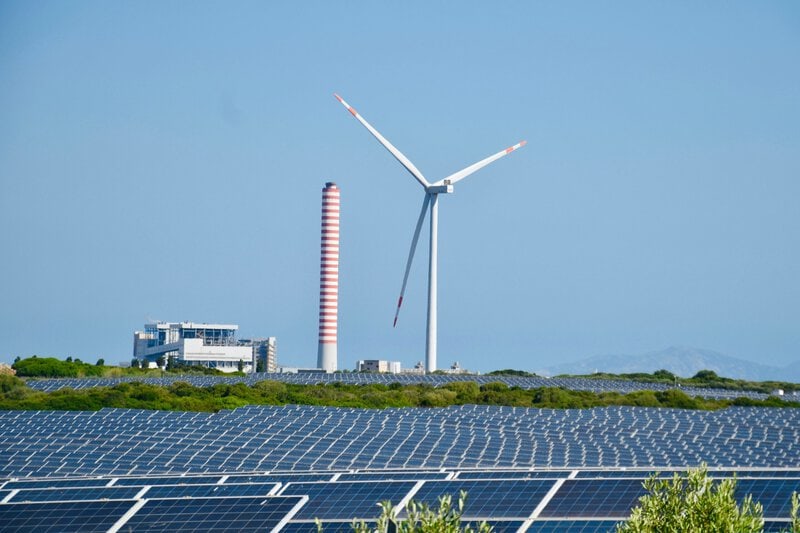
The atmospheric science points to four practical requirements for a phase-out that limits harm rather than redistributing it.
Start cuts immediately, not in the next decade. Because of committed warming already locked in and the narrowing carbon budget, delay does not simply defer costs — it multiplies them. Every year of business-as-usual combustion forecloses options that would otherwise remain open in the 2030s and 2040s.
Manage the aerosol transition deliberately. Clean-air policy and fossil fuel phase-out must be coordinated. Rapid removal of high-sulfur coal combustion — undertaken purely for public health reasons, which is entirely warranted — accelerates aerosol loss faster than CO₂ declines. Policymakers designing clean-air legislation alongside energy transition roadmaps need to account for this dynamic explicitly, rather than treating the two agendas as independent.
Invest in carbon dioxide removal at scale, but without treating it as a substitute for emissions cuts. The IPCC AR6 is clear that CDR is a complement to steep near-term emissions reductions, not a reason to slow them. Technologies such as direct air capture and enhanced ocean alkalinity remain expensive and unproven at the scales needed; relying on future CDR to compensate for present inaction is a bet the carbon budget arithmetic does not support.
Prioritise equity in the transition design. The countries and communities most dependent on fossil fuel exports and employment are frequently those least responsible for cumulative historical emissions. A phase-out that ignores this dimension will face political resistance sufficient to undermine its timeline — resistance that is, on distributional grounds, often justified. The science of how fast to move is inseparable from the politics of who bears the costs of moving.
The Takeaway: Why Timing and Rate Both Matter
The atmospheric science of fossil fuel phase-out yields a conclusion that is both sobering and clarifying: how fast emissions fall matters almost as much as that they fall. An abrupt overnight halt paradoxically worsens near-term warming before improving it, as the aerosol sunshade dissolves faster than CO₂ forcing declines. A rapid but managed phase-out over two to three decades avoids that aerosol termination shock while still keeping global emissions within the carbon budget necessary to limit peak warming to levels human societies can adapt to — provided the transition begins immediately and does not drift into the 2030s.
There is no version of halting fossil fuels that produces immediate atmospheric relief. But there is a version that limits total warming to levels human societies can adapt to, and it requires cuts beginning now rather than being deferred to a future decade — a conclusion that reflects the language of the IPCC AR6 Summary for Policymakers.
It is also worth being clear about what remains a physical reality versus what remains a policy choice. The committed warming already locked in by past emissions — that 0.3-0.5 °C still in the pipeline — is not a policy failure. It is the inescapable consequence of the CO₂ already in the air, and no decision made today can eliminate it. What remains entirely a policy choice is how much additional warming humanity adds on top of it.
The next frontier in energy transition science is whether engineered carbon dioxide removal — from direct air capture facilities that filter CO₂ from ambient air to enhanced ocean alkalinity approaches that accelerate the ocean’s natural carbon absorption — can safely compress the atmospheric recovery timeline. That question is where climate model research, and a growing share of international climate funding, is now most urgently focused. The answer will shape not just the atmosphere of the twenty-second century, but the livability of the twenty-first.