
A half-mile-wide rock shaped like a peanut is cartwheeling through space on two separate axes simultaneously — one full end-over-end spin every 10.5 days, one lurching wobble every 26.5 days — and it has been doing so for roughly 155 million years, since the age of the dinosaurs. NASA’s Lucy spacecraft has now flown past this tumbling world, called Donaldjohanson, and returned data that reframes what scientists know about water, collisions, and the chaotic early history of the solar system.
What Is Donaldjohanson? Anatomy of a Peanut-Shaped World
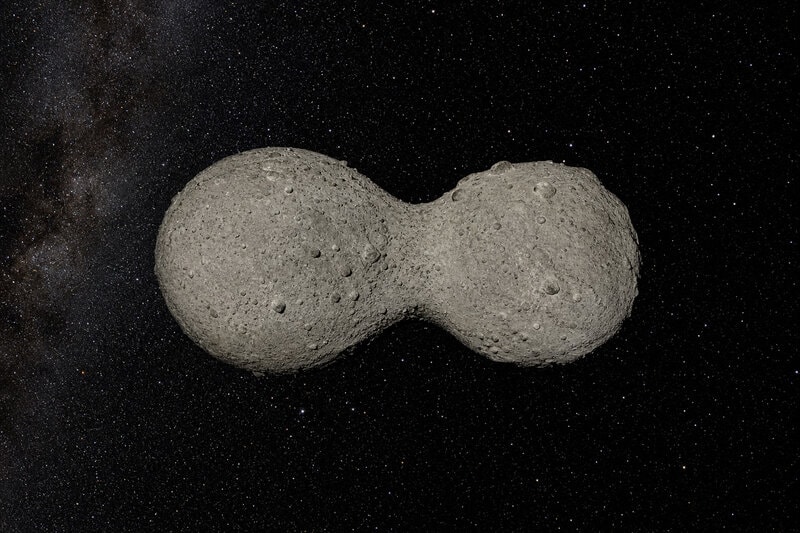
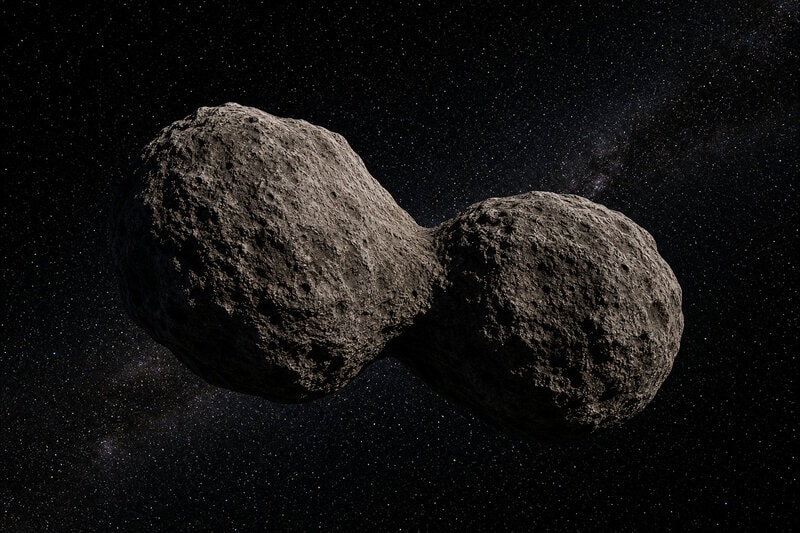
Donaldjohanson is a contact binary asteroid — a single body formed when two separate objects merged under mutual gravity, leaving a distinctive two-lobed shape joined by a narrower neck. Think of two lumpy spheres pressed together at the waist: that is the structure NASA’s Lucy spacecraft resolved in sharp detail during its flyby. At approximately half a mile, or roughly 800 meters, across its longest axis, the asteroid is small enough that a person could theoretically circumnavigate its narrow waist on foot in a matter of hours, yet massive enough to have preserved a 155-million-year geological record largely intact.
The name carries deliberate meaning. Donaldjohanson is named after paleoanthropologist Donald Johanson, discoverer of the ancient hominin fossil known as “Lucy” — a conscious nod to the mission’s namesake and its overarching theme of uncovering origins. The asteroid sits in the main belt between Mars and Jupiter, making it a waypoint target rather than one of Lucy’s primary destinations. Those primary goals lie further out, among the Trojan asteroids sharing Jupiter’s orbit. Yet this intermediate stop has already delivered findings that NASA’s Lucy mission team describes as landmark results for small-body science.
The Wobble Explained: Why Donaldjohanson Tumbles on Two Axes
Most asteroids spin like a gyroscope, rotating around a single stable axis in a predictable, steady motion. Donaldjohanson does something far stranger. It undergoes what planetary scientists call non-principal axis rotation, or tumbling: the asteroid simultaneously completes one end-over-end flip every 10.5 days and an independent wobble every 26.5 days. The result is a lurching, unpredictable motion that makes its orientation in space change continuously rather than repeating in a simple cycle.
The Lucy mission team attributes this complex rotation to two compounding factors. First, Donaldjohanson’s two lobes are unequal in size and mass, creating an asymmetric distribution of bulk that resists settling into a single clean spin. Second, the violent collision that produced the asteroid approximately 155 million years ago likely injected chaotic rotational energy into the newly assembled body — energy that has not fully dissipated in the time since. It is worth being precise: the two-axis rotation is a directly measured result from Lucy’s flyby data, while the specific trigger for the wobble remains an active area of analysis as researchers work through the full dataset.
Tumbling asteroids are relatively rare in the observed population, partly because their complex motion makes them harder to characterize remotely. Donaldjohanson’s well-documented double rotation gives researchers an unusually clean natural laboratory for understanding how angular momentum is stored and slowly dissipated in small solar-system bodies — a question with broad implications for asteroid dynamics across the belt.
Ancient Water: What the Mineral Evidence Suggests
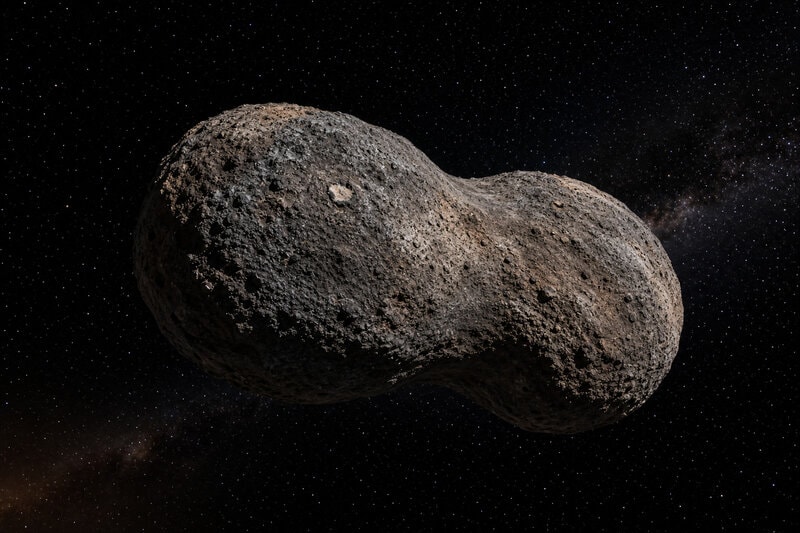
Among the most consequential findings from the Donaldjohanson flyby is the detection of spectral signatures consistent with hydrated minerals — compounds that form when liquid water chemically reacts with dry rock. Lucy’s instruments detected these signatures on the asteroid’s surface, pointing to the presence of liquid water roughly 155 million years ago, when the asteroid’s parent body was still intact.
The underlying process is called aqueous alteration. When liquid water percolates through rocky material, it converts dry silicate minerals into hydrated phyllosilicates — clay-like compounds — through a chemical reaction that leaves a distinctive fingerprint in the way a surface reflects sunlight. Spacecraft spectrometers can read that fingerprint from thousands of miles away, identifying the altered minerals without ever touching the rock.
The Lucy mission team is careful about what this finding claims. These are indicators of past hydration, not evidence of a standing body of water on Donaldjohanson itself. The signal most likely reflects aqueous alteration that occurred within the larger parent body before the collision that shattered it and eventually produced Donaldjohanson. The asteroid is, in that sense, a surviving fragment of a once-wetter world. That interpretation aligns with a growing body of evidence: hydrated minerals have been confirmed on other asteroids, most notably by NASA’s OSIRIS-REx mission at Bennu and JAXA’s Hayabusa2 at Ryugu, lending weight to the view that liquid water was once widespread in the early asteroid belt. Whether that applies broadly across the belt remains an open research question.
Birth of a Contact Binary: A Violent Collision 155 Million Years Ago
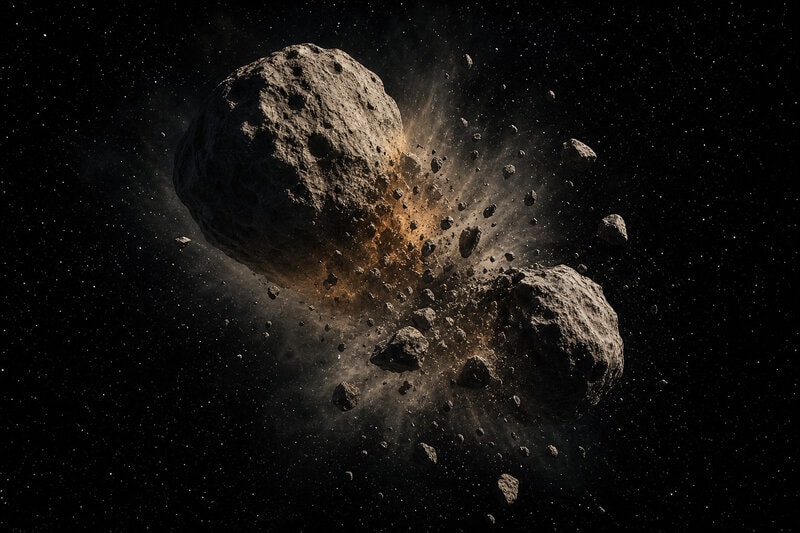
The origin story of Donaldjohanson, as reconstructed by the Lucy mission team, begins with destruction. Approximately 155 million years ago — during the Jurassic period, when large theropod dinosaurs dominated the land — a larger parent body suffered a high-energy impact that shattered it into fragments. Those fragments, still loosely bound by their mutual gravity, did not disperse entirely into space. Instead, they gradually reaccumulated, with two larger chunks settling against each other to form the characteristic peanut shape visible today.
The narrow neck connecting Donaldjohanson’s two lobes is particularly valuable scientifically. Its shape, width, and material properties constrain the speed and geometry of that reaccumulation process — essentially recording in rock how fast and at what angle the two lobes came together. That information helps planetary modelers refine their simulations of how contact binaries form, a process that appears to be common across the solar system but is poorly constrained by direct observation. As with the wobble’s trigger, the 155-million-year formation age and collision origin represent the Lucy team’s current best interpretation of the flyby data and remain subject to revision as the full dataset is analyzed.
Researchers studying the Donaldjohanson findings have highlighted how rare it is to obtain this combination of rotational, compositional, and morphological data from a single flyby of a contact binary — making the dataset a new reference point for scientists studying how small bodies coalesce and evolve.
Lucy’s Instruments: How the Spacecraft Made These Discoveries
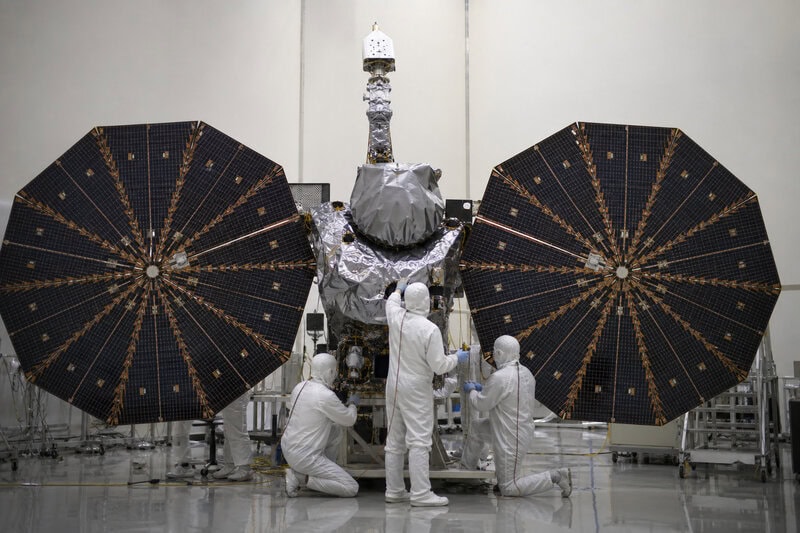
NASA’s Lucy spacecraft launched in October 2021 and is currently on a 12-year mission to study the Trojan asteroids — ancient, primitive bodies that share Jupiter’s orbit and are thought to be survivors from the solar system’s earliest epoch. Lucy’s looping trajectory carries it through the main asteroid belt multiple times, creating opportunities for flybys of intermediate targets like Donaldjohanson that lie along its path.
The flyby itself lasted only a matter of hours. During that window, Lucy deployed a suite of instruments — including visible-light cameras, infrared spectrometers, and thermal imagers — to capture as complete a portrait of Donaldjohanson as its brief passage allowed. The spacecraft’s L’Ralph spectrometer, which analyzes the wavelengths of sunlight reflected from a surface to identify chemical compounds, is the instrument responsible for detecting the hydrated mineral signatures. Crucially, the same instrument will later examine the Trojan asteroids, allowing scientists to make direct compositional comparisons between main-belt bodies and the outer solar system’s more primitive population.
That comparison is one of the most scientifically valuable aspects of Donaldjohanson’s role in the mission. It serves as a calibration point: a well-characterized asteroid whose data the Lucy team can place beside future Trojan results to determine whether water-bearing minerals are broadly distributed across the outer solar system or concentrated in specific dynamical regions.
Why This Matters: Water, Earth’s Oceans, and the Belt’s Chaotic Past
Taken together, Donaldjohanson’s hydrated minerals and contact-binary structure suggest that the early main asteroid belt was a more dynamic and water-rich environment than some earlier models assumed. That has direct implications for one of planetary science’s most debated questions: how water arrived on Earth.
One leading hypothesis holds that water-bearing asteroids and comets delivered much of Earth’s ocean inventory through impacts during the solar system’s early, turbulent period. Every asteroid confirmed to carry ancient hydration markers adds statistical weight to that hypothesis. The question of Earth’s water origin, however, remains genuinely contested among researchers, and no single asteroid finding resolves it.
What Donaldjohanson does provide is an unusually detailed record from a single body: the age of a collision, the geometry of a reassembly, the chemical signature of past water, and a precisely measured rotation state — all captured in one flyby. Scientists analyzing the Lucy data have described this combination as unprecedented for a contact binary asteroid studied at this level of resolution.
With the Trojan asteroids still ahead on Lucy’s itinerary, the Donaldjohanson flyby functions less as a conclusion than as an opening chapter. The peanut-shaped, wobbling, once-watery rock that has been tumbling through space since the Jurassic is now, 155 million years later, helping scientists read the solar system’s earliest geological record — one flyby at a time.