
During atmospheric reentry, the outer surface of a returning spacecraft can exceed 3,000°F (1,650°C) — hot enough to melt structural steel — yet the astronauts seated just a few feet inward remain in shirtsleeve comfort. That visceral contrast is not magic; it is the product of decades of aerospace physics research. SpaceX’s Starfall reentry capsule is designed to prove the next generation of those solutions works under real operational conditions.
What Is the Starfall Mission, and Why Does It Matter?
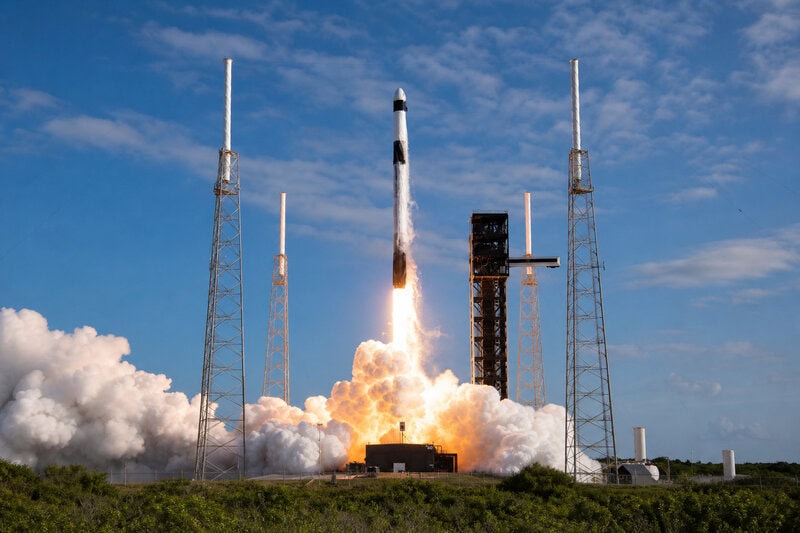
SpaceX launched the Starfall Demo mission aboard a Falcon 9 rocket from Space Launch Complex 40 (SLC-40) at Cape Canaveral Space Force Station on Florida’s Space Coast. A live webcast began approximately 10 minutes before liftoff on SpaceX’s website and on X (@SpaceX), with additional live video coverage available on YouTube for viewers worldwide.
According to Gunter’s Space Page, SpaceX has planned two missions in this series — Starfall Demo 1 and Starfall Demo 2 — whose shared primary objective is to demonstrate the performance of the Starfall reentry capsule under operational conditions. That phrasing carries real engineering weight: ground simulations, wind tunnels, and computational fluid dynamics models can approximate reentry, but they cannot fully replicate the complex, coupled behavior of plasma, ablating materials, and structural loads that occur in actual flight. Flying hardware and collecting real data is the only way to close that gap.
The choice of SLC-40 is deliberate. The launch azimuth allows the capsule to reenter over open ocean, giving engineers a controlled recovery environment to measure thermal performance and structural response without risk to populated areas. A second mission — Starfall Demo 2 — is also planned, suggesting SpaceX intends an iterative test campaign in which findings from the first flight inform the configuration or flight profile of the second, consistent with the company’s established build-fly-learn engineering philosophy.
One important distinction is worth stating clearly: while the underlying physics of atmospheric reentry are well understood and represent broad scientific consensus, the specific performance envelope of the Starfall capsule — including its heat shield material composition and ablation rate — remains proprietary and has not been independently verified by third parties at this stage. What follows is an explanation of the established science that governs all reentry vehicles, applied to what is publicly known about Starfall.
Reentry Plasma Explained: What Actually Creates the Heat
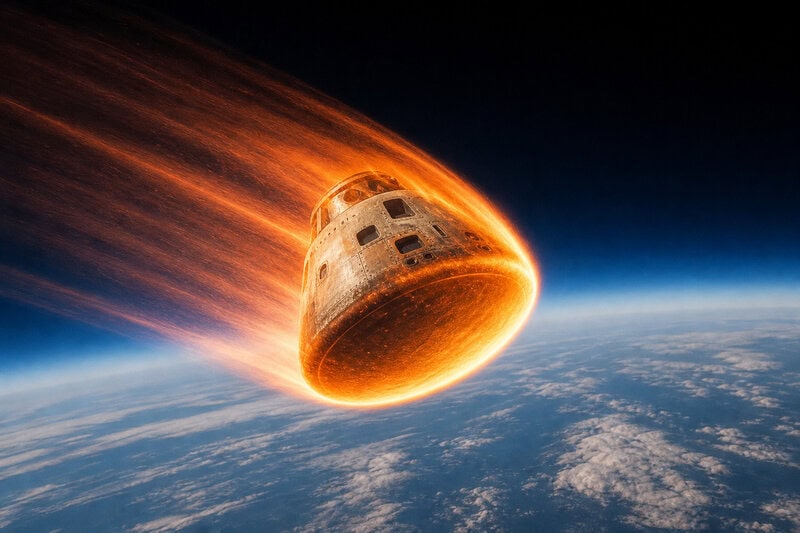
A common misconception is that a spacecraft heats up during reentry primarily because of friction — like a match head striking a matchbox. Friction plays a minor role, but it is not the dominant mechanism. The primary driver of extreme heating is aerodynamic compression: at orbital speeds of roughly 17,000-25,000 mph (27,000-40,000 km/h), the vehicle slams into air molecules so violently and so rapidly that the gas cannot flow out of the way fast enough. The kinetic energy of that collision converts almost entirely into heat. This mechanism is well established in NASA’s aerothermodynamics research literature and is not specific to any single vehicle.
The compressed air ahead of the capsule reaches temperatures high enough to strip electrons from their parent molecules — a process called ionization. The result is a superheated, electrically charged state of matter known as plasma. This reentry plasma forms a luminous sheath around the vehicle, visible from the ground as the iconic fireball streak across the sky.
That plasma sheath creates a secondary engineering challenge beyond heat. Ionized gas absorbs radio waves, causing a temporary communications blackout that mission controllers must plan around — a well-documented phenomenon with no straightforward fix beyond waiting for the vehicle to decelerate enough for the plasma to dissipate.
The peak heating zone typically occurs between roughly 200,000 and 60,000 feet altitude. At that band, the atmosphere is dense enough to cause severe compression heating while the vehicle is still traveling at hypersonic speeds. Peak stagnation-point temperatures — measured at the single hottest spot on the heat shield’s leading face — can reach approximately 2,700°F to 3,000°F (1,480°C-1,650°C) for low-Earth-orbit reentries. Faster lunar-return trajectories, where a vehicle enters at roughly 25,000 mph rather than 17,500 mph, can push stagnation temperatures above 5,000°F (2,760°C). The duration of peak heating is brief — often two to four minutes — but the total accumulated heat load over the full descent is substantial, and that cumulative figure, not just the peak temperature, governs how thick an ablative heat shield must be.
How Heat Shields Work: The Blunt-Body Insight and Ablation
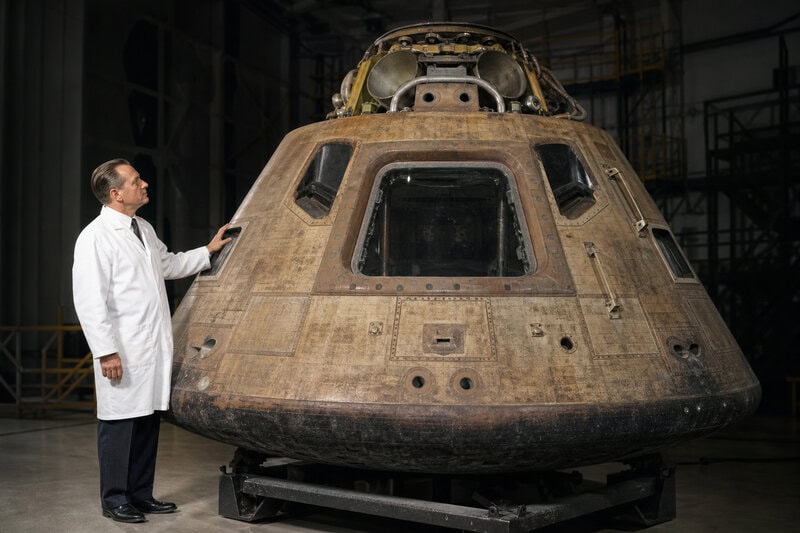
The foundational engineering principle behind modern reentry heat shields is the blunt-body concept, first formalized by physicist H. Julian Allen at NASA Ames Research Center in the 1950s. Allen’s counterintuitive finding was that a rounded, blunt nose shape is dramatically safer during reentry than a sharp, streamlined one. A blunt body creates a detached bow shock wave — a standing wall of compressed gas that sits slightly ahead of the vehicle’s surface. Most of the plasma’s energy is deposited into that shock layer and shed to the sides rather than being conducted directly into the structure. A sharp nose, by contrast, attaches the shock to the surface and channels heat directly into the material. The blunt-body insight is why every crewed reentry capsule in history — Mercury, Gemini, Apollo, Soyuz, Dragon — has a rounded, wide heat shield face pointing into the direction of travel.
The heat shield itself on most crewed vehicles is made of ablative material — a substance engineered to char, vaporize, and carry heat away from the surface in a controlled process called ablation. Ablation is sacrificial by design: the material absorbs and dissipates energy through phase changes and mass loss rather than conducting heat inward toward the crew. Think of it as a precisely engineered candle that burns outward instead of inward.
The benchmark ablative material for modern commercial capsules is PICA — Phenolic Impregnated Carbon Ablator — developed by NASA Ames Research Center. PICA was first flight-proven on the Stardust sample-return mission in 2006, which returned from a comet flyby at one of the fastest reentry speeds ever recorded for a human-made object. SpaceX subsequently licensed and adapted PICA for the Dragon capsule’s heat shield. Whether Starfall uses PICA, a derivative, or an entirely different ablative formulation has not been publicly disclosed by SpaceX.
Between the ablative outer layer and the pressurized cabin sits a secondary insulation layer and a structural standoff architecture — physical gaps and low-conductivity supports that prevent the hot outer skin from directly contacting the inner pressure vessel. This standoff approach is essential for keeping structural temperatures within material limits even when the outer aeroshell surface glows at thousands of degrees. Once any residual heat does migrate inward, the vehicle’s Environmental Control and Life Support System actively removes it, maintaining cabin temperatures within the standard human tolerance range of approximately 65°F to 80°F (18°C-27°C).
The Reentry Corridor: A Few Degrees Between Safe and Catastrophic
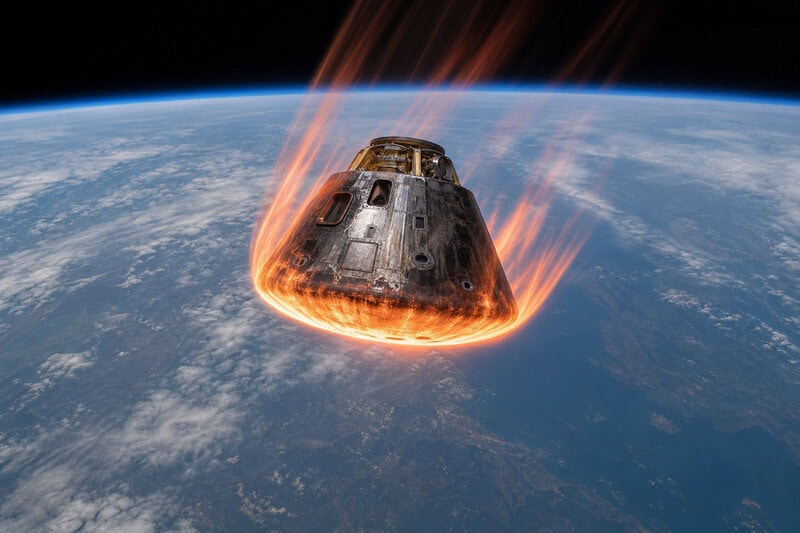
Beyond material science, the geometry of how a capsule enters the atmosphere matters enormously. The safe reentry corridor is typically only a few degrees wide in terms of flight-path angle. Enter too steeply and heating rates spike toward the upper survivable limit within seconds, potentially overwhelming the heat shield faster than it can ablate safely. Enter too shallowly and the capsule skips off the upper atmosphere like a flat stone on water, sailing back into space — a scenario that has driven reentry trajectory design since the earliest crewed programs.
Hitting that narrow corridor consistently requires guidance systems to perform accurately after the communications blackout ends, at a point when the vehicle has already committed irrevocably to its reentry path. Validating that guidance, navigation, and control systems perform as modeled during the actual reentry event — not just in simulation — is a prerequisite for certifying any vehicle for crewed use, and it is one of the core reasons demonstration missions like Starfall carry genuine scientific value.
What to Watch For — and What Comes Next

For observers following the live coverage from Spaceflight Now or the WESH 2 News Facebook livestream, the most visually dramatic moment will be reentry itself — when the capsule becomes visible as a bright streak and ground-based cameras may capture the plasma glow — expected approximately 30 to 45 minutes after launch, depending on the orbital insertion profile.
The key data products engineers will analyze after recovery include:
- Heat-flux measurements from sensors embedded in the heat shield, revealing how thermal energy was distributed across the surface and whether it matched pre-flight models
- Peak deceleration loads recorded by onboard accelerometers, which validate structural models and confirm the vehicle stayed within design limits
- Post-recovery inspection of ablative material loss, allowing engineers to compare actual ablation depth against computational predictions — the most direct check on heat shield performance
- Reconstructed telemetry from the communications blackout period, recovered from onboard recorded data after splashdown
Together, these measurements allow engineers to close the loop between simulation and reality — the core scientific rationale for any reentry demonstration mission. Findings from Starfall Demo 1 will then inform design or flight profile adjustments for Starfall Demo 2, completing an iterative validation cycle that is standard practice in aerospace vehicle development.
The broader context is significant. As NASA’s Artemis program targets lunar return trajectories — which impose reentry speeds and heat loads meaningfully higher than low-Earth-orbit missions — and as commercial spaceflight expands the number of vehicles and operators in the market, the industry needs a larger toolkit of validated, cost-effective reentry solutions. Starfall Demo represents one company’s effort to build and prove that toolkit in the most reliable way aerospace engineering knows: by flying into the fire and measuring exactly what happens.