
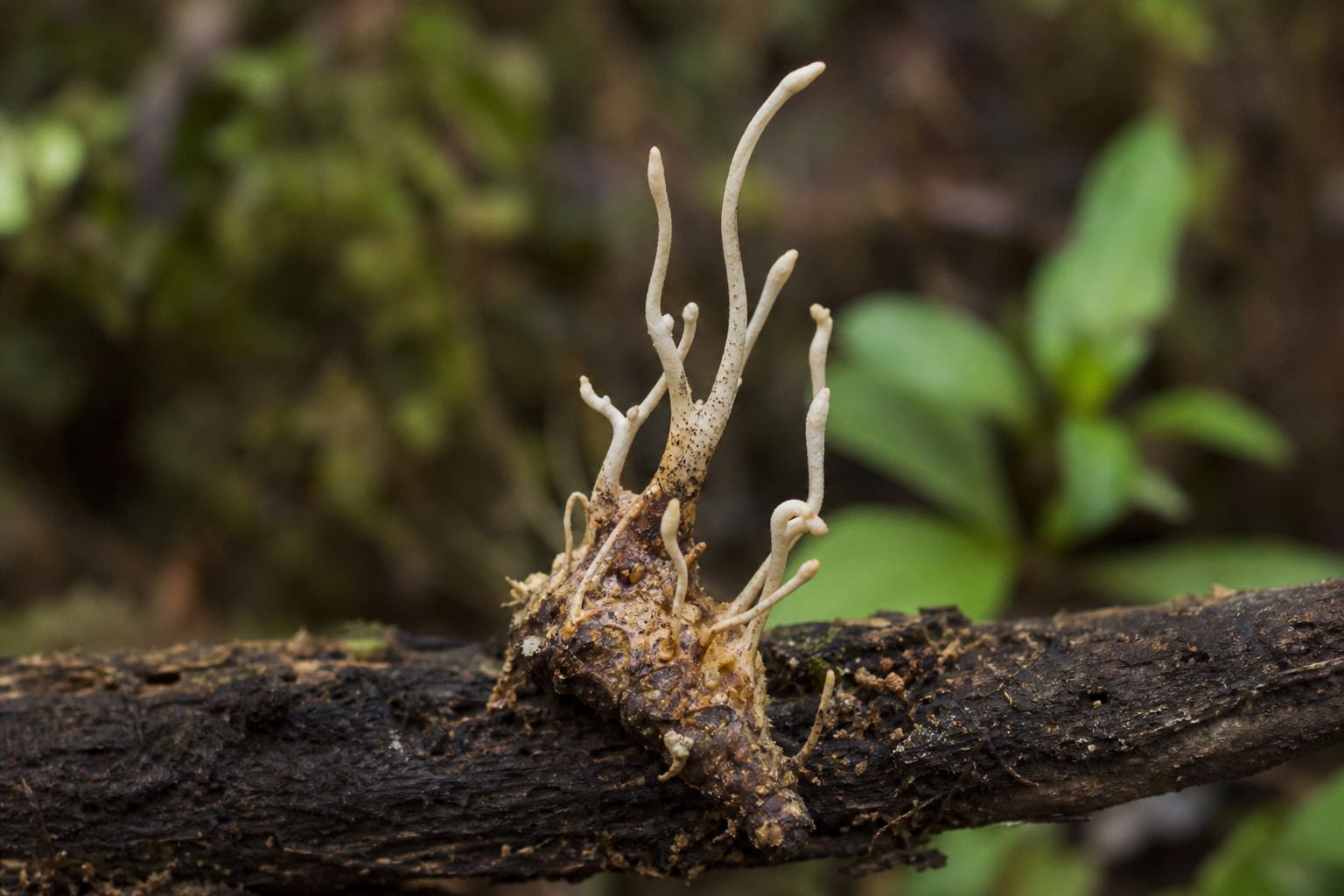
Deep in the layered green chaos of Malaysian Borneo’s rainforest, scientists have found a fungus that does something no formally described fungus of its kind has ever been documented doing: it parasitizes another parasite, infiltrating a so-called zombie fungus that was already in the process of killing and colonizing a living insect. The discovery of Pleurocordyceps cornusynnemata — named for the striking horn-shaped reproductive structures that set it apart from every other member of its genus — represents what researchers have called a world first in parasitology.
What Is a Hyperparasite, and Why Does This One Matter?
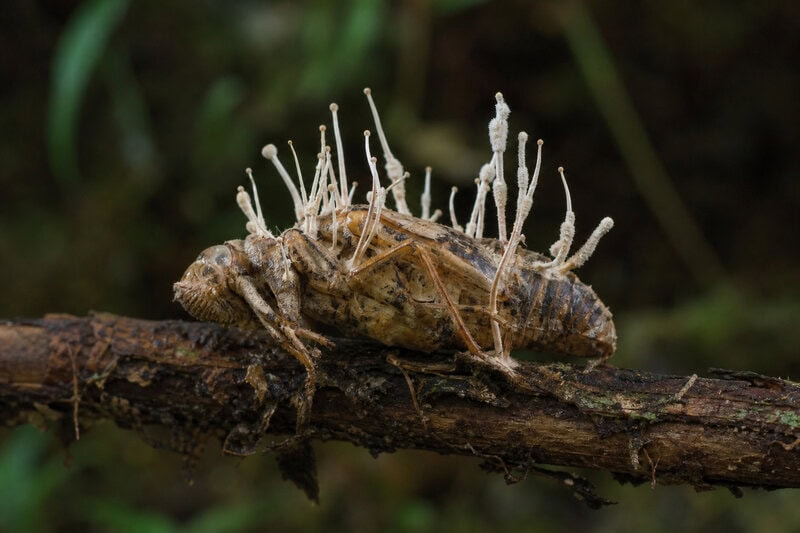
A hyperparasite is an organism that parasitizes another parasite — meaning its immediate host is not a free-living organism but one that is itself surviving by exploiting a third species. The result is a chain of ecological exploitation nested at least two levels deep: host, parasite, and parasite of the parasite. While hyperparasitism is a recognized phenomenon in virology and in certain agricultural fungi, a horn-shaped fungal hyperparasite targeting an entomopathogenic zombie fungus had never been formally documented before this find, according to the researchers involved in the discovery.
The distinction between ordinary parasitism and hyperparasitism is more than semantic. Standard parasites evolve strategies for locating, colonizing, and exploiting healthy host organisms. Hyperparasites must accomplish something considerably more specialized: they must locate a host that is itself locked in an active parasitic relationship, attach to or penetrate that host, and complete their own reproductive cycle while the host is simultaneously engaged in its own lethal campaign against a third organism. That layered biological dependency demands a level of ecological specificity that makes each confirmed example scientifically significant.
Understanding hyperparasites carries practical weight beyond pure taxonomy. Ecologists studying how tropical forest systems self-regulate have long suspected that multi-level parasitic chains play a role in keeping dominant fungal species in check. A formally described hyperparasite like Pleurocordyceps cornusynnemata gives researchers a concrete model system for testing those ideas — and opens the question of whether similar relationships are quietly operating throughout rainforest canopies worldwide, undiscovered simply because no one was looking for them at this level of resolution.
The Zombie Fungus at the Center of the Chain
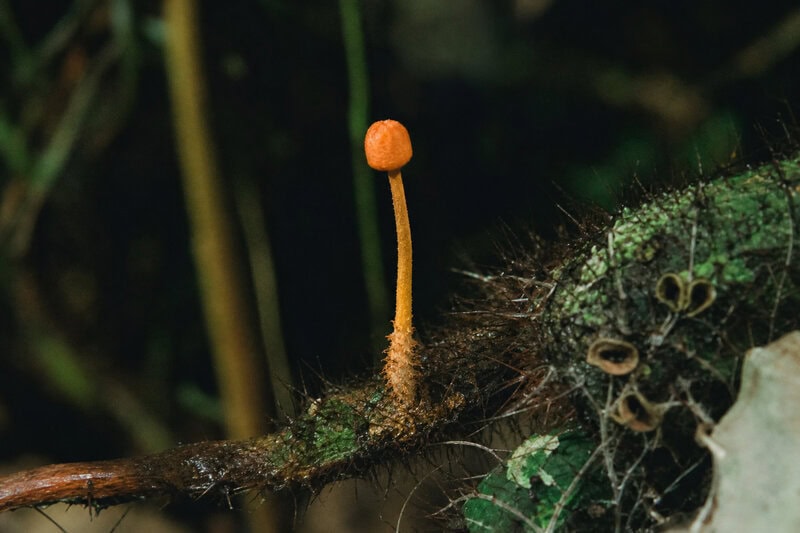
To understand what Pleurocordyceps cornusynnemata is targeting, it helps to understand its host’s own grim life history. Zombie fungi — a colloquial but scientifically used term for entomopathogenic fungi in genera such as Ophiocordyceps and their relatives — infect living insects, invade their tissues, and manipulate the insect’s behavior to move it toward a location optimal for spore dispersal. The fungus then kills the insect and erupts through the carcass to release spores into the surrounding environment. This process is well-documented across peer-reviewed mycology and behavioral ecology literature and is widely considered one of the more extraordinary examples of host manipulation in the natural world.
Pleurocordyceps cornusynnemata inserts itself into this cycle by attacking the zombie fungus — before or during that lethal process — effectively parasitizing the parasite mid-operation. The new species does not infect the insect directly; its host is the fungal organism that is itself in the process of exploiting and destroying an insect. This means the ecological disruption runs in both directions: the hyperparasite potentially interrupts the zombie fungus’s own reproductive success while simultaneously completing its own life cycle on the zombie fungus’s tissue.
As reporting in the Times of India noted, the new species lives on other fungi in a relationship that sounds almost implausibly layered — yet the biological logic is consistent with what ecologists know about resource partitioning in high-diversity ecosystems, where even highly specialized niches tend to be exploited once conditions allow it. The zombie-fungus behavior being exploited is established science; the specific hyperparasitic interaction of the new species was identified and formally described by the discovery team working in Malaysian Borneo.
The Horn-Shaped Structure That Defines the Species
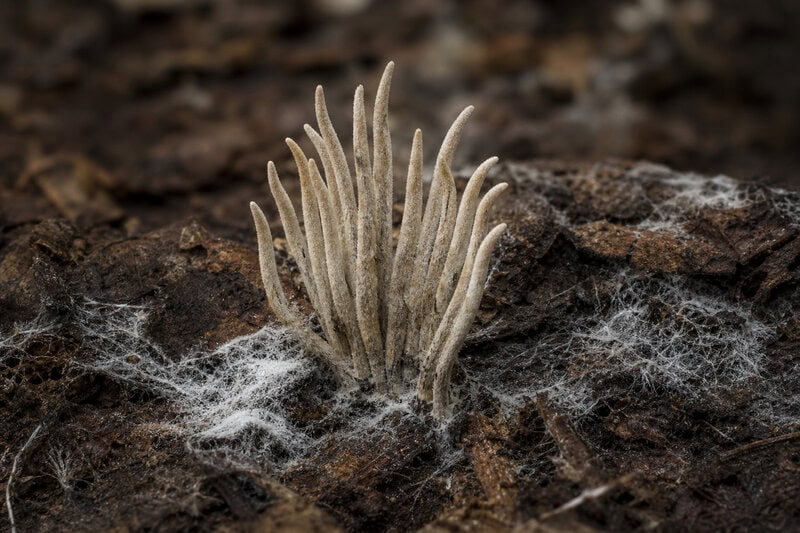
The species name cornusynnemata is not decorative — it is diagnostic. The term combines Latin and Greek roots meaning “horn” and “bundled threads,” directly referencing the fungus’s distinctive horn-shaped synnemata: compact, fused columns of fungal filaments that produce and disperse spores. In mycological taxonomy, synnemata are well-known structures, but the specific horn-shaped morphology observed in this specimen is unlike anything previously documented within the genus Pleurocordyceps, making it the defining character that separates this species from all known relatives.
The shape matters for reasons beyond aesthetics. Morphological structures in fungi often reflect functional adaptations to the substrate on which they grow and the environment from which they need to disperse spores. The horn-shaped architecture of P. cornusynnemata may represent an adaptation specifically suited to growing on zombie fungus tissue — which differs substantially in texture, chemistry, and surface geometry from the insect cuticle that entomopathogenic fungi typically colonize. Researchers note, however, that this functional interpretation remains a hypothesis rather than an experimentally confirmed conclusion, and that the adaptive advantage of the horn morphology is an open question requiring further study.
What is confirmed is the combination of hyperparasitic lifestyle and horn-shaped reproductive structure within this genus. The morphology alone would have been notable; paired with its unprecedented ecological role as a hyperparasite of zombie fungi, it places Pleurocordyceps cornusynnemata in a category of its own within the scientific literature.
Why Borneo: Location as a Scientific Variable
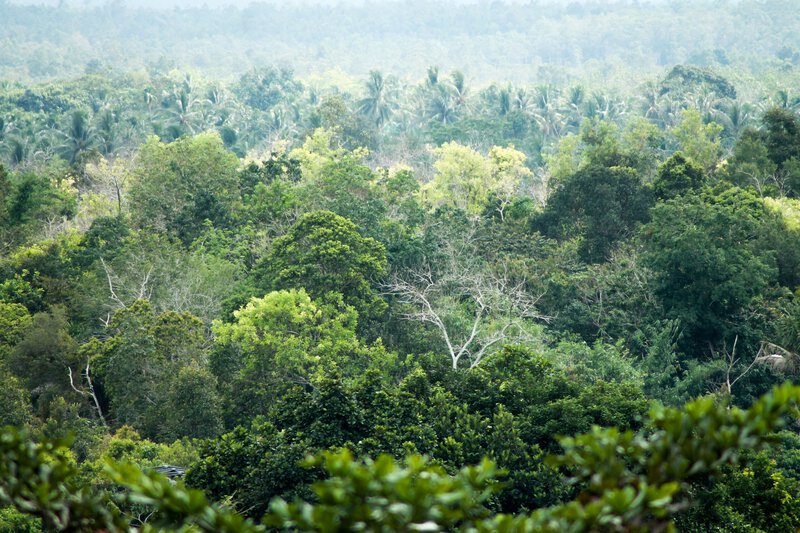
The choice of location is not incidental. Malaysian Borneo hosts one of the world’s oldest and most species-rich rainforest ecosystems, with distinct canopy layers and microclimates that support extraordinary fungal diversity — much of it still undescribed by science. The region’s combination of year-round humidity, dense leaf litter, and exceptionally high insect biomass creates precisely the ecological conditions in which zombie fungi thrive and diversify.
Where zombie fungi are abundant and ecologically active, the evolutionary pressure exists for a hyperparasite to emerge and persist. Borneo’s forest essentially provides both the raw material — a rich and active community of entomopathogenic fungi — and the ecological complexity that makes multilevel parasitism not just possible but likely. The find strongly suggests that additional hyperparasite species may be present in this and neighboring habitats, simply awaiting the kind of targeted systematic survey that produced this discovery.
Coverage in the Economic Times described the find as something that “sounds like science fiction” — but the ecological logic is grounded in established theory about niche specialization in high-biodiversity environments. Tropical rainforests consistently yield novel fungal species precisely because the density of ecological interactions there creates opportunity for biological strategies that would be unsustainable in less complex systems. The more levels of interaction a system supports, the more niches there are to fill.
There is also a conservation dimension that researchers and science communicators have been careful not to overstate but cannot responsibly ignore. As tropical forests in Borneo and across Southeast Asia face ongoing deforestation pressure, discoveries like this illustrate concretely that unknown species with potentially significant ecological roles continue to disappear before science has the opportunity to document them. Pleurocordyceps cornusynnemata was found; how many comparable species were not — and never will be — remains an open and uncomfortable question.
Where This Fits in the Broader Science of Parasitology
Fungal hyperparasitism is not entirely without precedent in applied contexts. Species of Trichoderma, for example, are known to parasitize other fungal pathogens and have attracted significant research interest in agricultural biocontrol. However, those systems involve fungi attacking other fungi that are pathogenic to plants — a structurally different scenario from a fungus attacking an entomopathogenic fungus that is itself in the process of manipulating and killing an insect. The specific combination of entomopathogenic zombie-fungus host, horn-shaped morphology, and formal species description in a wild tropical context has no documented precedent, according to the discovery report.
As reporting from Free Malaysia Today highlighted, the new species preys on zombie fungi known to inflict a gruesome fate on insects — a framing that is accurate and reflects the legitimate scientific shorthand used by researchers in this field. The ecological significance of the hyperparasitic chain, however, rather than the dramatic imagery, is the core scientific contribution.
Pleurocordyceps cornusynnemata is also the first member of its genus known to exhibit this horn-shaped synnematal structure, which carries a taxonomic implication beyond the single specimen: the genus Pleurocordyceps itself may harbor considerably more morphological diversity than current records suggest, warranting a systematic re-examination of existing herbarium specimens worldwide. It is a well-established pattern in mycology that novel discoveries in a genus prompt productive re-evaluation of previously collected material that was either misidentified or set aside as anomalous.
Open Questions and the Road Ahead
The description of a new species is a beginning, not a conclusion. Several foundational questions about Pleurocordyceps cornusynnemata remain unanswered and will require both sustained fieldwork and controlled laboratory investigation to resolve.
- Geographic range: It is not yet known whether the species is endemic to a restricted area of Malaysian Borneo or distributed more broadly across Southeast Asian rainforests. Targeted surveys of comparable habitats in Indonesia, the Philippines, and mainland Southeast Asia are a logical next step.
- Life cycle and infection mechanism: The precise sequence by which P. cornusynnemata locates, attaches to, and colonizes a zombie fungus has not been experimentally characterized. Understanding this mechanism would clarify whether the hyperparasite actively suppresses zombie-fungus sporulation — an outcome with theoretical implications for biological control research.
- Population dynamics: How common is this hyperparasite relative to its zombie-fungus hosts in the wild? Whether it exists at population densities sufficient to meaningfully affect zombie-fungus abundance in any given forest patch is unknown.
- Herbarium re-examination: Collections of Pleurocordyceps specimens held in institutional herbaria worldwide may include additional unrecognized hyperparasitic or morphologically unusual members of the genus that were overlooked or insufficiently characterized at the time of collection.
Laboratory cultivation of the species and controlled infection trials would help move several of these questions from hypothesis to evidence. As noted in coverage shared by Phys.org, the discovery underscores that the biodiversity of Malaysian Borneo’s jungle continues to yield organisms unknown to science, even in groups as extensively studied as the entomopathogenic fungi.
This single specimen from a Malaysian jungle demonstrates something that deserves to be stated plainly: Earth’s fungal tree of life still holds genuinely novel structures and ecological strategies, and the age of foundational mycological discovery is far from over. A parasite that parasitizes a parasite, sporting a horn no one had seen before, found in one of the world’s most ancient forests — Pleurocordyceps cornusynnemata is a reminder that the most surprising chapters in biology are still being written, often in the leaf litter underfoot.