
Buried near the Milky Way’s crowded core, a dense swarm of stars called Terzan 5 has quietly endured for roughly 12 billion years — while virtually everything around it was destroyed, scattered, or absorbed into the galaxy we inhabit today. Astronomers now describe it as a bulge fossil fragment: the preserved remnant of one of the primordial clumps that merged to build the Milky Way’s central bulge, and the first such relic ever captured in detail by the James Webb Space Telescope.
A 12-Billion-Year-Old Survivor Hidden in Plain Sight
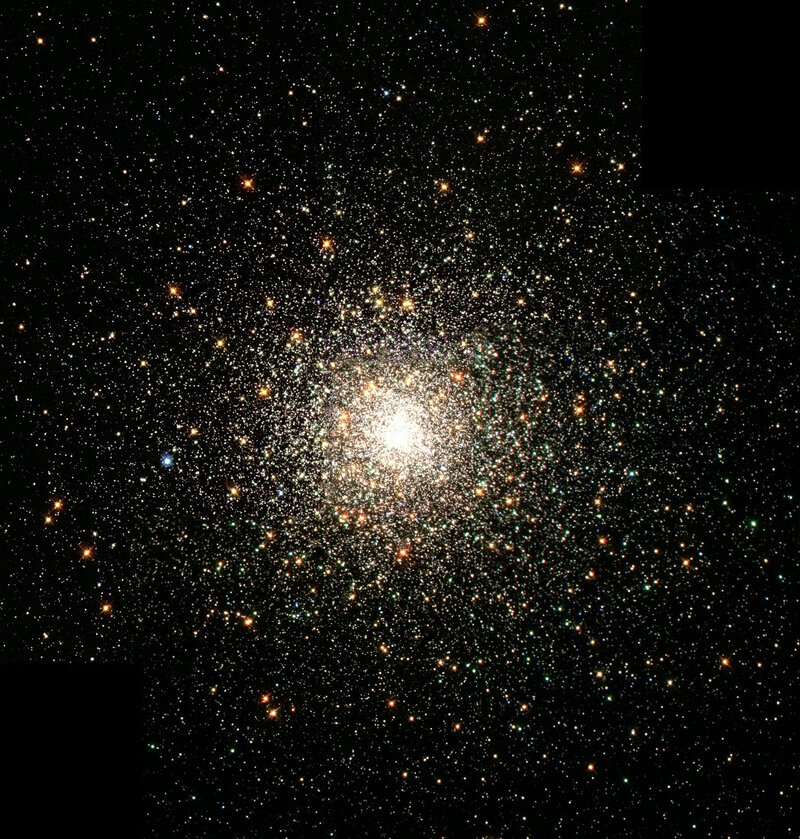
The find is remarkable not just for its age but for what survived intact. Over cosmic timescales, the gravitational chaos at the center of the Milky Way grinds structures apart. Yet Terzan 5 remains coherent — its stars still bound together, its chemical fingerprints still legible. For astronomers studying how the Milky Way formed, that makes it something close to irreplaceable: a physical time capsule from the galaxy’s earliest chapter, sitting only about 19,000 light-years from Earth rather than billions of light-years away in the deep universe.
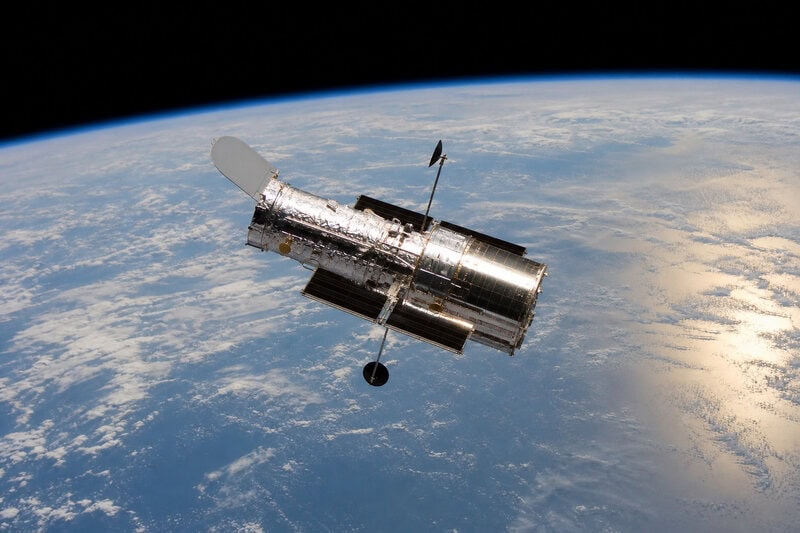
A combined observing campaign using the James Webb Space Telescope and the Hubble Space Telescope has now peeled back the evidence layer by layer, giving researchers their sharpest look yet at this ancient stellar system. ESA’s Webb mission office describes the result as revealing the history of a relic of the Milky Way, with the two observatories together providing a multi-wavelength portrait that neither could have produced alone.
What Exactly Is a Bulge Fossil Fragment?
To understand why Terzan 5 matters, it helps to understand what it is — and what it is not. The galactic bulge is the bright, densely packed spherical region at the Milky Way’s center. Cosmologists believe it grew billions of years ago when massive primordial clumps of gas and stars migrated inward and merged, a process called hierarchical assembly. Think of it less like bricks being laid in an orderly fashion and more like massive, irregular boulders tumbling together to form a mountainside.
A bulge fossil fragment is a surviving shard of one of those original boulders — a piece of a primordial clump that never fully dissolved into the merger, preserving chemical and structural signatures from the galaxy’s earliest epoch. It is the mold, not the finished cast. Distinguishing a true fossil fragment from an ordinary globular cluster — a simple, ancient ball of stars formed in a single burst — requires detecting two distinct stellar populations born at different times. That specific chemical fingerprint is what Terzan 5 uniquely carries, and it is what elevates it above the thousands of other star clusters scattered through the galaxy.
According to the research team behind the Webb-Hubble study, Terzan 5 is most likely the remnant of a far more massive stellar system that began forming in the universe’s first few billion years. Most of its original stars have since been stripped away by billions of years of gravitational interaction with the bulge, leaving behind the dense, compact core we observe today.
How Webb and Hubble Cracked the Case
Observing Terzan 5 has never been straightforward. It sits behind thick curtains of interstellar dust that block visible light, and its stars are packed so tightly together that separating individual points of light requires exceptional resolution. For decades, those two obstacles combined to make detailed study of its stellar populations extremely difficult.
Webb’s NIRCam instrument changed that calculation. Infrared light passes through dust more readily than visible wavelengths, and NIRCam’s high spatial resolution allowed researchers to resolve individual stars inside a system that had previously appeared as an indistinct blur in critical infrared bands. Hubble, meanwhile, contributed ultraviolet and optical data that added chemical and age context impossible to derive from infrared observations alone. The Space Telescope Science Institute notes that the combined dataset gave scientists an unprecedented view of Terzan 5’s stellar populations.
The picture that emerged confirmed what earlier, lower-resolution studies had suggested but could not definitively prove: Terzan 5 contains stars born in two separate bursts — one approximately 12 billion years ago, and another several billion years later. That extended, episodic star-formation history is entirely inconsistent with a conventional globular cluster, which forms its stars quickly and essentially all at once. It is, however, exactly what you would expect from a massive primordial system capable of retaining gas after its first generation of stars ignited and then recycling that gas into a second generation. This marks the first time Webb has captured a bulge fossil fragment in this level of detail, representing a methodological milestone for the field of galactic archaeology — the discipline that reconstructs a galaxy’s history from its oldest surviving structures.
The Mechanism: How Primordial Clumps Built the Milky Way’s Bulge
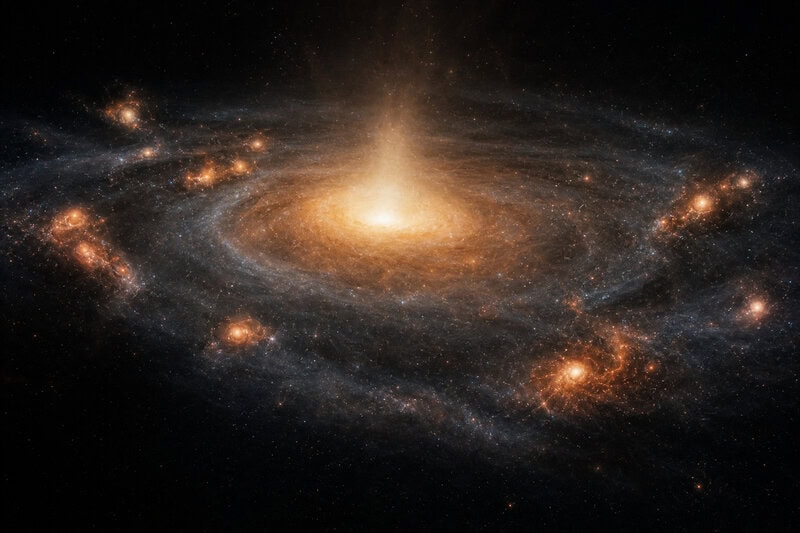
Primordial clumps of stars and gas migrated toward the centers of early galaxies, and many of them merged to form the galactic bulges we observe today. The driving force behind that inward migration is a process called dynamical friction — essentially, a massive object moving through a surrounding sea of matter experiences a gravitational drag that gradually robs it of orbital energy, causing it to spiral inward over hundreds of millions of years. This mechanism is a cornerstone of the hierarchical galaxy-formation model supported by most cosmological simulations.
The key question the research helps answer is why Terzan 5 survived intact when its counterparts were destroyed. The working explanation involves its orbit and internal binding energy: Terzan 5 appears to have been massive and compact enough that its stars remained gravitationally bound to one another even as surrounding material was stripped away and incorporated into the bulge. Its survival is not miraculous — it is a matter of physics — but it is statistically fortunate, which is precisely why it is so scientifically valuable. Each dissolved clump erased a data point. Terzan 5, still intact, provides direct observational evidence for a chapter of galaxy formation that theorists had previously reconstructed only indirectly, from computer models.
What Terzan 5 Tells Us About How the Milky Way Assembled
The two distinct stellar populations inside Terzan 5 carry implications that extend well beyond the object itself. The fact that the system was massive enough to retain gas after its first burst of star formation and trigger a second round points to a progenitor closer in scale to a dwarf galaxy than to a simple ancient star cluster. Dwarf-galaxy-scale systems have the gravitational depth to hold onto gas even after the intense radiation and supernova shockwaves of early star formation have swept through — smaller systems cannot manage the same feat.
Its chemical abundances reinforce that picture. Terzan 5 displays elevated iron and alpha-element ratios — signatures of rapid, large-scale star formation — that closely mirror those found in bulge field stars, the ordinary stellar population that dominates the Milky Way’s center today. That chemical similarity strengthens the case that objects like Terzan 5 are not curiosities from a forgotten era but the direct ancestors of the stellar population that defines the galactic bulge as we know it.
Researchers emphasize that billions of years ago, similar primordial clumps spread across the proto-Milky Way, migrated inward, merged, and dissolved to build the bulge we see now. Terzan 5 is not an anomaly; it is a uniquely preserved example of what was once a common class of object. That reframing shifts the scientific picture of early galactic growth from a relatively smooth, gradual process to something clumpier and more violent — a nuance with broad implications for how astronomers model bulge formation in the Milky Way and in spiral galaxies across the universe.
What Scientists Are Confident About — and What Remains Contested
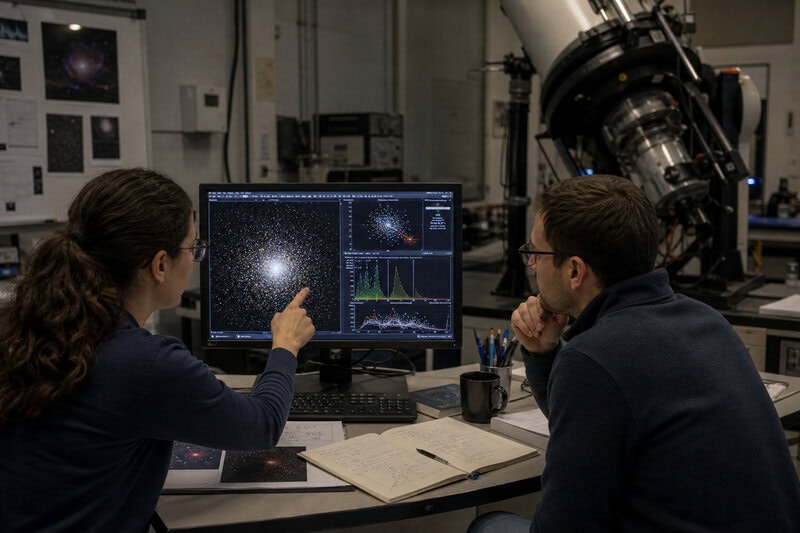
Careful science requires distinguishing what is established from what is still emerging. On the established side, the consensus is clear: Terzan 5 hosts two chemically and age-distinct stellar populations, a finding reproduced across multiple independent studies and now sharpened considerably by the Webb-Hubble data. This detail alone rules out the conventional single-burst globular-cluster model, and no serious challenge to that conclusion currently exists in the literature.
What remains less settled is the broader claim: that Terzan 5 represents a whole category of bulge fossil fragments that seeded the Milky Way’s center, and that this formation pathway was typical rather than exceptional. Most researchers in galactic archaeology find the hypothesis plausible and well-supported by Terzan 5 specifically, but confirming it as a general principle requires finding and characterizing additional candidate objects. Terzan 5, for now, is a sample size of one.
The precise original mass of the Terzan 5 progenitor system is also still modeled rather than directly measured. Estimates suggest it was substantially more massive than Terzan 5 appears today, with most of its stars having been stripped away over billions of years — but those figures carry significant uncertainty and should be treated as working estimates rather than established values.
Why This Finding Matters Beyond Our Galaxy
Galaxy formation is one of cosmology’s central unsolved problems. Theorists can simulate the large-scale structure of the universe — the cosmic web of filaments and voids — with reasonable accuracy. But the fine-grained history of individual galactic components, including how bulges assembled star by star and clump by clump, has been poorly constrained by direct observation. Simulations make predictions; fossils like Terzan 5 provide the ground truth needed to test them.
The research also demonstrates something strategically important: genuine fossil fragments of early galactic assembly can survive to the present day and be identified through multi-telescope campaigns. That is a proof of concept for an entirely new observational strategy — probing the early universe not by pointing telescopes billions of light-years away and looking back in time, but by studying objects within our own galaxy that have preserved evidence of that early era within their stars.
Webb’s demonstrated ability to resolve stellar populations inside dust-obscured bulge regions means astronomers can now systematically survey other dense clusters for additional fossil fragments, effectively turning the Milky Way itself into a laboratory for studying cosmic history. The research also reinforces the scientific value of combining next-generation infrared observatories with legacy visible-light instruments — a methodological lesson that will shape how future survey programs are designed for studying the galaxy’s oldest and most enigmatic structures.
Terzan 5 has endured for 12 billion years without anyone fully understanding what it was. Now, armed with the most powerful space telescopes ever built, scientists are finally beginning to read what it has preserved — and what it quietly reveals about the violent, clumpy dawn of the galaxy we call home.