
Thermodynamic calculations suggest that certain mineral-water reactions on early Earth did not merely permit the assembly of life’s building blocks — they may have chemically compelled it, leaving organic molecules with nowhere energetically favorable to go but toward greater complexity. That single word, compels, sits at the center of a notable entry in NASA’s ongoing origins-of-life seminar series, and it is doing deliberate scientific work.
When the Planet Itself Becomes the Chemist
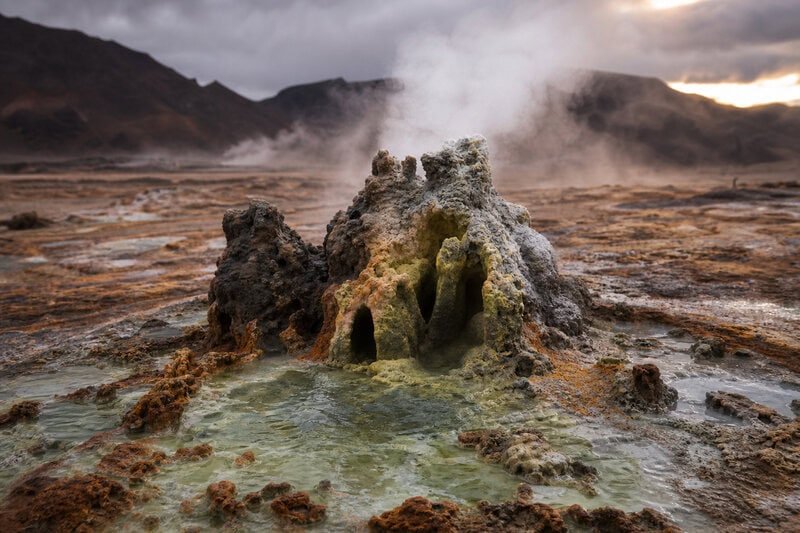
The title of the seminar — 2026 LIFE NASA RCN Seminar: Geochemistry Compels Biochemistry — is not accidental phrasing. In the language of science, “compels” implies directionality: not a lucky accident in a primordial puddle, but a systematic thermodynamic pressure nudging chemistry toward biology. Where most popular accounts of life’s origin invoke randomness and improbable coincidence, this framework invokes constraint. The rocks, the fluids, and the energy gradients of early Earth may have narrowed the field of possible chemical outcomes so severely that something resembling life was not a long shot but a near-inevitability in the right geological setting.
That claim deserves immediate qualification. It is an active, contested hypothesis — one supported by growing thermodynamic evidence and taken seriously by a significant cohort of researchers, but not yet accepted as scientific consensus. Competing frameworks, including ultraviolet-driven surface chemistry, atmospheric prebiotic synthesis, and clay-mineral templating models, remain viable and are actively pursued by other research groups. The “geochemistry compels biochemistry” position is best understood as a serious, well-developed research program rather than a settled conclusion.
The stakes nonetheless extend well beyond Earth. If geochemistry genuinely steers chemistry toward biological organization, then any world harboring liquid water in contact with mineral-rich rock becomes a candidate for the same thermodynamic pressure. That description fits Europa and Enceladus — icy moons of Jupiter and Saturn, respectively — where subsurface oceans are believed to be actively reacting with rocky seafloors. Understanding whether geochemistry drives biochemistry would reframe how NASA designs its search for life on those worlds, shifting the question from “could life exist there?” to “under what conditions would life be hard to avoid?”
What the LIFE NASA RCN Is — and Why It Exists
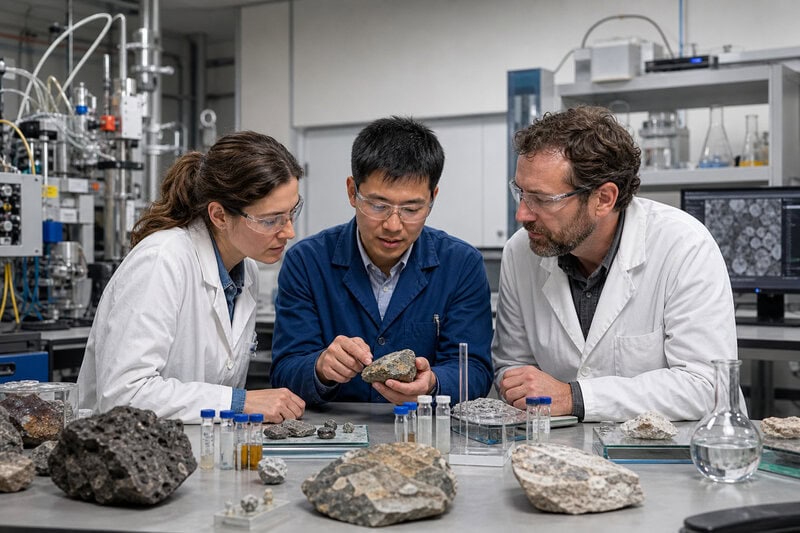
The LIFE NASA RCN — Laboratory Investigation of the Formation of Environments for Life, Research Coordination Network — is a NASA-funded collaborative framework built to dismantle the disciplinary silos that have long separated geochemists, biochemists, and astrobiologists working on the same fundamental question. Origins-of-life research has historically fragmented across departments and journals that rarely speak to one another; the RCN model is designed to force productive conversation before ideas calcify into competing orthodoxies.
The network’s seminar series, announced through astrobiology.com and promoted via @astrobiology on X, represents the initiative’s primary public-facing output. By broadcasting working-scientist presentations rather than polished consensus statements, the series makes scientific uncertainty visible in real time — a deliberate choice signaling that the field is in active hypothesis-testing mode rather than settled doctrine.
The series deliberately cultivates disciplinary breadth. A February 11, 2026 installment — held at 8 AM PDT / 11 AM EDT and documented in the 2026 NASA Astrobiology Seminar Series records — featured Dr. Martina Preiner, whose experimental work brings a distinct biochemical lens to the overarching question. Different speakers, different experimental systems, but a shared conviction that the gap between geology and biology is narrower than it appears.
Dr. Everett Shock and the GEOPIG Lab
Episode 6 of the 2026 LIFE NASA RCN Seminar Series features Dr. Everett Shock, who leads the GEOPIG Lab — the Group Exploring Organic Processes In Geochemistry. The name is deliberately irreverent; the science is not. Shock and his collaborators have spent decades building the quantitative case that the chemistry of hydrothermal systems is not random but deeply constrained by thermodynamic laws that systematically favor certain organic reactions over others.
GEOPIG’s core methodology integrates three streams of evidence that are rarely combined in origins-of-life research: field measurements taken directly from geologically active environments, controlled laboratory experiments run under simulated early-Earth conditions, and thermodynamic modeling — the branch of physics governing energy transfer and chemical equilibrium. The goal is to map, with mathematical precision, how energy and matter flow between rocks, water, and organic compounds across the boundary that separates geochemistry from biochemistry.
The Core Idea: Thermodynamics as a Biological Foreman
Thermodynamics governs which chemical reactions proceed spontaneously and which do not. A reaction that releases energy as it proceeds is described as thermodynamically “downhill” — it happens without requiring an external push. Shock’s research group uses this framework to ask a pointed question: in the specific geological settings of early Earth’s seafloor, which organic reactions were downhill? And do those reactions resemble the ones that underpin modern metabolism — the network of chemical transformations that sustains every living cell?
The answer, according to GEOPIG’s modeling work, is that the overlap is substantial and non-random. In hydrothermal environments characterized by particular mineral compositions, temperature gradients, and fluid chemistry, thermodynamics does not present organic molecules with an open field of equally probable outcomes. It presents a heavily tilted landscape in which certain reaction pathways — pathways recognizable as metabolic — are energetically preferred over others.
This reframes the central mystery of prebiotic chemistry. Most models treat it as a vast, largely random search through chemical space, with life emerging when the right molecules happened to encounter one another under the right conditions. The “geochemistry compels biochemistry” framework argues that geological constraints dramatically narrow that search space, making certain biochemical outcomes near-inevitable wherever the rock-water chemistry is right. The distinction matters enormously: a random search can produce life anywhere or nowhere; a constrained search produces life wherever and whenever the constraints are met.
Field Sites as Natural Laboratories
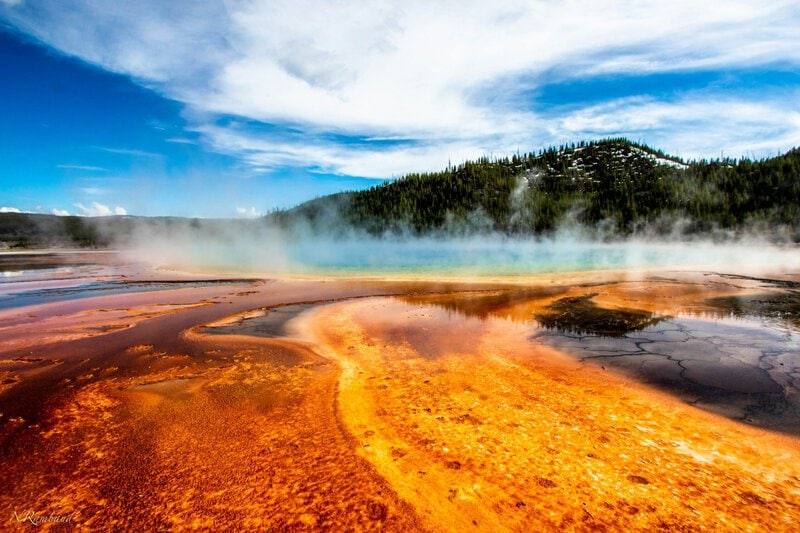
GEOPIG’s approach is grounded in real geology, not idealized reaction vessels. Hydrothermal vents on the seafloor, terrestrial hot springs such as those in Yellowstone National Park, and serpentinization sites — where water reacts with iron- and magnesium-rich rocks to produce hydrogen gas and strongly alkaline fluids — serve as natural laboratories where the team can measure actual chemical conditions rather than relying solely on assumed early-Earth parameters.
Serpentinization deserves particular attention. The process generates molecular hydrogen, a potent electron donor that provides chemical energy capable of driving organic synthesis. The alkaline, mineral-rich fluids it produces are precisely the conditions that thermodynamic models predict should favor the formation of organic compounds central to metabolism. Alkaline hydrothermal vents have attracted sustained scientific interest as potential cradles of life — most prominently in work associated with researchers Michael Russell and William Martin, who have argued for deep evolutionary connections between vent chemistry and the earliest metabolic pathways — and the GEOPIG approach builds on that tradition while adding rigorous thermodynamic quantification.
By moving between field measurements, laboratory simulations, and computational models, the GEOPIG Lab tests whether thermodynamic predictions match observed organic chemistry in actual geological systems. This field-to-lab pipeline is a methodological signature of the LIFE NASA RCN approach: it insists that origins-of-life chemistry be evaluated against real planetary science, not only the controlled conditions of a chemistry department bench. The seminar announcement for Episode 6 reflects this grounding, situating Shock’s presentation within a series explicitly designed to connect laboratory findings to conditions found on other worlds.
Why This Matters for NASA’s Search for Life Beyond Earth
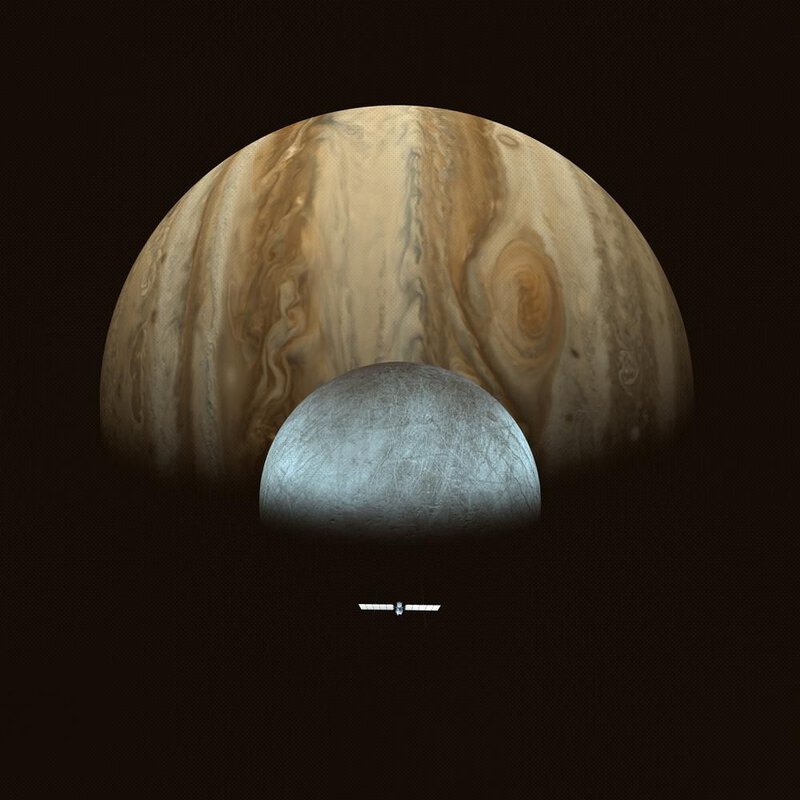
The astrobiological implications of the “geochemistry compels biochemistry” framework are direct and practical. NASA’s Europa Clipper mission, which launched in October 2024, is designed in part to characterize the chemistry of Europa’s subsurface ocean — a body of liquid water believed to sit atop a rocky seafloor where hydrothermal activity may be ongoing. If Shock’s framework is correct, that rock-water interface is not merely a place where life could exist but a thermodynamic environment where life-like chemistry is actively favored. That changes what scientists should look for and how they should interpret the data Clipper returns.
The same logic applies to Enceladus, Saturn’s small moon, where the Cassini spacecraft detected hydrogen gas — consistent with serpentinization — venting from a subsurface ocean through fractures in the icy crust. Hydrogen production of that kind is precisely the geochemical signal that the GEOPIG framework predicts should accompany thermodynamically favorable organic synthesis. Whether that organic synthesis has occurred on Enceladus, or whether additional contingencies are required to bridge the gap between favorable chemistry and actual life, remains an open and genuinely exciting question.
The LIFE NASA RCN’s growing institutional profile reflects NASA’s recognition that origins-of-life geochemistry is now directly relevant to the design of biosignature detection strategies — the methods scientists use to identify signs of life from spacecraft instruments — because those strategies must be built on a defensible theory of what conditions life actually requires.
What Remains Unresolved — and What Comes Next
The “geochemistry compels biochemistry” hypothesis is intellectually rigorous and increasingly well-supported by thermodynamic evidence. It is not proven. The gap between a thermodynamically favorable set of organic reactions and a self-replicating, membrane-enclosed, information-carrying cell remains one of the deepest unsolved problems in all of science. Thermodynamics can explain why certain molecules form preferentially in certain geological settings; it cannot yet explain how those molecules crossed the threshold into Darwinian evolution, where heritable variation and natural selection take over from chemistry.
That gap is the honest frontier of the field, and the LIFE NASA RCN Seminar Series is designed to inhabit it honestly. By featuring speakers like Dr. Martina Preiner alongside Dr. Everett Shock — complementary research programs, distinct experimental systems, the same overarching question — the series models productive scientific uncertainty rather than premature convergence. The February 11 installment and Episode 6 are not competing claims; they are different angles of approach to a problem large enough to accommodate both, and to reward continued investigation.
For anyone tracking the origins-of-life field, the clearest signal from the 2026 LIFE NASA RCN Seminar Series is this: geochemistry has moved from background condition to primary suspect in the story of life’s beginning. The investigation is no longer informal. NASA is funding it, coordinating it across institutions, and broadcasting the uncertainty in real time. The planet, it turns out, may have had far more to do with the emergence of life than anyone appreciated — and the science of figuring out exactly how much is now well underway.