
One engine failure during a crewed lunar descent, at an altitude too low to abort, and there is no rescue mission coming — no second crew, no emergency shuttle, nothing but 384,000 kilometres of vacuum between the astronauts and Earth. That is the scenario a Chinese research team has formally flagged as a life-threatening structural weakness in NASA’s Artemis programme, and it opens a wider, largely underreported conversation about whether the most ambitious human spaceflight effort since Apollo has adequately solved the compounding dangers of deep-space travel.
What the Chinese Team Actually Found
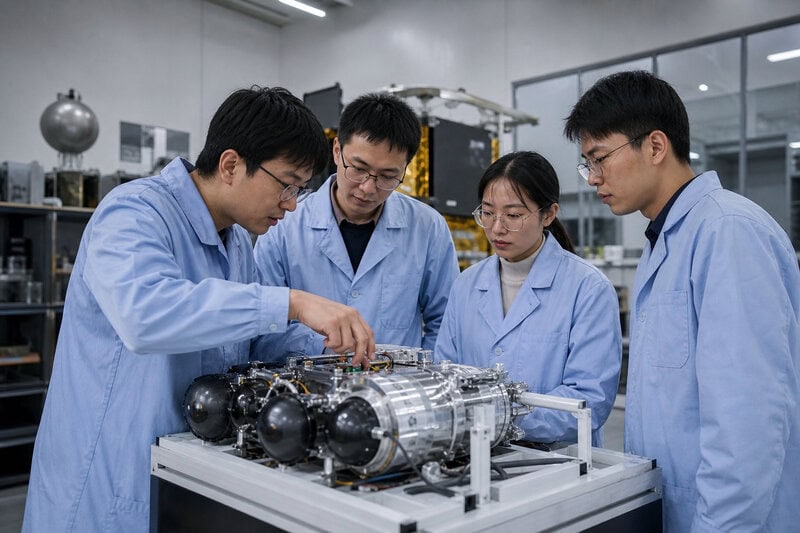
The critique originates from a Chinese research team whose analysis contrasted the propulsion redundancy philosophies of the two nations’ rival lunar lander designs. According to reporting by the South China Morning Post, the researchers identified what they characterised as a critical safety flaw in NASA’s Artemis lunar landing system. China’s own lander architecture incorporates three backup engines, distributing propulsion risk across redundant sources in a philosophy borrowed from aviation’s fault-tolerant engineering standards. The Artemis descent vehicle — NASA’s Human Landing System (HLS), developed by SpaceX as a Starship variant — relies on a single main propulsion architecture that the Chinese team argued is insufficiently resilient for a crewed lunar descent.
The distinction matters most during the final phase of any Moon mission. Lunar descent is irreversible in a way that few spaceflight manoeuvres are: below a certain altitude, there is no survivable abort option. A propulsion failure at that point is not a contingency to be managed — it is a mission-ending, crew-ending event. As Interesting Engineering reports, the Chinese scientists specifically characterised this as a life-threatening vulnerability rather than a routine engineering trade-off.
It is important to be precise about the status of this assessment. The Chinese team’s findings represent an emerging and contested evaluation, not settled engineering consensus. NASA and SpaceX have pointed to the Raptor engine cluster on the Starship HLS as providing a degree of fault tolerance at the vehicle level. Independent aerospace engineers have noted, however, that this is architecturally distinct from a dedicated backup engine philosophy: a cluster sharing common fuel and plumbing lines is not the same as a purpose-designed redundant propulsion system. The redundancy gap the Chinese researchers identify is traceable in both programmes’ public technical disclosures, even if its safety implications remain a matter of legitimate engineering debate. Ground News aggregates multiple perspectives on the engine vulnerability question, illustrating that coverage of this issue reflects a genuine range of analytical positions rather than a single settled view.
Deep Space Radiation: The Chronic and Acute Threat
Propulsion redundancy is the most immediately dramatic of the risks the Chinese team’s critique touches, but it is not the only one worth examining carefully. Astronauts on an Artemis lunar mission will travel through a radiation environment fundamentally different from anything experienced aboard the International Space Station (ISS). The ISS orbits within Earth’s magnetosphere, which deflects a significant fraction of the most energetic particles. The Moon does not.
Galactic cosmic rays — GCRs — are high-energy atomic nuclei accelerated by supernovae and other astrophysical processes to near-light speed. They travel in every direction through the galaxy and penetrate any currently practical spacecraft shielding with relative ease. NASA’s own Human Research Program data indicates that astronauts in cislunar space encounter GCR dose rates roughly 2.6 times higher than those measured aboard the ISS. A round-trip Artemis lunar mission of approximately 21 days would expose crew members to an estimated 8 to 16 millisieverts of radiation — for context, a chest X-ray delivers roughly 0.1 millisieverts, and a transatlantic flight approximately 0.08 millisieverts. The Artemis lunar dose sits within NASA’s career exposure limits for a single mission, but research published in journals including Space Weather has found that even short GCR exposures may elevate long-term cancer and central nervous system risk in ways that simple linear dose models underestimate.
NASA’s own Human Research Program report on space radiation cancer risk projections is candid about the scale of this uncertainty: GCR risk models carry uncertainties of a factor of two to four. In practical terms, the actual cancer risk from a lunar mission could be twice the central estimate — or, optimistically, half as high. That is a wide band of uncertainty for a risk that is both involuntary and irreversible.
The acute counterpart to this chronic background is the solar particle event — a sudden, intense burst of proton radiation from the Sun associated with solar flares or coronal mass ejections. A major event catching astronauts outside the Orion capsule’s shielded shelter could deliver a potentially lethal radiation dose within hours. NASA’s Artemis architecture incorporates radiation weather forecasting and a designated shelter protocol using the Orion capsule’s water-wall shielding. However, researchers have noted that reliable forecasting windows for dangerous solar particle events remain under 24 hours — a narrow margin if the crew is conducting a surface sortie or a critical descent manoeuvre when an alert arrives.
Cislunar Navigation: Flying Without GPS Between Two Worlds
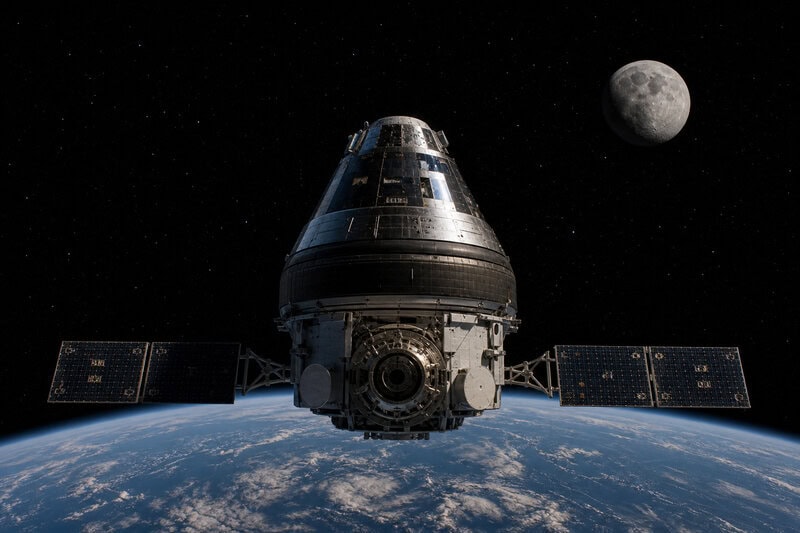
A third category of risk is less viscerally dramatic than an engine failure or a radiation surge, but no less consequential during time-critical manoeuvres: navigation. GPS operates only within a limited altitude range above Earth. In cislunar space — the volume between Earth and the Moon, including lunar orbit — GPS signals become too weak to be operationally useful. Artemis crews must rely on deep-space tracking methods supplemented by newer optical and autonomous navigation systems that are still being validated under operational conditions.
NASA’s primary cislunar navigation architecture depends on the Deep Space Network, a global array of large radio dish antennas that has supported missions since the Apollo era. The DSN is a shared resource: scheduling demands from multiple simultaneous missions create windows where Artemis crews may receive trajectory updates less frequently than would be ideal. Signal latency — the round-trip light-travel time between Earth and the Moon — reaches approximately 1.3 seconds, which means that during time-critical manoeuvres such as lunar orbit insertion, any correction command is already working from data that is over a second old before it can be acted upon.
Researchers at institutions including MIT’s Draper Laboratory have been developing autonomous cislunar navigation systems that use lunar terrain features and star trackers rather than Earth-based signals, precisely because the navigation challenges of cislunar space cannot be fully solved by ground infrastructure alone. China’s Queqiao relay satellite demonstrated an alternative architecture — a dedicated cislunar communication relay — during the Chang’e 4 far-side lunar mission. The absence of a comparable dedicated relay in the early Artemis missions has been noted by navigation engineers as a gap in communication redundancy. NASA’s Lunar Communications Relay and Navigation Systems programme aims to address this by the late 2020s, but Artemis III — the first crewed lunar landing attempt — is currently planned before that infrastructure reaches full operational status.
How These Risks Compound: The Simultaneous Failure Problem
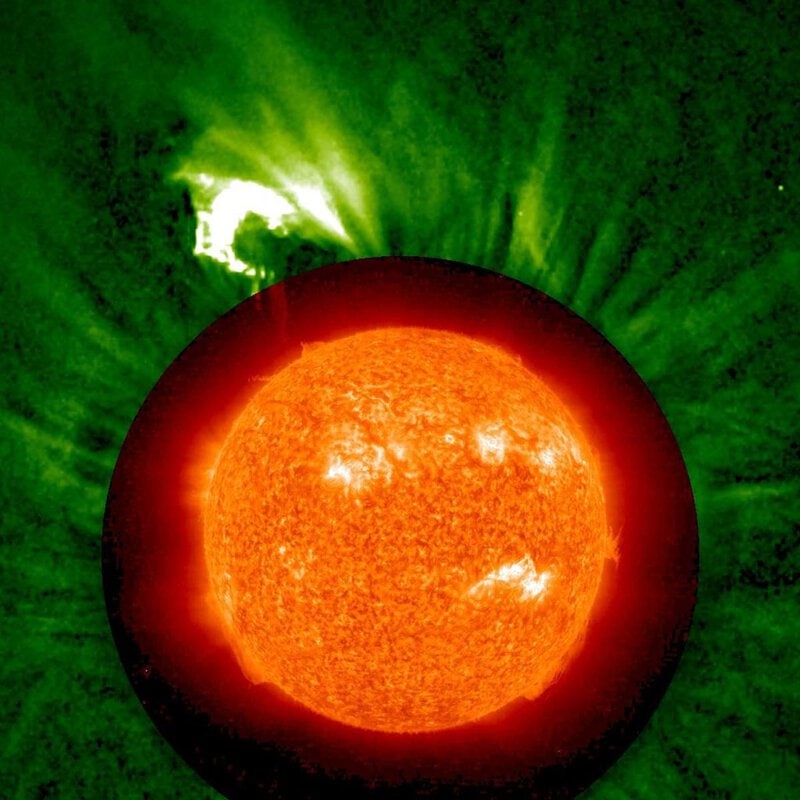
Each of these risks — propulsion vulnerability, radiation exposure, and navigation dependency — carries its own probability and consequence profile. What safety engineers call a common-cause failure occurs when a single external event degrades multiple systems simultaneously. A major solar particle event is precisely this kind of trigger: intense radiation can damage unshielded spacecraft electronics, degrade astronaut cognitive performance through acute exposure effects, and — because severe solar activity also disrupts radio communications — coincide with a period of impaired ground-based navigation support. A crew on the lunar surface during a simultaneous solar particle event and a Deep Space Network outage, aboard a lander carrying the single-point propulsion risk the Chinese researchers identified, would face compounding threats that no individual system’s risk assessment fully captures.
This methodological concern — that assessing risks in isolation misses dangerous interactions — appears in NASA’s own probabilistic risk assessment literature for deep-space missions. Established safety engineering practice holds that redundancy requirements must scale with mission abort impossibility: the closer to the lunar surface and the less recoverable the situation, the higher the consequence of any single failure. This is precisely the phase of the mission where the propulsion vulnerability the Chinese team identified is most acute, and precisely the phase where compounding failures are hardest to survive.
Members of NASA’s independent Aerospace Safety Advisory Panel have raised concerns in publicly released annual reports about schedule pressure reducing the time available for safety verification — a systemic risk factor that operates independently of any specific technical vulnerability and has historically been a precursor to catastrophic failures in human spaceflight.
What This Means for the Future of Human Lunar Exploration
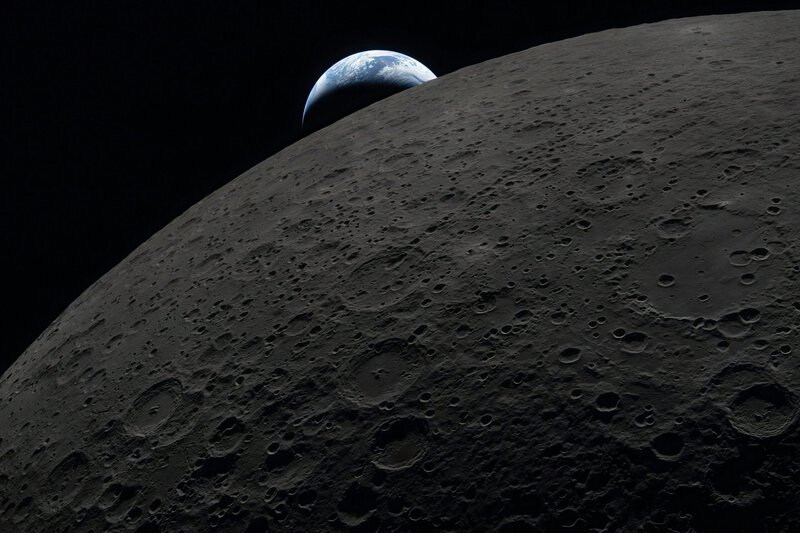
The Chinese team’s critique arrives at a moment of genuine, publicly acknowledged competition between two lunar programmes with divergent engineering philosophies. That competition, however politically charged, may ultimately serve safety: external scrutiny forces each programme to justify its design choices with evidence rather than institutional momentum. NewsBytesApp’s summary of the Chinese scientists’ warning illustrates how quickly this technical debate has entered broader public discussion about Artemis programme readiness.
The radiation and navigation challenges facing Artemis are not hypothetical dangers invented by critics. They are quantified, documented risks that NASA acknowledges and is actively working to reduce through its Human Research Program, its navigation infrastructure plans, and its solar particle event shelter protocols. The honest scientific position is that no current Artemis mission architecture eliminates these risks — it manages them to levels NASA’s risk framework deems acceptable. Whether those thresholds are set appropriately is a values question as much as a technical one. Apollo accepted higher risk in a different geopolitical era, with different public expectations and a more limited understanding of radiation biology. The public, policymakers, and the astronauts themselves have a legitimate stake in how that threshold is set for the missions that follow.
The clearest conclusion the available evidence supports is this: flying humans to the Moon in the 2020s is technically achievable, the risks are real and partially quantified, and the margin between mission success and catastrophe is meaningfully thinner than the public communications of any space agency — NASA or its Chinese counterpart — typically convey. Understanding that margin honestly is the prerequisite for closing it.