
The Sun looks steady from where we stand, but from a scientific standpoint, it is anything but. Its energy output shifts in ways invisible to the naked eye — and those invisible shifts ripple through every climate projection scientists have ever built.
Why the Sun’s Energy Output Is Not a Fixed Constant

Here is the counterintuitive truth at the heart of modern climate science: the amount of energy the Sun delivers to Earth is not stable. It varies subtly across days, years, and decades. Those variations are small by everyday standards, but at the scale of Earth’s climate system, even a fraction of a percent change in incoming solar energy can shift temperature and precipitation patterns across entire continents. Without precise, uninterrupted measurements from space, climate scientists are working with an incomplete picture of the most important energy source our planet has.
That is the problem NASA’s Total and Spectral Solar Irradiance Sensor – 2, known as TSIS-2, is designed to solve. The mission recently cleared one of its most demanding pre-launch hurdles, successfully completing both vacuum and vibration testing — a rigorous engineering process that brings the spacecraft significantly closer to delivering the data climate science urgently needs. NASA’s official TSIS-2 blog details how the mission reached this milestone and what comes next.
What TSIS-2 Is Actually Measuring
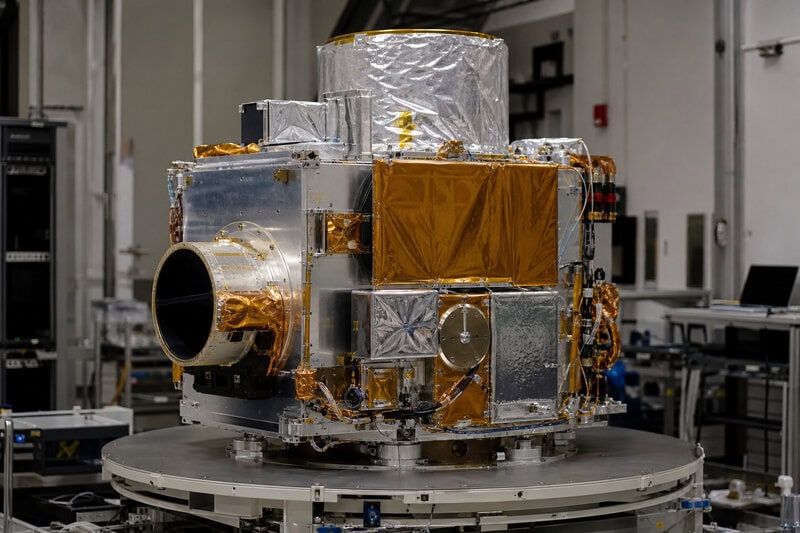
At its most basic, TSIS-2 measures total solar irradiance — the full amount of energy the Sun delivers to the top of Earth’s atmosphere, expressed in watts per square meter. But the mission goes further than producing a single combined figure. It also measures spectral solar irradiance, breaking incoming sunlight into its component wavelengths: how much energy arrives as ultraviolet radiation, how much as visible light, and how much as infrared heat.
This spectral breakdown matters enormously. Ultraviolet light drives ozone chemistry in the upper atmosphere. Infrared energy heats the oceans. Visible light powers photosynthesis across the biosphere. Different wavelengths affect Earth’s systems in entirely different ways, and a single blended total cannot capture that complexity. TSIS-2 captures each piece separately, giving researchers the granular data their models require.
The reason this work must be done from space is straightforward: Earth’s atmosphere gets in the way. Gases absorb and scatter sunlight before any ground-based instrument can record a clean signal. Only a sensor positioned above the atmosphere, exposed to raw, unfiltered sunlight, can produce measurements accurate enough to be scientifically meaningful. A continuous solar measurement record maintained by satellite is, for this reason, irreplaceable.
What Vacuum and Vibration Testing Actually Involves
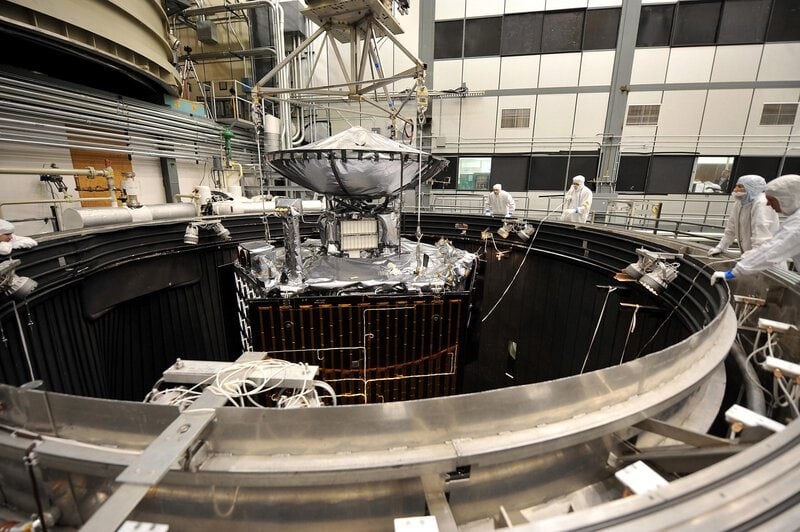
Before any spacecraft earns the right to operate in orbit, it must prove it can survive getting there — and survive the environment it will spend years inside. Vacuum testing places the instrument inside a sealed thermal vacuum chamber that replicates the airless, temperature-extreme conditions of space. Temperatures cycle between intense heat and near absolute zero, exposing any weakness in materials, solder joints, or mechanical connections. If a component is going to fail, engineers need it to fail on the ground, where it can be diagnosed and repaired.
Vibration testing is equally unforgiving. A rocket launch is not a smooth ride. It is a sustained explosion accompanied by intense acoustic energy and mechanical shaking capable of destroying poorly assembled hardware. Vibration tests deliberately replicate those forces, subjecting every component to conditions that would reveal any flaw in construction or assembly.
Together, these two tests form the closest simulation of an actual mission that engineers can conduct without leaving Earth. Completing both is not a procedural formality — it is a genuine and meaningful milestone. A solar irradiance instrument NASA sends into orbit must function correctly from the moment it arrives, because there is no repair crew available hundreds of kilometers above the planet.
Earth’s Energy Imbalance: The Number That Drives Climate Science
To understand why TSIS-2 matters beyond its engineering achievement, consider the concept of Earth’s energy imbalance. Earth continuously absorbs solar energy and continuously radiates energy back to space as heat. When those two flows are balanced, global temperatures remain stable. When Earth absorbs more than it releases — as is currently the case — the excess energy accumulates, warming the oceans, melting ice, and raising sea levels. That imbalance is the fundamental engine driving contemporary climate change.
Measuring that imbalance accurately requires knowing both sides of the equation with precision. Scientists can estimate how much energy Earth radiates outward using a range of instruments. But the input side — exactly how much solar energy arrives at the top of the atmosphere — depends directly on continuous, accurate solar irradiance data from space. This is TSIS-2’s core scientific contribution.
The stakes around accuracy are significant. Even small measurement errors in incoming solar energy, carried across decades of climate modeling, can translate into meaningful differences in projected temperatures and sea-level rise. Climate assessments used by policymakers worldwide, including those produced for the Intergovernmental Panel on Climate Change, rely on this foundational solar data. The measurements TSIS-2 will provide are not peripheral inputs — they sit near the center of how scientists understand and quantify the planet’s energy budget.
Why Continuity in the Solar Record Is Everything

The scientific value of any single solar measurement is modest. The value of a long, consistent, overlapping measurement record is immense. A long, unbroken record allows researchers to distinguish genuine long-term solar trends from normal short-term variability — the difference between a meaningful climate signal and background noise.
A gap in that record, even one lasting only a few months, creates serious problems. Merging data from two different instruments is only possible if their measurement periods overlap, allowing scientists to calibrate one against the other. Without overlap, the records on either side of the gap cannot be reliably connected, and any conclusions drawn across it become scientifically uncertain.
TSIS-2 is specifically designed to overlap with its predecessor, TSIS-1, which currently operates aboard the International Space Station. That overlap ensures the decades-long continuous satellite record survives the transition between missions intact. Losing that continuity would be something like tearing pages from the middle of a centuries-long climate diary — the entries before and after the gap no longer connect clearly enough to tell a coherent story.
The Engineering Behind the Measurements
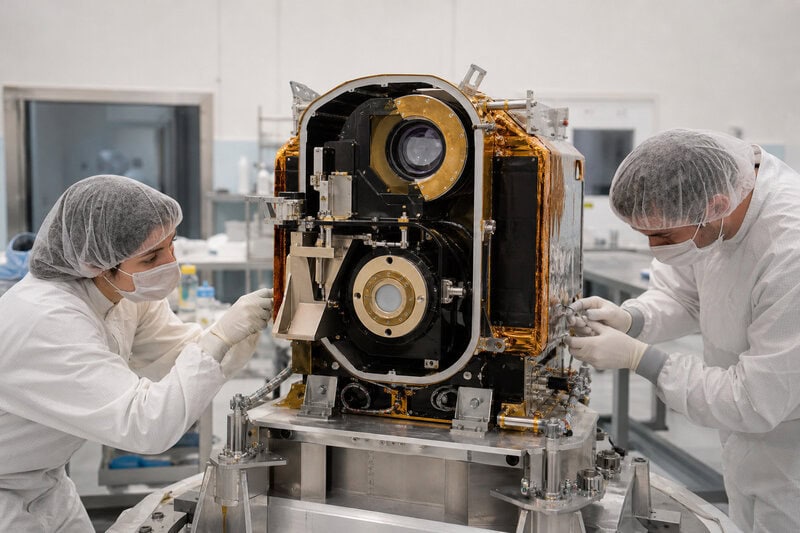
The precision TSIS-2 achieves does not happen by accident. The instrument uses radiometers — devices that convert absorbed sunlight directly into a measurable electrical signal — calibrated to accuracy within a tiny fraction of a percent. A separate spectral irradiance monitor divides incoming light into specific wavelength bands, producing the detailed data that underpins ozone chemistry research, ultraviolet exposure science, and atmospheric modeling.
One of the most important design features is the instrument’s ability to self-calibrate over time. Sensors degrade when exposed to sustained solar radiation, and a measurement that drifts gradually becomes a measurement that misleads. Internal calibration mechanisms in TSIS-2 detect and correct for that degradation, ensuring the data produced years into the mission is as trustworthy as the data produced on day one. That engineering discipline is what transforms a satellite into a reliable scientific instrument rather than simply a device pointed at the Sun.
What Comes Next
With vacuum and vibration testing now complete, TSIS-2 advances toward final pre-launch preparations. When it reaches orbit, its data will flow to climate researchers, atmospheric scientists, and model builders around the world — the people whose work informs flood planning, agricultural policy, and international negotiations over emissions targets.
For anyone who has read a headline about projected global temperatures in 2050 or 2100, the connection is direct. Those projections are only as reliable as the data feeding them, and that data begins with knowing, precisely and continuously, how much energy the Sun is delivering to Earth right now.
TSIS-2 represents the careful, methodical work that makes bold scientific conclusions possible. It will not dominate headlines the way a Mars landing does, but its measurements will underlie nearly every credible climate forecast produced for the next decade. Follow the mission’s progress through NASA’s science blog — this is a story worth tracking as it moves from the test chamber to orbit.