
Inside the leg bone of a dinosaur that died 115 million years ago in what is now Brazil, scientists have found something that conventional fossil science insisted could not exist: microscopic structures that look unmistakably like red blood cells, still carrying chemical echoes of the molecule that once made them work.
A 115-Million-Year-Old Secret Hidden in Bone
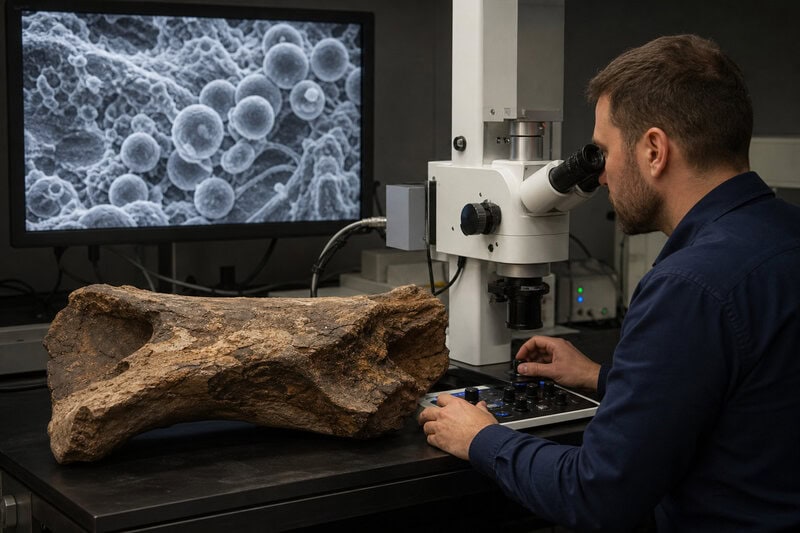
The fossil belongs to Aratasaurus museunacionali, a Cretaceous-era theropod dinosaur whose remains were preserved in extraordinary detail — far beyond what the standard model of fossilisation said was possible. Researchers from Curtin University used electron microscopes to peer inside the bone’s fine internal channels and found small, round, three-dimensional structures sitting exactly where blood vessels once ran.
If confirmed, this represents the oldest direct evidence of fossilised red blood cells ever discovered. It also forces a serious conversation about what the fossil record has been hiding all along — and what scientists may have been too quick to assume was gone forever.
The findings, which have drawn both excitement and measured skepticism from the scientific community, are detailed in coverage by Reuters and assessed in depth by Science.org.
What Exactly Did They Find Inside the Fossil?
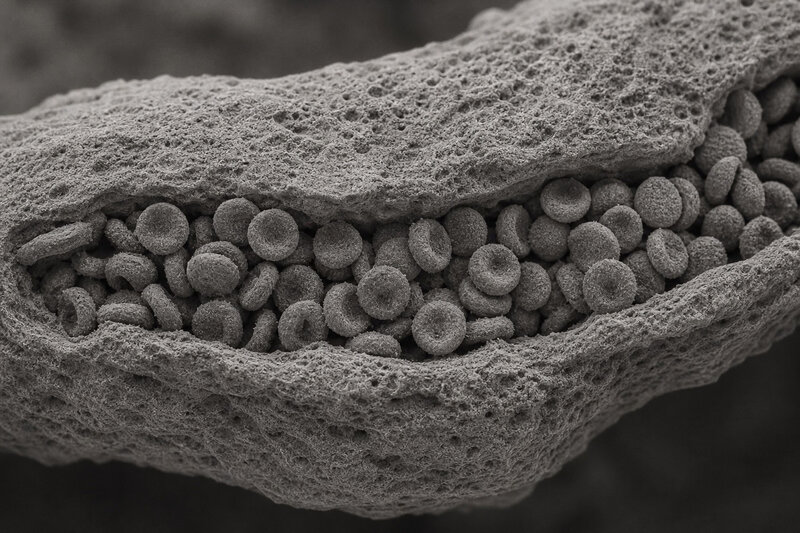
Electron microscope imaging revealed abundant, mineralised, three-dimensional structures resembling red blood cells packed into the vascular channels of Aratasaurus limb bones. These were not faint impressions or ambiguous smears — the structures were round, discrete, and positioned precisely where blood cells would have been in life.
Alongside these cellular structures, the research team detected chemical traces consistent with heme — the iron-carrying molecule at the core of hemoglobin, the protein that makes blood red and transports oxygen through a living body. Amino acids associated with collagen, the structural protein found in bone and connective tissue, were also identified within the same fossil material.
The study describes this combination — cell-like structures plus molecular signatures — as the first direct molecular evidence of compounds from dinosaur blood preserved within structures resembling red blood cells. That is a carefully worded but genuinely significant claim. It is not simply a case of something that looks biological; the chemistry appears to match as well.
Why Soft Tissue in Dinosaur Bone Was Supposed to Be Impossible
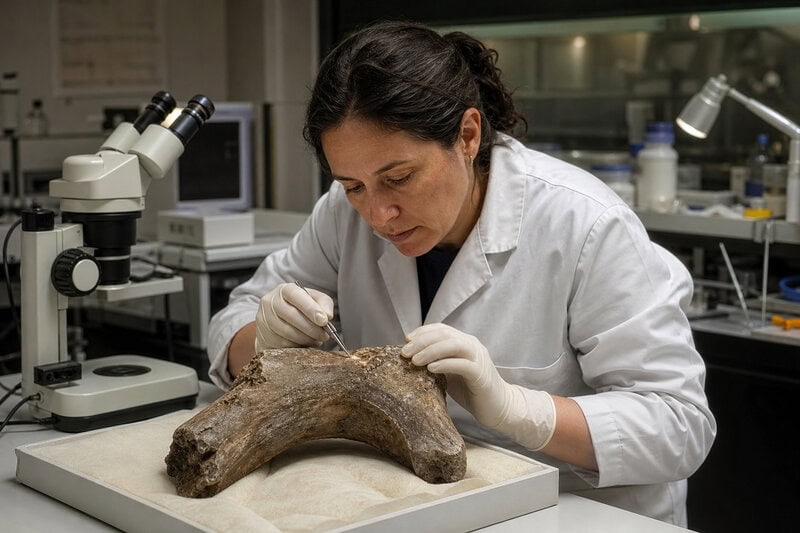
For most of the history of palaeontology, the scientific consensus held firm: organic molecules — proteins, cells, soft tissue — simply cannot survive millions of years of fossilisation. The standard model describes minerals gradually replacing biological material over time, leaving rock in the shape of bone but erasing almost every trace of original chemistry.
That assumption was rattled in 2005 when palaeontologist Mary Schweitzer reported soft tissue preserved in a T. rex fossil, sparking fierce debate that has never fully settled. Critics questioned contamination. Supporters pointed to the evidence. The argument has continued for two decades.
The Brazilian Aratasaurus find adds new and significant pressure to that debate. It pushes the soft tissue preservation record further back in time and into a completely different species, on a different continent, under different geological conditions. As The Conversation explains, this is not simply a replication of earlier findings — it extends and complicates the picture in ways that demand attention.
How 115-Million-Year-Old Blood Cells Could Possibly Survive
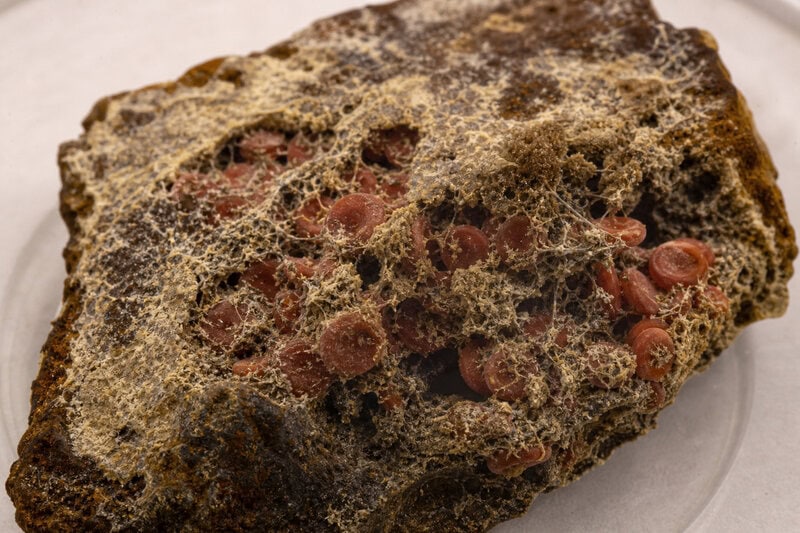
The question of mechanism is both fascinating and unresolved. Several factors appear to have worked together to produce what the Curtin University team found:
- Microbial encasement: The bone was encased in a dense mat of microbes at the time of analysis, suggesting a microbial biofilm may have played a role in sealing and chemically stabilising the organic material shortly after the animal died.
- Mineralisation: Rather than destroying the cellular structures, the gradual replacement of organic molecules with minerals appears to have preserved their three-dimensional shape — a kind of accidental casting in stone at the microscopic level.
- Rapid burial: The specific geology of Brazil’s Cretaceous formations may have shielded the material from oxygen and water, the two agents most responsible for breaking down soft tissue after death.
Researchers believe a combination of these factors created an accidental preservation system of remarkable efficiency. But exactly how it worked well enough to retain heme compounds over 115 million years remains an open and important scientific question — one that this discovery has made considerably more urgent to answer.
Who Is Aratasaurus museunacionali — and Why This Dinosaur Matters
Aratasaurus museunacionali is a theropod dinosaur from Brazil’s Cretaceous period, named partly in honour of the Museu Nacional in Rio de Janeiro, which suffered a devastating fire in 2018 that destroyed irreplaceable scientific collections. The naming was an act of tribute as much as taxonomy.
It lived roughly 115 million years ago during a period when South America was an isolated continent, making its fauna distinct from what was evolving elsewhere in the world. The limb bones examined in this study were the source of all the cellular and molecular evidence. Leg bone structure in dinosaurs is among the most thoroughly studied in palaeontology, which makes it easier for researchers to identify when something in that bone is genuinely unusual rather than an artefact of normal fossilisation.
The discovery elevates Aratasaurus from a relatively obscure find to one of the most scientifically significant dinosaur specimens ever analysed — not because of its size or its predatory reputation, but because of what was hiding inside its bones.
Not Everyone Is Convinced — and That Is Normal Science
Some scientists have expressed skepticism about the findings, questioning whether the structures and chemical signals genuinely represent preserved blood cells or whether another explanation might account for them. This skepticism is neither unfair nor unusual — it is how high-stakes science is supposed to work.
Critics of soft tissue preservation claims frequently point to contamination as the most plausible alternative: modern microbes or organic material infiltrating ancient fossils and mimicking biological structures. The presence of a dense microbial mat on the Aratasaurus bone complicates interpretation, since microbes themselves produce organic compounds that could potentially be mistaken for ancient biological material. The structures’ positioning within vascular channels is one reason the research team considers contamination a less likely explanation — but independent replication will be the true test.
The Curtin University team acknowledges that the findings are extraordinary and that independent verification will be essential before broader conclusions can be drawn. ABC Science’s coverage reflects this careful balance, noting both the significance of the discovery and the scientific caution that surrounds it.
What Needs to Happen Next
For this discovery to move from compelling to conclusive, several steps are required. Independent research teams will need to examine the same fossil material using their own instrumentation and methodologies. The chemical signatures identified — heme compounds, collagen-associated amino acids — will need to be reproduced and confirmed as genuinely ancient rather than the product of modern contamination. New analytical techniques, including mass spectrometry and synchrotron imaging, may be applied to probe the molecular evidence at even finer resolution.
The research also raises an immediate practical question for palaeontology institutions: existing museum collections contain thousands of dinosaur specimens collected and catalogued under the long-standing assumption that all organic material had been destroyed by fossilisation. Many of those specimens have never been examined for soft tissue preservation using modern molecular tools. The Aratasaurus finding suggests that assumption may have led scientists to stop looking before they needed to.
Why This Discovery Could Change Palaeontology
If soft tissue preservation at this scale and age holds up to scrutiny, the implications ripple far beyond a single Brazilian dinosaur. It means the fossil record may contain far more biological information than scientists have ever thought to look for — and that decades of specimens in museum collections around the world may be worth re-examining with modern molecular tools.
Evidence of red blood cells in dinosaur fossils, combined with collagen and heme signals, opens the possibility of understanding dinosaur physiology directly from chemistry rather than from bone shape alone. Questions about metabolism, growth rates, and other aspects of dinosaur biology that have always seemed permanently out of reach may become answerable in ways previously considered impossible.
It also raises an uncomfortable but productive question: how many fossils sitting in storage, collected and catalogued decades ago under the assumption that all organic material was long gone, might still contain preserved soft tissue that nobody has thought to search for?
The Aratasaurus discovery is not the end of the argument about soft tissue in dinosaur bone. As The Guardian reports, it is the beginning of a more rigorous, better-equipped chapter of that argument — one with real consequences for how science understands ancient life, and one that a single remarkable leg bone from Cretaceous Brazil has forced open wider than ever before.