
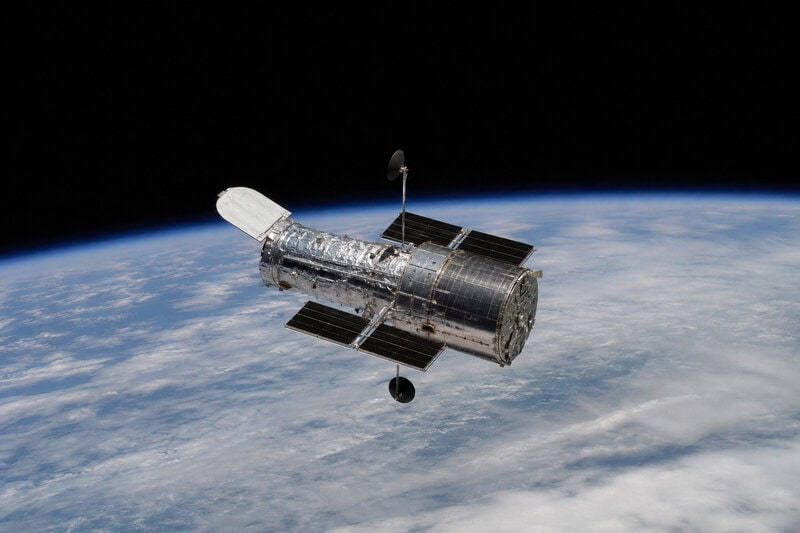
The Hubble Space Telescope is not broken. Its mirrors still focus light with extraordinary precision, its instruments still capture images that rewrite textbooks, and scientists around the world still depend on it for peer-reviewed discoveries every year. What Hubble is doing, slowly and silently, is falling — and for the second time in roughly four years, NASA has gone back to the public and private industry to ask whether anyone has a credible idea for how to stop it.
The Most Important Telescope in History Is Losing Altitude — and Time
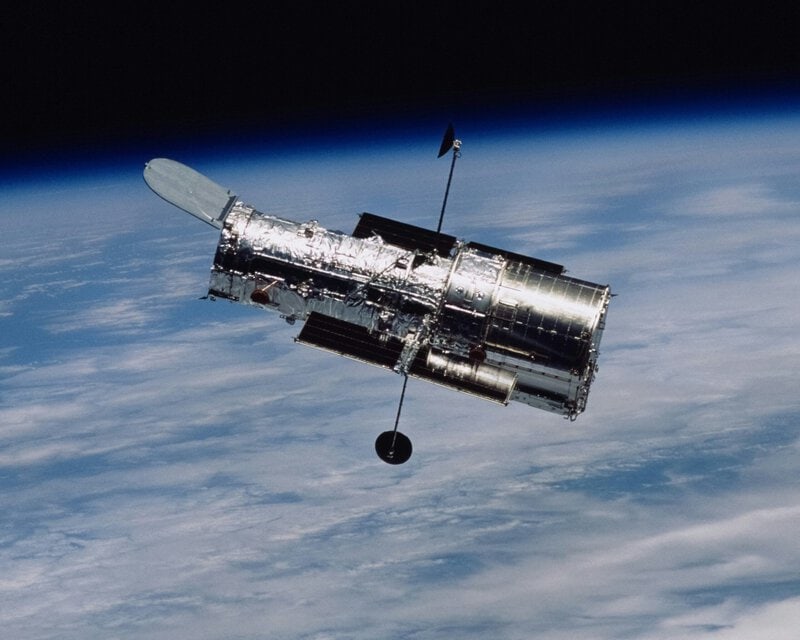
Every day, the thin wisps of atmosphere that reach Hubble’s orbital altitude of roughly 515 kilometers above Earth exert a tiny but relentless drag on the spacecraft. That drag robs the telescope of momentum, pulling its orbit imperceptibly lower. Over months and years, the effect compounds. This is orbital decay — not a malfunction, not a design flaw, but an unavoidable physical reality for any object orbiting close enough to Earth to feel any atmosphere at all.
Without an intervention to push Hubble back up to a safer altitude, the telescope will eventually spiral low enough that an uncontrolled reentry becomes a genuine public safety concern. At that point, mission controllers would have no choice but to deliberately deorbit it — ending more than 35 years of science in a controlled but permanent splashdown. The question facing NASA, astronomers, and the commercial space industry right now is whether a rescue can be organized before that fate becomes inevitable.
In July 2026, NASA issued a new public call for ideas to save Hubble — the second such solicitation in approximately four years. As of this writing, no partner has been selected, no mission design has been funded, and no launch timeline has been confirmed. The astronomy community is left watching the clock.
What Orbital Decay Actually Means — and Why the Window Is Closing

At Hubble’s altitude, the atmosphere is extraordinarily thin — nothing a person could breathe — but it is not nothing. Molecules of air collide with the spacecraft often enough to create measurable drag, and that drag gradually lowers the orbit over time. The process has a compounding, feedback quality that makes early action vastly cheaper than late action. The lower Hubble falls, the denser the atmosphere it encounters, which accelerates the drag, which lowers the orbit faster still.
During the Space Shuttle era, this problem was manageable. Five servicing missions not only repaired and upgraded Hubble’s instruments — they also reboosted the telescope to higher, safer orbits. The last of those missions flew in 2009. When the shuttle program retired in 2011, it took with it the only proven mechanism NASA had for reaching Hubble and doing something physically useful once there. In the fifteen years since, no replacement capability has been flown.
The consequence is straightforward: Hubble has been losing altitude continuously since 2009 with no corrective boost, and the gap between where it is and where it needs to be grows wider every year.
NASA Has Asked This Question Before — So Why Is It Asking Again?
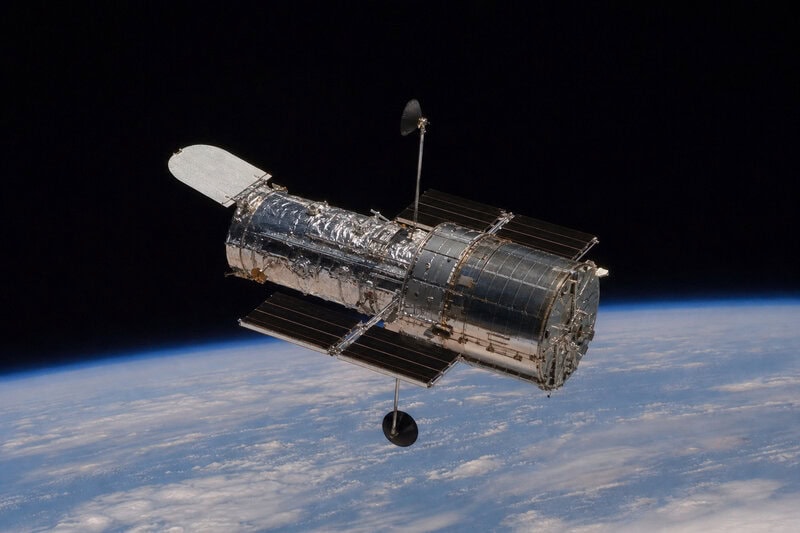
The fact that NASA is soliciting reboost ideas for at least the second time is an honest indicator of how difficult the problem is. The first modern public call for Hubble rescue concepts came roughly four years before the 2026 solicitation. That round of interest-gathering did not produce a funded mission or a selected contractor. The telescope kept falling. NASA returned to the drawing board — and back to the public.
NASA no longer operates any spacecraft capable of rendezvousing with Hubble and delivering the sustained, controlled thrust needed to raise its orbit meaningfully. Building that capability from scratch within the agency would take years and resources the current budget environment does not easily accommodate. So NASA has done what it has increasingly done across many mission categories: turned to the private sector.
NASA is now asking the commercial space industry to step in and save Hubble, hoping that companies with growing experience in satellite servicing, orbital rendezvous, or proximity operations might offer a realistic path forward. The approach mirrors a broader strategic shift at the agency — the same logic that produced SpaceX cargo runs to the International Space Station and commercial lunar landers now applies to one of humanity’s most storied scientific instruments.
That shift carries genuine promise, but it also carries risk. Commercial satellite servicing is an emerging, not a mature, field. The companies best positioned to attempt a Hubble reboost are still accumulating flight heritage on far simpler targets. Whether any of them can meet the technical demands of a Hubble rendezvous on a timeline that matters remains an open question.
What a Rescue Mission Would Actually Require
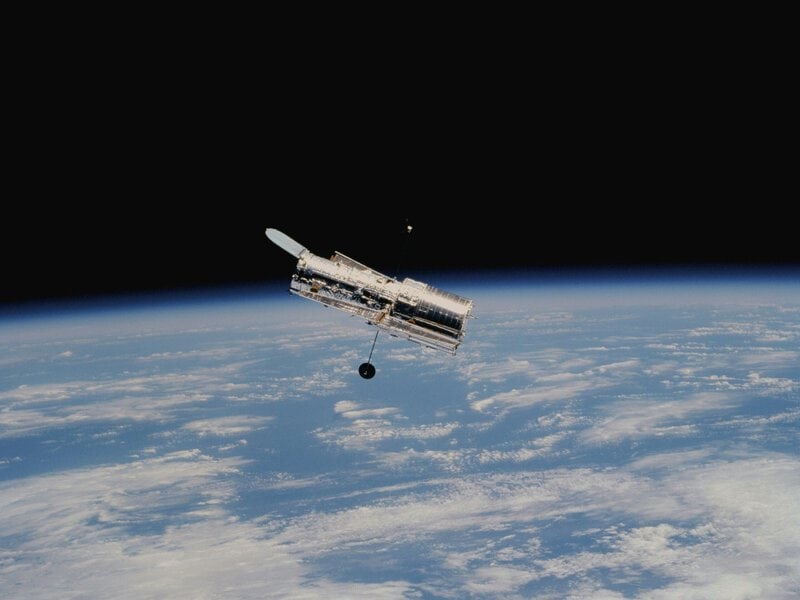
Saving Hubble is not a routine docking operation. The telescope was designed to be serviced by astronauts working from a shuttle’s cargo bay, not by robotic spacecraft operating autonomously at a distance. It has no dedicated capture interface built for an uncrewed vehicle. Any rescue mission would need to solve the problem of safely approaching a large, delicate, and effectively uncooperative spacecraft — one whose solar arrays and precision optics cannot tolerate a rough or miscalculated encounter.
A successful reboost would require a vehicle capable of precisely matching Hubble’s velocity and orbital inclination, then applying sustained and carefully controlled thrust over a long enough period to raise the telescope’s orbit by a meaningful margin — potentially tens of kilometers. Done well, such a mission could extend Hubble’s operational life by a decade or more, buying time for its instruments to continue producing science alongside — not instead of — the James Webb Space Telescope.
Researchers studying the race to save Hubble have pointed to NASA’s earlier work preserving the Swift satellite as a relevant comparison — an example of the agency successfully intervening to extend the life of an aging orbital asset. The comparison is instructive, but it also underscores the scale difference: Swift is a far smaller and simpler spacecraft than Hubble, and even that operation required significant technical coordination. A Hubble reboost would represent a substantially greater engineering undertaking.
Hubble Is Not Redundant — and Cannot Simply Be Replaced
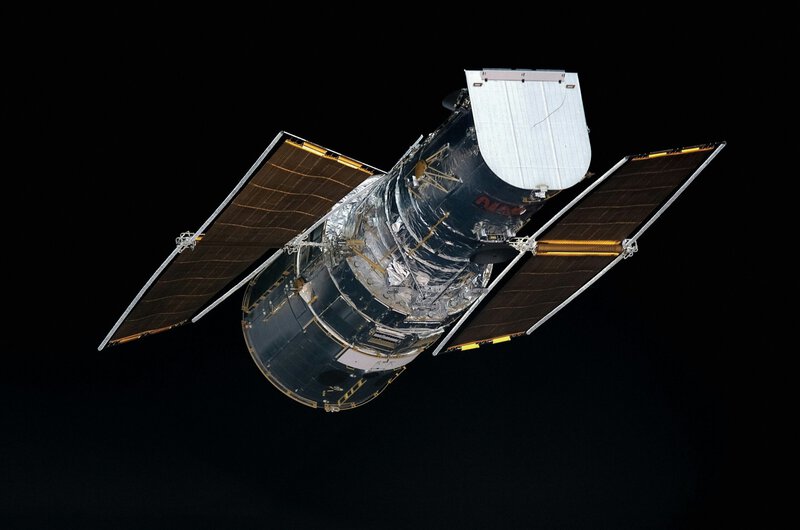
Some observers assume that the James Webb Space Telescope makes Hubble expendable. That assumption does not hold up to scrutiny, and it matters that it be corrected clearly.
Webb operates primarily in infrared wavelengths and is positioned nearly 1.5 million kilometers from Earth at the second Lagrange point — far beyond any realistic servicing or rescue reach. Hubble, by contrast, observes in ultraviolet and visible light, wavelengths Webb cannot access at all. The two telescopes are complementary tools covering different portions of the electromagnetic spectrum. Losing Hubble would eliminate a critical observational capability that no currently planned mission is designed to replace.
The ultraviolet window Hubble uniquely provides is not a scientific luxury. Studies of stellar atmospheres, the intergalactic medium, and the chemical evolution of galaxies all depend heavily on ultraviolet observations. A future without Hubble is a future with a meaningful blind spot in humanity’s ability to study the universe across multiple wavelengths simultaneously.
What Happens If No One Steps Up
The stakes of inaction are worth stating plainly. If Hubble’s orbit is not raised, mission planners will eventually be forced to perform a controlled deorbit to prevent an uncontrolled reentry over populated areas. That operation would end all science operations permanently. There would be no recovery, no restart, no second chance.
Astronomers and space policy analysts broadly agree that the years immediately ahead represent the most cost-effective window for a Hubble rescue. Every year of inaction makes the orbital mechanics harder, the engineering challenge steeper, and the eventual mission more expensive. The solicitation NASA issued in July 2026 is a hopeful sign — it means the agency has not given up. But a public call for ideas and a funded, contracted mission are very different things, and only the latter saves the telescope.
The Clock Is Running
Hubble spent more than three decades showing humanity things it had never seen before: a precise measurement of the universe’s age, evidence for supermassive black holes at the centers of most large galaxies, the discovery that the expansion of the universe is accelerating. It remains, today, an active scientific instrument producing results that matter — not a museum piece, not a relic, but a working observatory with a queue of approved science programs and astronomers waiting on its data.
Whether it continues to do so depends on whether the ingenuity that built it — and the public and private organizations that now carry the space industry forward — can summon a solution before gravity finishes the job. The telescope is ready. The question is whether the rescue is.