
On July 23, 2015, NASA’s Kepler mission announced the discovery of a planet 60% wider than Earth, orbiting a Sun-like star on a 384.8-day cycle — numbers so close to our own world’s vital statistics that the agency called it “Earth’s cousin.” That single announcement captured global attention. Yet the same features that make Kepler-452b look familiar on paper are precisely what would make survival there brutal in practice — and the planet’s most celebrated properties rest on shakier observational ground than most coverage has acknowledged.
What the Data Actually Confirms — and What It Doesn’t
Kepler-452b sits roughly 1,800 light-years from Earth in the constellation Cygnus. It is formally classified as a super-Earth exoplanet — a world with a radius of approximately 1.6 times Earth’s (1.6 R⊕). Its orbital period of 384.8 days is only 20 days longer than Earth’s year, placing it within its star’s habitable zone — the orbital band where liquid water could theoretically persist on a rocky surface.
Kepler-452b is a transit-detected planet: scientists identified it by measuring the faint, regular dimming of starlight as the planet passed in front of its host star. This technique confirms orbital period and radius with high confidence. It does not directly measure mass, atmospheric composition, or surface temperature. The discovery paper by Jon Jenkins and colleagues at NASA Ames Research Center was explicit about this constraint. An estimated mass of roughly 3 to 5 Earth masses appears frequently in coverage, but that figure comes from statistical modeling of planets at this radius — not from a direct measurement. Subsequent reviews of the Kepler catalog have also raised questions about whether the detection itself is fully secure, placing some headline properties in the category of contested rather than settled science.
Responsible science communication therefore requires separating three tiers of certainty: what transit data confirms, what physical modeling estimates, and what remains genuinely speculative. Conflating them — in either direction — distorts public understanding of what the search for Earth-like planets has actually achieved.
The host star, catalogued by NASA’s Exoplanet Program, is a G2-type star — the same stellar classification as our Sun — but roughly 1.5 billion years older, about 10% larger in radius, and approximately 20% more luminous. That extra age and brightness carry significant consequences for the planet’s surface history, discussed below.
The “Cousin” Label and Its Built-In Limits
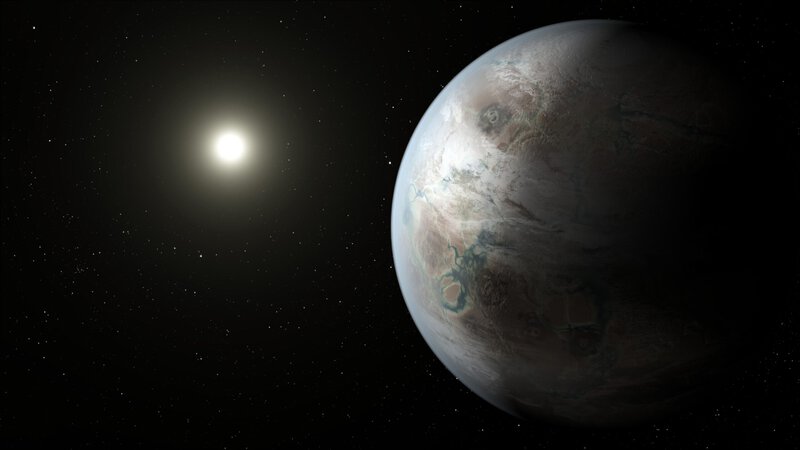
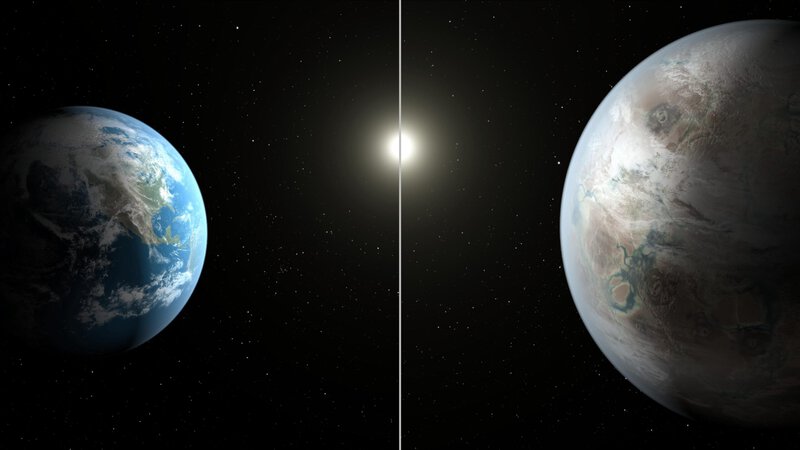
NASA’s own announcement used the phrase “Earth’s cousin rather than Earth’s twin” — a deliberate hedge acknowledging that shared orbital geometry does not imply shared habitability. The distinction is worth unpacking for anyone evaluating Kepler-452b as a candidate for one of the most Earth-like exoplanets discovered to date.
The cousin framing draws partly on a metric called the Earth Similarity Index (ESI), developed by researchers at the Planetary Habitability Laboratory at the University of Puerto Rico at Arecibo. The ESI scores planets on a zero-to-one scale across parameters including radius, bulk density, escape velocity, and estimated surface temperature. Kepler-452b scores reasonably well on radius and orbital position but less well on mass-dependent parameters, where modeling uncertainty is highest. No ESI score, however carefully constructed, can substitute for direct spectroscopic data — data that does not yet exist for this planet.
The “cousin” analogy is pedagogically useful precisely because it signals family resemblance without implying identity. Cousins share some traits; they do not share a home or a life. Applied to Kepler-452b, this means the planet occupies a statistically interesting region of parameter space without guaranteeing any particular surface environment.
Gravity Conditions: The Weight of a Heavier World

If Kepler-452b is rocky — the most optimistic physical assumption — its surface gravity is estimated at roughly twice Earth’s. That figure is derived from distributing an estimated mass of approximately 3 to 5 Earth masses across a planet 60% wider in radius. Under those conditions, a person weighing 70 kilograms on Earth would experience the equivalent of roughly 140 kilograms of force on every joint, muscle, and organ.
Sustained exposure to doubled gravity affects nearly every biological system. The cardiovascular system must work considerably harder to pump blood vertically against greater downward force. Bones and skeletal muscles bear chronically elevated mechanical load. Simple locomotion — walking, climbing stairs, rising from a chair — requires substantially more energy expenditure. Research on long-duration spaceflight at NASA’s Human Research Program has documented how even microgravity, the opposite extreme, degrades cardiovascular and musculoskeletal health over months. A permanent environment of twice Earth’s gravity would impose stresses in the other direction, with no established adaptation pathway for human physiology.
There is, in principle, one potential compensating benefit: a more massive planet can retain a thicker atmosphere over geological time, providing surface pressure and radiation shielding. Whether that thicker atmosphere would be a net advantage or would instead amplify a greenhouse effect depends entirely on atmospheric composition — a variable that instruments cannot yet measure from 1,800 light-years away.
The Habitable Zone: A Filter, Not a Guarantee
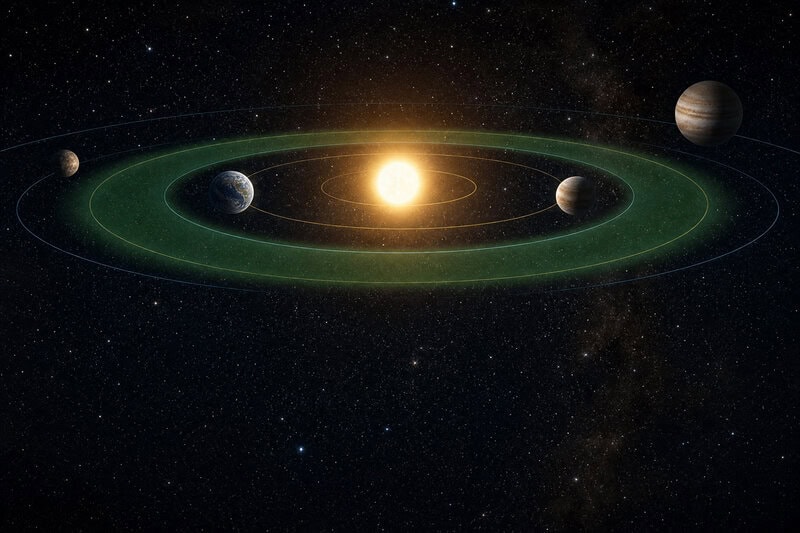
The habitable zone concept — sometimes called the Goldilocks zone — defines the range of orbital distances where a planet with an Earth-like atmosphere could maintain liquid surface water. It does not indicate where life is guaranteed to exist. That distinction is foundational and frequently blurred in popular coverage.
Kepler-452b’s position in the habitable zone of a G-type star carries genuine scientific weight for a specific reason: G-type stars are relatively stable and long-lived compared with the smaller, more magnetically active M-dwarf stars that host many other habitable zone candidates. M-dwarf stars frequently emit intense ultraviolet and X-ray flares capable of stripping planetary atmospheres and bombarding surfaces with radiation. Kepler-452b’s host star does not carry that particular liability, making its habitable zone scenario more physically plausible than those of many competing candidates.
However, the host star’s greater age and higher luminosity introduce a different concern. Kepler-452b has been exposed to several hundred million more years of elevated stellar radiation than Earth has received at a comparable orbital distance. Researchers have modeled scenarios in which planets in analogous situations undergo a Venus-like greenhouse runaway — a process in which rising temperatures accelerate water vapor evaporation, which traps more heat, driving more evaporation, eventually leaving a scorched, waterless surface. Whether Kepler-452b followed that trajectory, or whether it retained surface water through some stabilizing feedback mechanism, is currently unknown.
The habitable zone is best understood as a filter that narrows the candidate list. Kepler-452b passes that filter, which is scientifically meaningful. But passing the filter is the beginning of the inquiry, not its conclusion. A detailed technical overview of the planet’s orbital and stellar parameters is available through the NASA Exoplanet Archive at Caltech.
Life Possibility: Honest Uncertainty Over Easy Answers
No biosignatures have been detected on Kepler-452b. No atmospheric oxygen, no methane disequilibrium, no chemical signal of biological activity has been observed — nor could any such detection be made with current instruments. The James Webb Space Telescope, operational since 2022, is optimized for characterizing atmospheres of planets orbiting smaller, dimmer stars, where the contrast ratio between star and planet makes spectroscopy tractable. A planet around a Sun-like star at 1,800 light-years presents a far more difficult observational challenge that JWST is not designed to resolve.
The Kepler-452b life question is therefore entirely open in the peer-reviewed literature: there is no evidence for life, no evidence against it, and no near-term observational pathway to settle the question. What the planet’s existence does confirm — even accounting for detection uncertainties — is that Sun-like stars can host long-period, roughly Earth-sized planets in the habitable zone. That confirmation carries real weight for estimating how frequently potentially life-bearing worlds might arise across the galaxy, a calculation central to ongoing astrobiology research. The broader scientific framework for evaluating such candidates is explored in research published in Proceedings of the National Academy of Sciences examining the conditions that define a potentially suitable world for life.
Why Kepler-452b Still Matters Despite Its Uncertainties
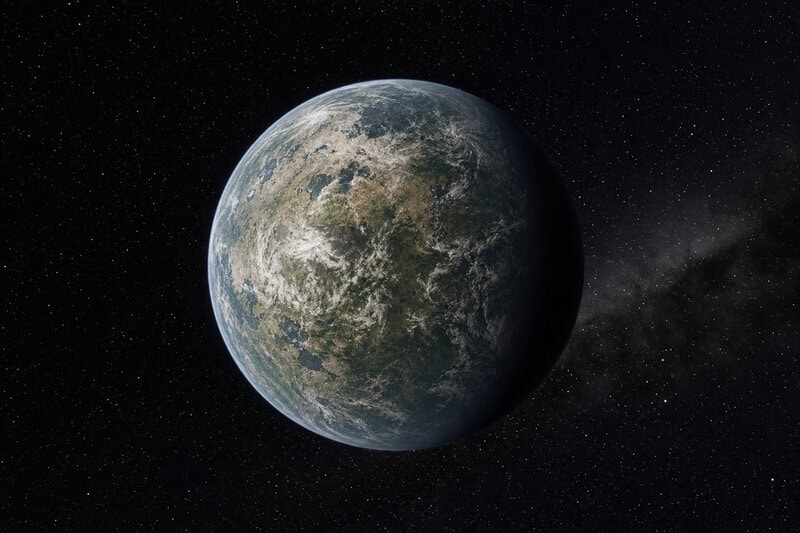
Despite unresolved questions about its precise physical properties, Kepler-452b holds legitimate landmark status in exoplanet science. When it was announced in 2015, it was a credible candidate in the habitable zone of a Sun-like star with a radius close enough to Earth’s to be plausibly rocky — a finding that shifted statistical expectations for how common such worlds might be. That shift has downstream consequences for how scientists allocate observational resources and prioritize mission targets.
Its contested status has also proven scientifically productive. The limitations exposed by transit-only characterization of planets like Kepler-452b helped build the technical and political case for next-generation direct-imaging missions. The 2021 Astronomy and Astrophysics Decadal Survey — the field’s consensus planning document — endorsed the proposed Habitable Worlds Observatory, a space telescope designed specifically to image Earth-sized planets around Sun-like stars and analyze their atmospheres for biosignatures. The high-profile ambiguity of candidates like Kepler-452b sharpened the argument for why such a mission is necessary.
For general audiences, Kepler-452b serves a legitimate pedagogical function. It makes the abstract concept of Earth-like planets in the habitable zone personally relatable in a way that catalog numbers and statistical distributions cannot. That function has genuine value — provided the conversation stays anchored in what the data actually supports rather than cinematic extrapolation about twin Earths and alien civilizations.
The honest summary, consistent with the peer-reviewed record: Kepler-452b earned its “most Earth-like exoplanet” headlines for defensible reasons. It occupies the right orbital position around the right kind of star, and its size falls within the range where rocky composition is possible. But the distance between “intriguing candidate” and “second Earth” is measured in data that does not yet exist and instruments that have not yet been built. Until direct spectroscopic characterization becomes possible, the planet will remain what it has always been — a well-reasoned hypothesis about a world 1,800 light-years away, not a confirmed destination.