
When archaeologists examining bronze swords recovered from Pit 1 of the terracotta army complex in Xi’an found that some blades remained sharp enough to cut paper after more than 2,200 years underground, it forced a fundamental reassessment of what Qin dynasty weapons actually were. These were not ceremonial props buried with a superstitious emperor. They were the instruments of a military system so precisely engineered that its logic is still legible today.
The Arsenal Was a System, Not a Collection
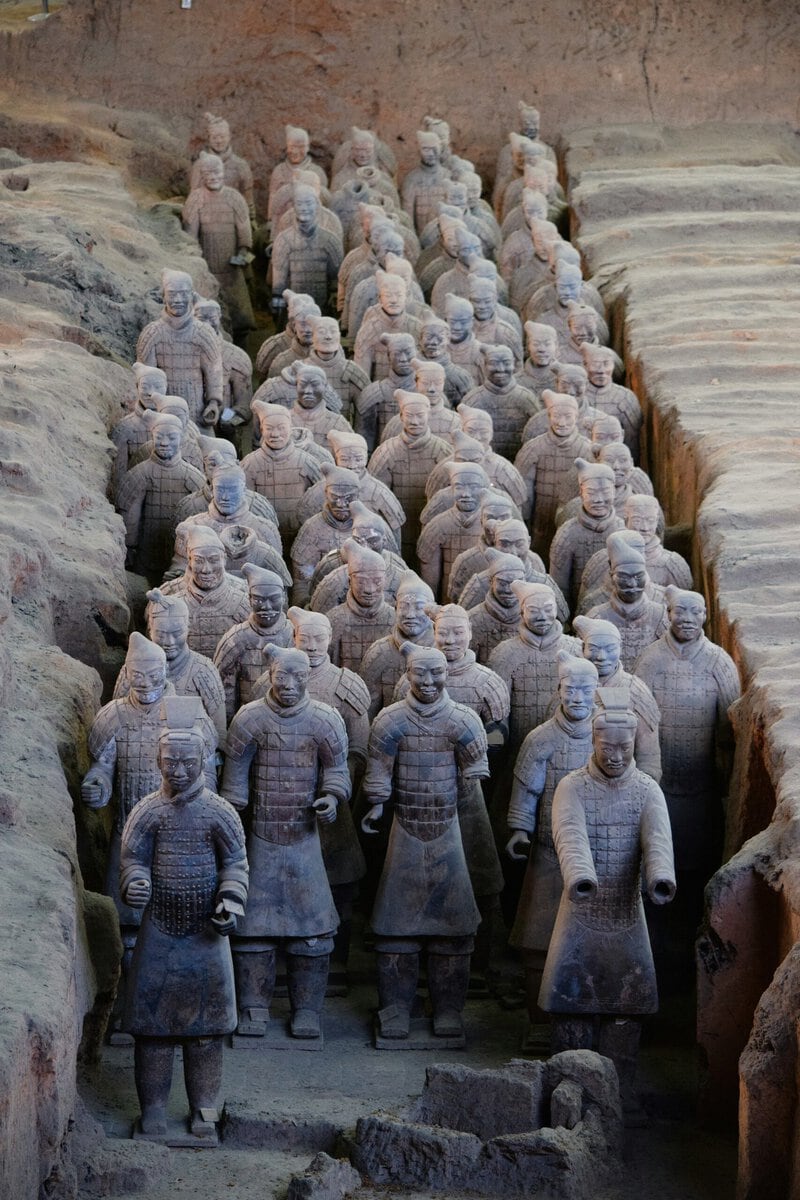
The terracotta army, first excavated in 1974, represents something archaeologists rarely encounter: a forensically accurate snapshot of a real battlefield unit, frozen at the precise moment of peak Qin military power. The figures carry weapons appropriate to their rank, wear armor calibrated to their role, and are arranged in formations that reflect documented tactical doctrine. Popular imagination tends to picture ancient Chinese warriors as colorful, ceremonial, or exotic — the archaeological record reveals something considerably more unsettling: a ruthlessly practical, innovatively engineered killing force.
This article draws on findings from the Emperor Qin Shi Huang’s Mausoleum Site Museum, published archaeometallurgical research, and scholarship on Warring States and Qin military organization to reconstruct what a real ancient Chinese warrior actually carried — and why each choice was made.
The Standard Load-Out: Layered Weapons for Layered Violence
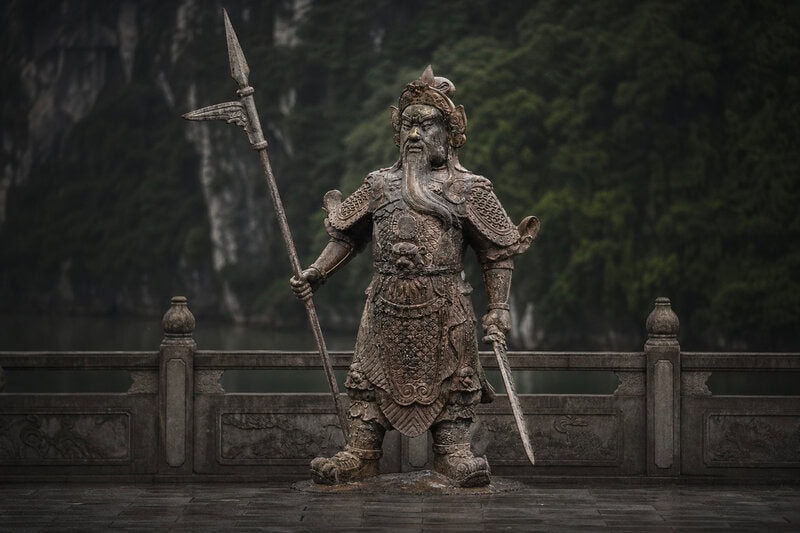
A Qin infantryman’s primary weapons addressed three distinct tactical ranges simultaneously. The jian — a double-edged straight bronze sword — handled close-quarters killing. The mao, a thrusting spear, controlled the mid-range space around the body. The ji, a halberd combining a spear-thrust with a lateral blade capable of slashing, bridged the gap between the two, making it perhaps the most versatile ancient Chinese warrior weapon of the period. Each filled a gap the others could not.
Beyond primary weapons, texts including the Sunzi Bingfa — known in the West as The Art of War — attest to a doctrine of redundancy that would be familiar to modern special-forces planners. Elite soldiers carried secondary weapons: concealed short blades and hand-thrown projectiles designed for the moment a primary weapon failed or was lost. This was not improvisation. It was deliberate redundancy built into the load-out from the start.
The terracotta figures confirm this philosophy visually. Kneeling archers are sculpted gripping a crossbow while a short sword is positioned at the hip — two complementary systems, not two alternative options. That swords and spears formed the infantry backbone is established scholarly consensus. What remains a contested area of ongoing research is the precise hierarchy of weapons a given rank would prioritize when open-field combat shifted to siege conditions.
The Crossbow: Ancient China’s Most Consequential Military Technology
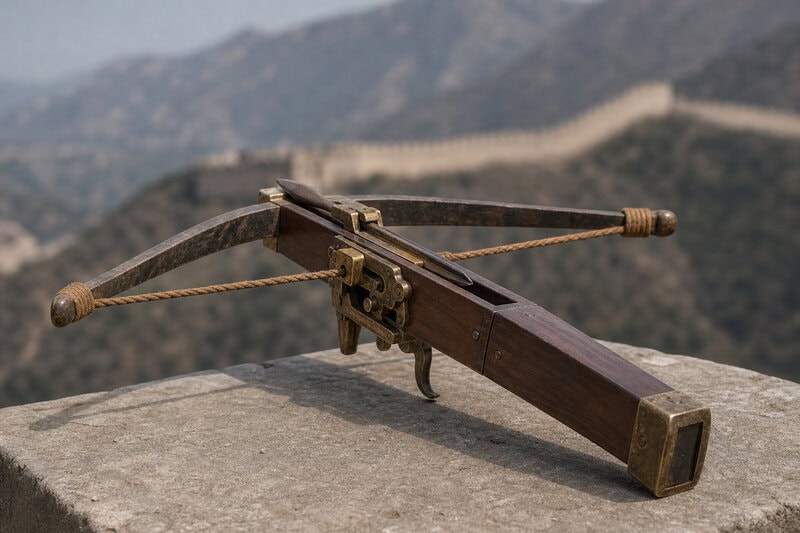
No single piece of ancient Chinese military technology reshaped warfare as fundamentally as the crossbow. Chinese crossbow history extends to at least the 5th century BCE, with bronze trigger mechanisms — called guo — recovered from Warring States sites displaying interchangeable, standardized parts. According to research published by the Shaanxi Provincial Institute of Archaeology, this standardization predates Western concepts of interchangeable manufactured parts by roughly 1,800 years.
Crossbows recovered from the terracotta pits had long since lost their organic wooden stocks to decay, but the bronze triggers survived intact. Metallurgical analysis by researchers affiliated with the Chinese Academy of Sciences identified alloy compositions tuned for spring-like elasticity — evidence of deliberate materials engineering, not trial-and-error craftsmanship. The weapon was designed with its physics in mind.
The crossbow’s core tactical advantage is mechanical rather than muscular: a soldier can hold a fully drawn crossbow at tension indefinitely without physical effort, allowing unhurried aim in a way a traditional bow does not permit. In the massed-volley tactics that Qin commanders favored, this meant consistent accuracy across the entire front line, not just from the strongest or most experienced archers.
Some researchers have proposed, based on the spatial arrangement of figures within the pits, that the Qin deployed crossbowmen in rotating volley lines — one rank firing while another reloaded — analogous to the pike-and-shot formations that appeared in Europe nearly two millennia later. This is a plausible interpretation of the pit layouts, but it has not yet been confirmed by textual or physical evidence alone and should be understood as an emerging hypothesis rather than established fact.
The Chariot: Status Symbol, Shock Weapon, and Rolling Command Post
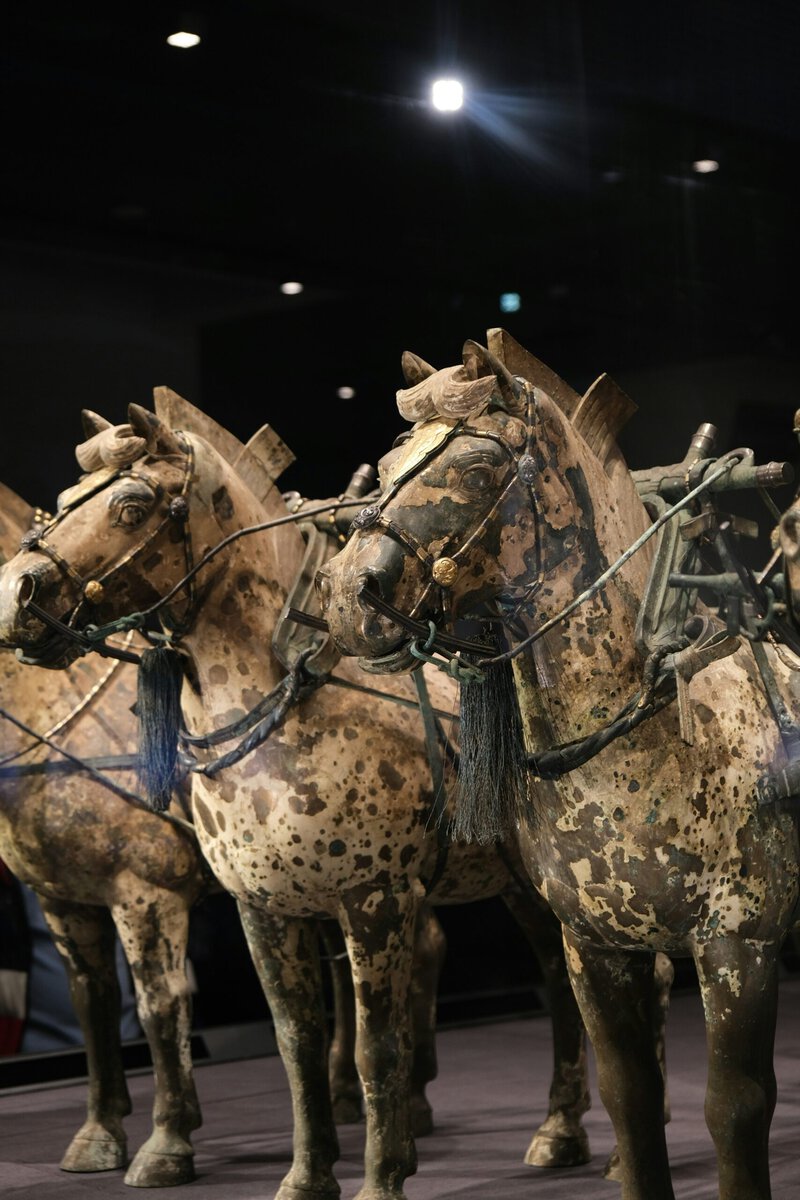
Each war chariot accompanying a Qin army carried three warriors with fixed, non-interchangeable roles. The central yuzhe — the charioteer — controlled a four-horse-drawn, single-shaft vehicle with reins that required considerable skill to manage at speed. A bowman stood to the left; a spearman to the right. This tripartite crew configuration is attested both in the terracotta arrangements and in Zhou-dynasty military manuals, giving it unusually strong corroboration from two independent source types.
The chariot’s military biography traces a clear arc. When it first appeared in Chinese warfare, it functioned primarily as a commander’s mobile status symbol — an elevated, fast-moving platform that broadcast rank and inspired troops by its mere presence on the field. Over several centuries it evolved into a genuine shock weapon, its weight and speed used to break infantry formations that lacked the discipline or equipment to hold against a charge.
By the Qin period, the chariot’s primacy in open battle was already fading. Crossbow volleys and mass infantry tactics had become the decisive elements of engagement, and chariots were increasingly valuable as elevated command-and-observation platforms and as psychological weapons against less organized opponents. Historian Robin Yates of McGill University has noted that the logistics of chariot operation — four matched horses, a trained crew, and a continuous supply chain of spare parts and maintenance — were organizationally as complex as sustaining a modern armored vehicle. The chariot was never a simple tool.
Armor: Lamellar, Lacquer, and the Counterintuitive Case for Paper

Among the most surprising findings in the study of ancient Chinese armor is evidence for paper armor. Ancient Chinese soldiers sometimes wore garments constructed from multiple layers of thick, hardened paper treated with lacquer to increase rigidity and resistance to penetration. Archaeological materials testing suggests this composite construction could deflect glancing blows from bronze arrowheads — a counterintuitive result that reflects how differently pre-modern materials science operated when metal was expensive and paper manufacturing was advanced.
Lamellar armor — small rectangular plates of leather or bronze laced together in horizontal rows to form a flexible surface — predominated from the Warring States period onward, as confirmed by both physical remains at excavation sites and the sculpted surface detail on the terracotta figures themselves. The individual scales on the figures are rendered with enough accuracy that researchers can identify specific lacing patterns, turning each statue into a technical diagram.
The terracotta figures display at least seven distinct armor configurations corresponding to military rank. Generals appear in full torso-and-shoulder plate; light infantry appear with no armor at all. The army effectively functions as a living organizational chart of Qin military structure, with protective equipment serving as the equivalent of modern rank insignia.
Lamellar’s engineering advantage over solid plate armor is straightforward: because each plate moves independently, the wearer retains the range of motion needed to draw a crossbow or swing a ji without the joint-binding that rigid cuirasses impose. This design principle was later arrived at independently by medieval European armorers working with no knowledge of Chinese precedent — a parallel evolution driven by the same physical constraints.
The Chemistry of Killing: Bronze Metallurgy and What the Chromium Debate Reveals
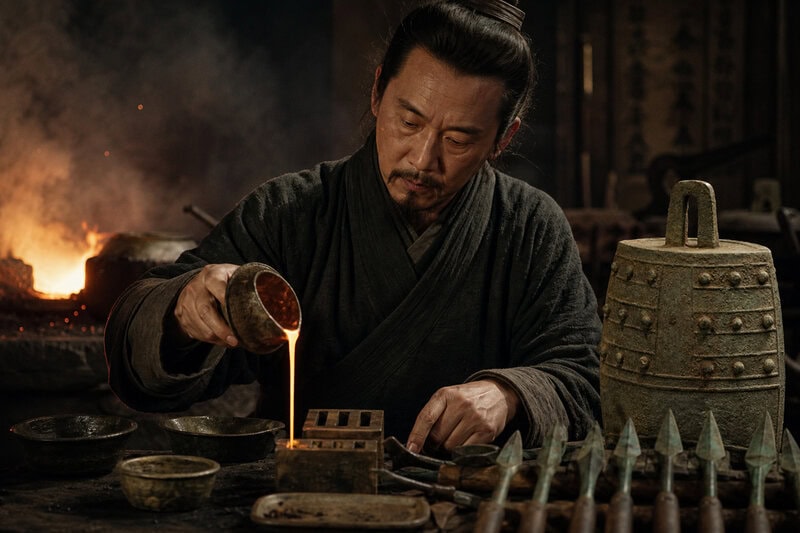
Qin bronze weapons were not uniform castings produced to a single formula. Lead content varied systematically by weapon type: arrowheads contained higher proportions of lead, which improves fluidity during casting and allows finer tips to form; swords were alloyed with more tin, which increases hardness at the cutting edge. X-ray fluorescence studies conducted by the British Museum in collaboration with Chinese institutional partners confirmed this graduated approach to alloy design.
A more contested finding concerns a chromium-oxide layer detected on some bronze weapons recovered from the terracotta pits in the 1990s. Early reports suggested this represented a deliberate anti-corrosion coating analogous to modern chrome plating — an astonishing technological claim that received substantial media attention. Subsequent peer-reviewed analysis, including a study published in Scientific Reports in 2019, found the layer is more likely a byproduct of soil chemistry interacting with decomposed lacquer rather than intentional metallurgical treatment. This episode illustrates why distinguishing vivid claims from verified findings matters in archaeometallurgy: the corrected conclusion is less dramatic, but no less interesting.
What is established consensus is that Qin bronze-smiths used graduated tin ratios to engineer weapons that were harder at the edge and tougher at the core — a functional equivalent of the differential heat-treatment used in modern high-performance steel blades. This was not accidental. It was applied materials science operating without modern chemistry’s vocabulary but not without its logic.
Perhaps the most striking evidence of industrial organization is the standardization of arrowhead dimensions. Hundreds of bronze arrowheads recovered from the pits cluster around identical measurements. The Emperor Qin Shi Huang’s Mausoleum Site Museum describes this as evidence of state-run foundries operating with documented quality control — a finding consistent with what some researchers characterize as the earliest known example of military-industrial standardization at scale.
Cavalry: The Emerging Arm and Its Open Questions
The terracotta pits include saddled horses and mounted warrior figures, confirming that cavalry existed within Qin military organization. Yet the precise operational doctrine governing their use remains one of the field’s genuinely unresolved debates. Mounted warriors of the period likely carried composite bows and short lances suited to harassing and pursuit roles rather than the heavy shock actions cavalry would later perform in other military traditions. The steppe-influenced horsemanship that would transform Chinese cavalry in subsequent dynasties was, during the Qin period, still being integrated into a force whose core logic remained infantry- and crossbow-centric. Scholars continue to debate whether Qin cavalry operated as an independent arm or functioned primarily as a fast-moving screen and pursuit force attached to chariot and infantry units.
What the Full Arsenal Reveals About Qin Military Thinking
The most significant conclusion drawn from the complete terracotta warrior equipment record is not about any individual weapon — it is about the relationship between weapons. No single arm dominates, because Qin battlefield doctrine was organized around combined arms: crossbow volleys to suppress and disorder an enemy formation, chariots to fix or rout it, and spear-and-sword infantry to close and finish. This conceptual architecture, in which different weapon systems are designed to enable each other rather than operate independently, parallels what modern military theorists call combined-arms doctrine.
For a fuller survey of how Chinese weapons evolved across dynasties and how individual arms fit into broader tactical systems, the archaeological and historical literature is now substantial enough to support quite detailed reconstruction. What it consistently shows is a state that treated military logistics as a science, not an improvisation — a finding that revises the popular narrative of ancient armies as heroic but organizationally primitive.
Open questions keep the field genuinely alive. Chemical and incendiary weapons are attested in some contemporaneous texts but have not yet been confirmed archaeologically at Qin sites. And the fate of the actual weapons — most bronze was apparently looted from the mausoleum complex in antiquity, possibly within decades of the emperor’s death — means that what survives is a sample, not a census. Each new excavation season has the potential to overturn assumptions that have stood for decades.
The terracotta army was designed to protect an emperor in the afterlife. What it actually preserved was something rarer: a freeze-frame of ancient Chinese military technology at the precise moment a unified state decided that organized, standardized, scientifically equipped violence was how civilization would be defended. The blades are still sharp. The argument they make has not dulled either.