
Inside an ancient Martian river channel, NASA’s Perseverance rover drilled into a mudstone called Cheyava Falls and found something geologists rarely expect on a dead planet: tiny dark rings — informally called “leopard spots” — of bleached iron minerals physically intertwined with organic carbon, arranged in patterns that on Earth are almost exclusively associated with microbial life. The discovery does not confirm life on Mars, but it is the most chemically and structurally suggestive biosignature candidate the rover has returned since it landed in Jezero Crater in February 2021.
What Is Cheyava Falls, and Why Did Perseverance Drill There?
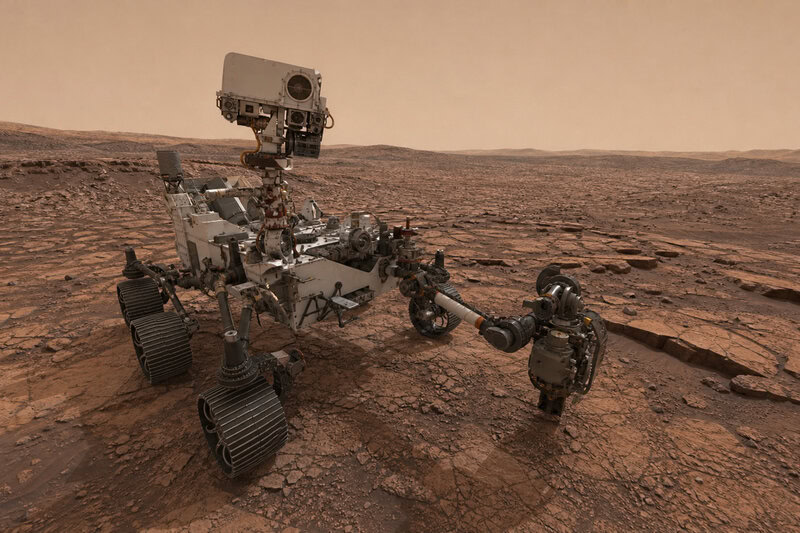
Cheyava Falls is a flat slab of mudstone — a fine-grained sedimentary rock formed when clay particles settle out of slow-moving or standing water — located in a preserved ancient river channel on the western margin of Jezero Crater. That site was chosen for the Perseverance mission precisely because orbital data indicated it once held a lake fed by river delta systems billions of years ago. Mudstone is scientifically valuable because fine sediment can trap and preserve organic molecules and microbial structures across geological timescales; on Earth, some of the oldest confirmed microbial fossils are locked in mudstone and chert dating back more than 3.5 billion years.
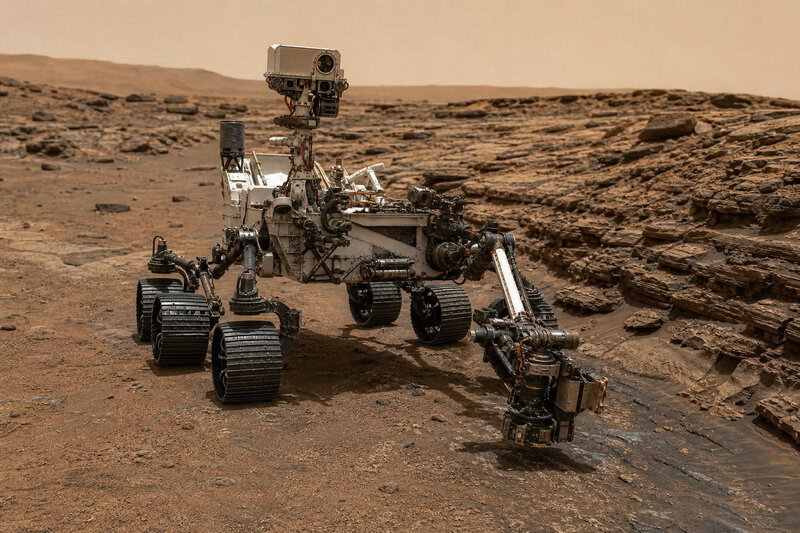
Perseverance’s science team targeted Cheyava Falls after instruments including the SHERLOC (Scanning Habitable Environments with Raman and Luminescence for Organics and Chemicals) spectrometer detected anomalous organic signals at or just below the rock’s surface before drilling, signaling that carbon-bearing compounds were present. The rover then used its rotary-percussive drill to extract a core sample. Close-up imaging revealed a wide stripe of material running across the rock’s clay-toned face, and within that stripe the leopard spots — small and dark — were visible in a pattern that immediately caught researchers’ attention. The results were subsequently detailed by a NASA-led team and published in the journal Nature.
For decades, the central question of Mars exploration has been whether liquid water alone was enough to spark biology. Cheyava Falls sits at the precise intersection of ancient water, organic chemistry, and mineral patterns that demand a coherent explanation — which is why the finding has drawn intense scientific scrutiny from researchers around the world.
The Leopard Spots Explained: Iron, Carbon, and a Bleaching Signature
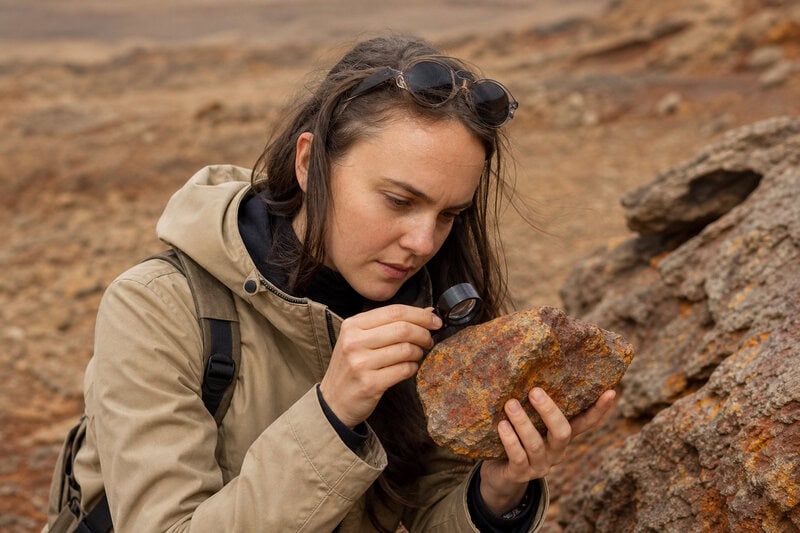
Each “leopard spot” — the informal but now widely used term coined by the research team — is a small, dark ring or halo of iron-oxide minerals, typically a millimeter or less in diameter, whose interior has been chemically altered. The rusty red ferric iron (Fe³⁺) that gives Martian rocks their characteristic color has been reduced and bleached to a paler ferrous iron (Fe²⁺) compound, creating a lighter core surrounded by a darker rim. This structural arrangement is the defining visual signature of the feature.
On Earth, this specific bleaching pattern — sometimes called a “redox halo” — forms when microbial communities consume organic matter and, in doing so, strip oxygen from iron-bearing minerals in their immediate vicinity. In effect, microbes use the iron as a metabolic resource in the absence of atmospheric oxygen, and the chemical fingerprint of that activity is a permanently lighter patch of rock. The process is well-documented in Precambrian iron formations and hydrothermally altered mudstones, where biological origin has been confirmed by additional geochemical testing.
What elevates Cheyava Falls above previous Mars organic detections is not the presence of organics alone, but their arrangement. SHERLOC data show that organic carbon is spatially co-located with the mineral halos — meaning the carbon and the bleached iron are physically intermixed at the microscale, exactly the arrangement you would expect if carbon-consuming microbes had once been active at those precise locations. Prior Perseverance and Curiosity findings confirmed that organics exist on Mars, but none had yet revealed organics entangled with mineral structures that independently point toward biology. Researchers analyzing the Cheyava Falls data describe this combination as a qualitative step forward in the Mars biosignature search.
Why Scientists Stop Short of Declaring Life
The central limitation is that every feature observed in Cheyava Falls — the leopard spots, the redox halos, the organic carbon — can also be produced by purely abiotic (non-biological) chemistry. Serpentinization reactions, for example, can bleach iron minerals and generate simple organic molecules without any living organism involved. Mars has a well-documented history of water-rock interactions that drive exactly these processes, and the planet’s geological record includes multiple episodes of hydrothermal activity that could mimic biological chemistry at the mineral scale.
The research team explicitly states in the Nature paper that the evidence is “consistent with” biological activity but does not constitute proof, because no single measurement from a rover can yet distinguish a microbial biosignature from a chemically identical abiotic mimic. Some planetary scientists not involved in the study have publicly cautioned that the leopard spot morphology, while suggestive, has been observed in abiotic hydrothermal systems on Earth, and that resolving the question definitively requires the kind of sample-by-sample laboratory analysis that only a returned sample can provide.
Researchers noted that leopard spot or redox halo features found in Earth samples are “usually indications of fossilized microbial life” — but “usually” is doing significant scientific work in that sentence, because exceptions exist in abiotic hydrothermal settings. The scientific consensus, as reflected in statements from NASA and ESA, remains clear: Cheyava Falls represents the strongest candidate biosignature yet recovered from Mars, but the word “life” cannot responsibly be applied until the samples are returned to Earth and subjected to the full suite of isotopic, molecular, and microscopic analyses that are unavailable to any rover currently operating.
A further complication is stratigraphic. Cheyava Falls sits in a rock unit that may have experienced multiple episodes of fluid flow and heating over billions of years, meaning organic carbon present today could have migrated into the leopard spot zones long after any potential biology was active, or could have been delivered by later abiotic hydrothermal pulses. Distinguishing these scenarios requires isotopic carbon analysis at a precision well beyond current rover instrumentation.
How Earth Analogs Sharpen — and Complicate — the Picture
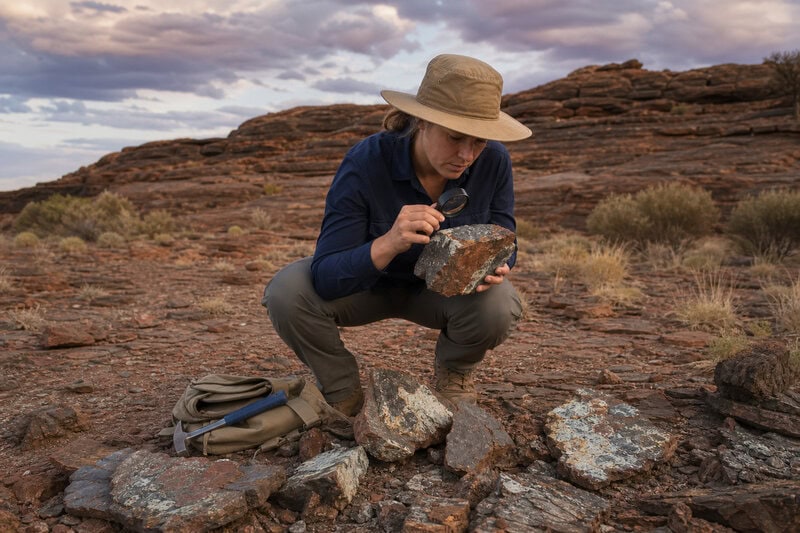
The closest terrestrial analogs to Cheyava Falls are ancient mudstones and iron formations in Western Australia’s Pilbara region and hydrothermally altered rocks in Iceland, where microbial iron reduction has produced nearly identical bleached halos around organic inclusions. In those Earth settings, biological origin has been confirmed through additional geochemical work — tests that Perseverance cannot yet replicate on Mars.
What researchers find particularly informative about Cheyava Falls is the spatial precision of co-location between the organics and the iron halos. Random abiotic contamination or molecular migration would be expected to produce a more diffuse organic distribution spread across the rock matrix. The tight clustering observed in Cheyava Falls more closely resembles the localized, structure-associated organic signatures found in confirmed terrestrial microfossil samples — a pattern that is harder, though not impossible, to explain through purely chemical processes.
Ongoing analysis of the Cheyava Falls sample continues to focus on whether the spatial relationship between the organics and the mineral halos holds up under additional instrument scrutiny, including mapping with the PIXL (Planetary Instrument for X-ray Lithochemistry) instrument, which can resolve elemental chemistry at sub-millimeter scales. The combination of SHERLOC’s molecular fingerprinting and PIXL’s elemental mapping gives scientists their most detailed in-situ chemical portrait of any Martian rock to date — and the portrait remains stubbornly ambiguous.
What Happens to the Sample — and When Will We Know More?
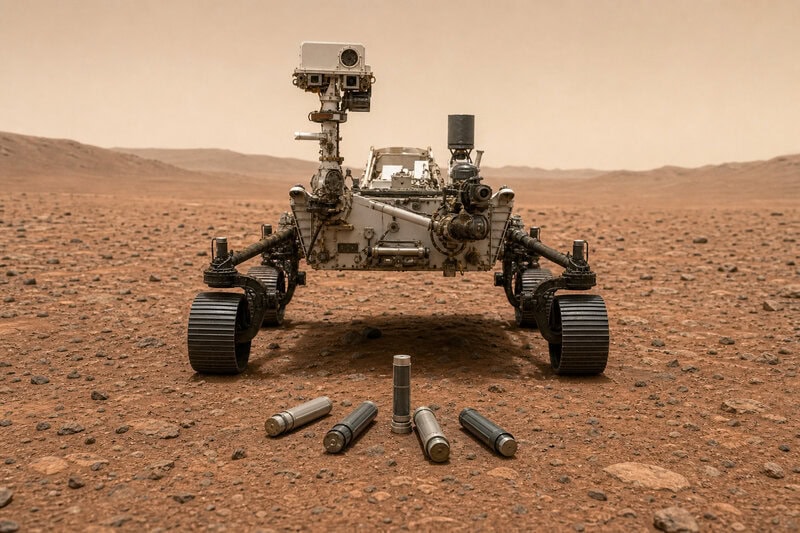
Perseverance has sealed a core of the Cheyava Falls mudstone in one of its titanium sample tubes, which are being deposited in a cache on the Martian surface as part of the Mars Sample Return (MSR) campaign — a joint NASA-ESA mission architecture designed to retrieve those tubes and deliver them to Earth-based laboratories. Instruments available in those laboratories are orders of magnitude more sensitive than any rover payload and could resolve the biosignature question in ways no in-situ measurement currently can.
The MSR timeline, under active revision as of 2025 due to budget constraints and engineering challenges, targets sample return no earlier than the mid-2030s. That gap of more than a decade is not merely a scheduling inconvenience — it means the most consequential rock sample in planetary exploration history will sit in a titanium tube on a desert planet while scientists work with the limited data Perseverance can send home. That reality explains why the rover’s in-situ measurements, however incomplete, are being subjected to such exhaustive analysis now. The Cheyava Falls finding has renewed public and institutional urgency around securing funding and a firm timeline for sample return.
In the interim, the Perseverance science team plans to use SHERLOC and PIXL to map additional sections of the Cheyava Falls core and nearby rocks, looking for whether the leopard spot pattern is localized to one rock unit or recurs across the ancient channel system. Broader distribution would strengthen the case that the features reflect a past habitable environment rather than a one-off chemical anomaly. NASA has also indicated that the Cheyava Falls results will directly inform target selection for future drilling campaigns in Jezero Crater, prioritizing mudstones in similarly ancient, water-influenced geological settings.
What Cheyava Falls Changes About the Mars Life Debate
Before Cheyava Falls, the strongest evidence for Mars habitability was indirect — ancient lake beds, chemical signatures consistent with past liquid water, and trace organic molecules detected by the Curiosity rover in Gale Crater — none of which combined organic carbon with a mineral biosignature structure in the same rock at the same microscale. Cheyava Falls is the first sample to do both simultaneously, which is why the Nature authors describe it as a qualitative step forward in the search for evidence of past life on Mars.
The discovery reframes the scientific question in an important way. Most planetary scientists already answer “yes” to the question of whether Mars was ever habitable: the planet had liquid water, organic chemistry, and energy sources sufficient to support microbial life for hundreds of millions of years. The harder and more consequential question is whether that habitability ever translated into actual biology. Cheyava Falls provides the first physical candidate evidence, however contested, that it might have.
For science communicators and the public alike, the finding demands careful language. It is accurate and appropriate to say that Perseverance has found the strongest hint yet that Mars once harbored life. It is not accurate to say that Mars life has been found, and both Nature and NASA have been explicit about that distinction in their public statements. Extraordinary claims require extraordinary evidence, and the evidence in hand — compelling as it is — remains insufficient to meet that threshold.
Regardless of whether the Cheyava Falls biosignatures survive the scrutiny of sample-return analysis, the rock has already accomplished something scientifically durable: it has demonstrated that Mars preserves the kind of organic-mineral associations worth searching for, and that targeting ancient mudstones in river channel systems is a sound strategy. That conclusion will shape Mars exploration for the next generation of missions, whether or not the leopard spots ultimately prove to be the remnants of life.