
On the day Infleqtion (NYSE: INFQ) announced its America’s Quantum Space Initiative, shares of the quantum technology company surged 19.3% in a single trading session. The move is a market signal that orbital quantum hardware is no longer a fringe research curiosity but a strategic commercial bet — and it reflects something physicists have understood for years: the vacuum of low-Earth orbit may be the single best laboratory humanity has ever had access to for quantum experiments. The race to exploit it is now formally underway.
A Coalition Takes Shape Above the Atmosphere
The initiative brings together Voyager Technologies, Monarch Quantum, Armada, and the University of Colorado in a formal multi-sector coalition. According to reporting by the Quantum Computing Report, the initiative’s explicit mandate is to accelerate the deployment of quantum technologies within orbital infrastructure — language that distinguishes it from a research program and positions it as an engineering and deployment effort. That distinction matters enormously. The gap between demonstrating that a quantum sensor works in space and building one that governments and commercial operators can actually rely on is precisely where most quantum programs have historically stalled.
The partnership architecture is revealing in its design. Voyager Technologies contributes space systems integration expertise — the hard-won knowledge of how to build hardware that survives launch, radiation, and thermal extremes. Monarch Quantum and Armada bring quantum hardware and mission architecture capabilities. The University of Colorado anchors the scientific pipeline, and not incidentally: its JILA institute, a joint facility with the National Institute of Standards and Technology (NIST), has produced multiple Nobel Prize-winning advances in atomic physics, including work foundational to the optical lattice clock — among the most precise timekeeping devices ever built. That scientific credibility is not decorative. Government contracts in quantum technology increasingly require peer-reviewed validation, and JILA’s track record provides exactly that.
The coalition structure also mirrors the public-private model envisioned under the U.S. National Quantum Initiative Act of 2018, which authorized more than $1.2 billion in federal quantum research funding and created the National Quantum Coordination Office. By explicitly targeting the industry-academia-government triangle that the Act envisioned, the coalition positions itself on a clear regulatory and funding runway. As Seeking Alpha noted, the initiative is framed around boosting U.S. competitiveness in space technology — a framing that resonates with both defense procurement officers and civil space agencies.
What Quantum Sensors Actually Do — and Why the Term Is Routinely Misused
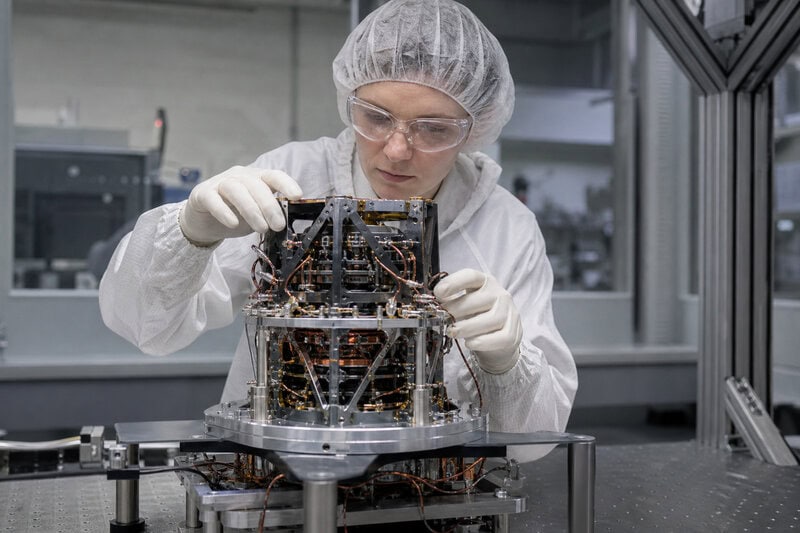
The term “quantum sensor” is frequently misapplied to mean any advanced or miniaturized sensor. It means something more specific: a device that exploits a fundamental property of quantum mechanics — superposition, entanglement, or quantum interference — to measure physical quantities such as gravity, acceleration, time, or magnetic fields with precision that classical instruments cannot match. Understanding that distinction is essential to evaluating what this initiative is actually attempting to build.
The most mature and widely deployed example is the atomic clock. By counting the natural oscillation frequency of cesium-133 atoms — precisely 9,192,631,770 cycles per second, a number enshrined in the 1967 SI definition of the second — atomic clocks achieve accuracy to within one second in roughly 300 million years. Every GPS satellite carries atomic clocks, and without them, the position fixes that modern logistics, aviation, and smartphones depend on would drift by kilometers within minutes. Atomic clocks in orbit are established, operational technology: this is scientific consensus, not an emerging claim.
Quantum gravimeters represent the less-publicized but rapidly advancing frontier. These instruments use laser-cooled atoms in free fall — a technique called atom interferometry — to detect minute variations in Earth’s gravitational field. Those variations encode information about what lies beneath the surface: underground aquifers losing volume, mineral deposits, and the slow movement of tectonic plates. Research from NIST has documented the sensitivity advantages of cold-atom gravimeters over classical instruments, and the European Space Agency’s GOCE mission validated the scientific value of high-resolution gravitational mapping from orbit using classical accelerometers. The next step — doing the same with quantum sensors — is at the advanced demonstration stage, not yet at operational deployment.
This distinction between established and emerging capability matters for anyone evaluating claims in this space. Cold-atom quantum gravimeters and entanglement-based quantum communication satellites are demonstrated at the prototype level; full operational deployment remains years away. Overstating their readiness sets up the kind of expectation gap that has historically damaged investor confidence in deep-technology sectors.
Why Space Is the Quantum Physicist’s Preferred Laboratory
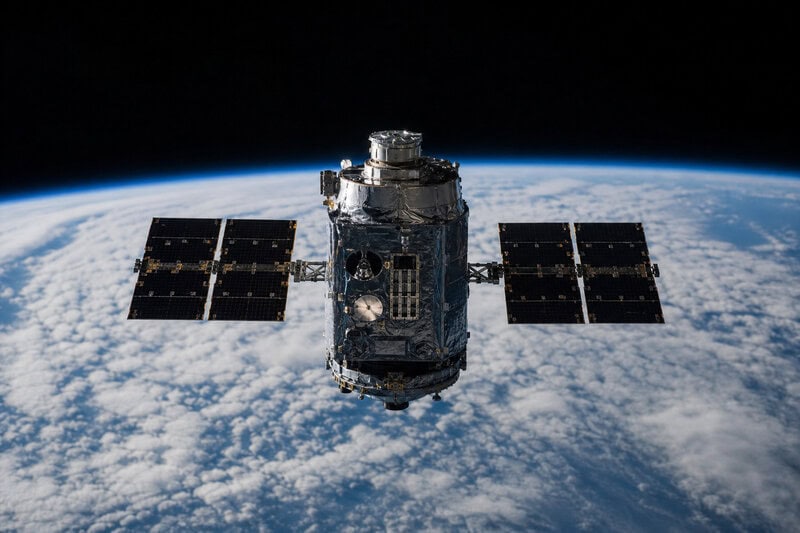
Quantum systems are extraordinarily fragile. Thermal vibration, electromagnetic noise, and Earth’s gravity all introduce decoherence — the process by which a quantum state loses its distinctly quantum properties and collapses into ordinary classical behavior. This is the central engineering challenge of quantum technology on the ground: every additional microsecond of coherence time wrested from the environment is a hard-won victory. Low-Earth orbit reduces or eliminates all three of these interference sources simultaneously, which is why physicists have long regarded space as a uniquely favorable environment for quantum experiments.
Microgravity provides the most dramatic advantage for cold-atom work. On Earth, even the best drop towers allow free-fall durations of only a few seconds before atoms reach the ground. In orbit, atoms can be held in free fall — and therefore in superposition — for far longer periods, enabling measurements of extraordinary precision. NASA’s Cold Atom Lab aboard the International Space Station has demonstrated Bose-Einstein condensates — a state of matter in which atoms cooled to within billionths of a degree of absolute zero collectively behave as a single quantum entity — sustained for durations that are simply impossible to achieve on the ground, according to NASA Jet Propulsion Laboratory publications. This is not a marginal improvement; it is a qualitative change in what experiments become possible.
The near-perfect vacuum of space provides a compounding advantage for quantum communication. On Earth, the atmosphere scatters photons carrying quantum information, limiting the range of ground-based quantum optical links to roughly a few hundred kilometers under optimal conditions. In orbit, that atmospheric barrier disappears. China’s Micius satellite demonstrated this conclusively in 2017, achieving quantum key distribution — a method of encrypting data using quantum states such that any eavesdropping is physically detectable — over 7,600 kilometers, in an experiment published in the journal Science. Micius remains the clearest proof-of-concept that space-based quantum communication is physically achievable, even as a full operational quantum internet remains a horizon measured in decades rather than years.
Together, these environmental advantages — longer coherence times, lower noise floors, and global line-of-sight coverage — compound in ways that make orbital platforms uniquely suited to quantum sensor arrays, quantum navigation satellites, and eventually quantum computing nodes. For many of the most important quantum applications, space may be the only viable venue at scale.
Three Applications Driving Commercial and Defense Interest
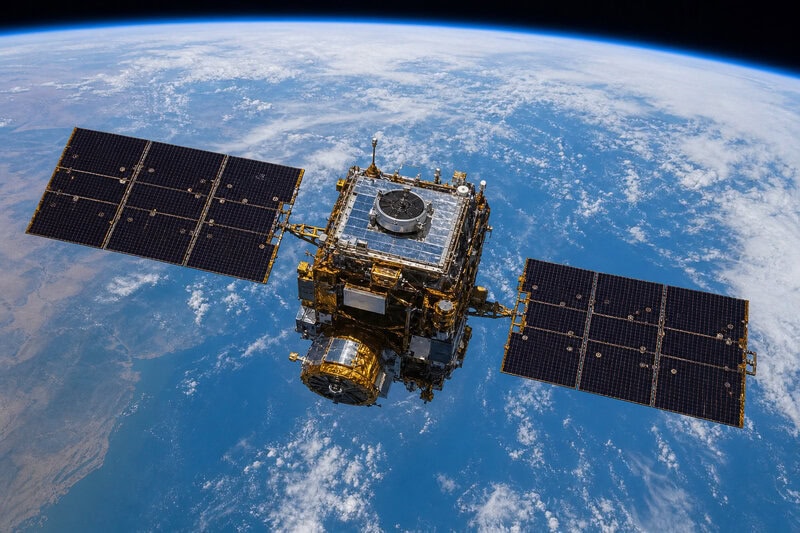
The strategic significance of quantum sensors in orbit becomes clearest when examined through specific applications, each at a different stage of development and each carrying distinct implications for security, commerce, and science.
- Quantum navigation satellites. Quantum inertial sensors using atom interferometry can provide GPS-independent positioning accurate to meters, even when GPS signals are jammed or spoofed — a vulnerability that has become a serious operational concern for military and aviation planners. The U.S. Defense Advanced Research Projects Agency (DARPA) has funded development of this capability through its Quantum-Assisted Sensing and Readout (QuASAR) program. Because quantum navigation derives its accuracy from fundamental atomic physics rather than signal reception, it cannot be defeated by conventional jamming. This makes it arguably the most strategically significant near-term application of space quantum technology and the one closest to deployment readiness.
- Quantum gravity sensors in orbit. A constellation of orbital quantum gravity sensors could produce continuous, high-resolution global gravitational maps with update rates impossible from ground stations alone. Applications span climate science — tracking ice-sheet mass loss and groundwater depletion with a precision that transforms water resource management — to mineral exploration and submarine detection. The European Space Agency’s GOCE mission validated scientific demand for better gravitational data from orbit; quantum gravimeters would represent a step-change improvement in measurement sensitivity.
- Space-based quantum communication networks. Often called a “quantum internet,” this concept envisions using entanglement distribution between orbital nodes to create cryptographic links theoretically immune to computational brute-force attack — including attack by future quantum computers powerful enough to break current encryption standards. The White House National Security Memorandum on Quantum Computing (NSM-10, 2022) directed federal agencies to inventory cryptographic systems vulnerable to such quantum decryption, establishing documented government demand for quantum-secure alternatives. A full quantum communication network, however, remains the longest-horizon application of the three.
Honest Accounting: What Remains Genuinely Uncertain
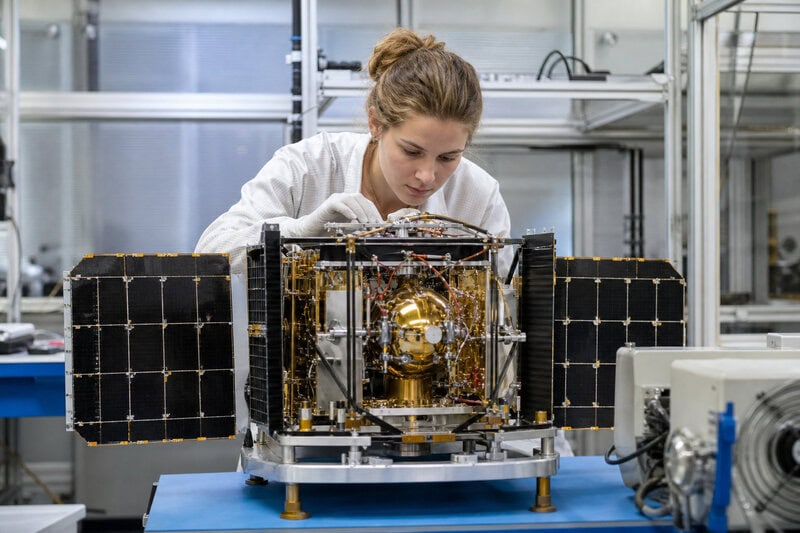
The physical principles underlying quantum sensing in space are well established and not seriously contested in the scientific literature. What remains empirically open — and actively debated among researchers and engineers — is which hardware architecture will prove most practical for orbital deployment at commercial scale. Cold-atom systems, photonic quantum devices, trapped-ion processors, and superconducting quantum circuits each offer different tradeoffs between performance, power consumption, and resistance to the space environment. No consensus has emerged, and the competition between these approaches is genuine and consequential.
Space qualification presents challenges that laboratory demonstrations do not capture. Quantum hardware must survive the mechanical vibration of launch, radiation exposure from cosmic rays and the Van Allen radiation belts, and wide thermal cycling between sun-facing and shadow passes in orbit. These environments have degraded sensitive quantum optical components in prior experimental satellites, a problem examined in detail in the European Space Agency’s SAGA (Space Atomic Gravity explorer) feasibility study. Solving these engineering problems at production scale — not just for a single demonstration satellite but for a constellation — is where the initiative’s near-term work will be concentrated.
Thermal management for any effort to place general-purpose quantum computing nodes in orbit also remains unsolved at operational scale. Current cold-atom sensor approaches partially sidestep this by using laser cooling rather than dilution refrigerators, but maintaining millikelvin temperatures in a space environment presents formidable engineering challenges that no organization has yet resolved at orbital scale.
Finally, the 19.3% single-session move in INFQ reflects genuine market enthusiasm for a nascent sector, but quantum technology commercialization timelines have historically run two to five years longer than initial projections. The stock’s surge is best interpreted as proof-of-direction — evidence that markets are beginning to price in the orbital quantum race — not as proof-of-product. Investors and policymakers would do well to calibrate current milestones accordingly.
The Strategic Stakes of the Quantum Space Race
China’s Micius quantum satellite program, the European Quantum Flagship’s €1 billion multi-year initiative, and now America’s Quantum Space Initiative together indicate that quantum technology has crossed a threshold: it is no longer primarily a scientific endeavor but a geopolitical infrastructure competition. That transition historically accelerates both funding flows and development timelines, as governments and commercial entities respond to the prospect of asymmetric strategic advantage.
The parallel to GPS is instructive without being overdrawn. GPS began as a U.S. military navigation program; over four decades it became the invisible foundation of a multi-trillion-dollar global economy that neither its designers nor its original funders fully anticipated. Whoever deploys reliable orbital quantum sensors and quantum navigation satellites first gains compounding advantages in positioning independence, encrypted communications, and environmental monitoring. Those advantages, once embedded in infrastructure, are extraordinarily difficult for later entrants to overcome.
Infleqtion’s initiative, by formally connecting a commercially listed quantum hardware company to an established space integrator and a world-class research university, assembles the kind of coalition that has historically been necessary to translate laboratory physics into deployed infrastructure. The clearest milestone to watch going forward is not the ticker price but the initiative’s first orbital demonstration mission. If America’s Quantum Space Initiative can place a functioning quantum sensor into orbit and return validated scientific data within the next three to five years, that moment will mark the transition of quantum technology in space from compelling promise into established precedent — the kind of precedent that rewrites the assumptions of every subsequent program that follows it.